Sample QuestionsRedox Reactions questions
One sample from each question group in this chapter. Select any group above to see the full set with answer keys.
$\mathrm{H}_2 \mathrm{O}_2+\mathrm{O}_3 \rightarrow \mathrm{H}_2 \mathrm{O}+2 \mathrm{O}_2$, in this reaction :
- A
$\mathrm{H}_2 \mathrm{O}_2$ is bleached.
- ✓
$\mathrm{H}_2 \mathrm{O}_2$ is oxidised.
- C
$\mathrm{H}_2 \mathrm{O}_2$ is dehydrated.
- D
$\mathrm{H}_2 \mathrm{O}_2$ is neither oxidised nor reduced.
Answer: B.
View full solution →What is the oxidation number of lithium in $\ce{LiCl}\ ?$
Answer: C.
View full solution →In $\mathrm{Ni}(\mathrm{CO})_4,$ the oxidation state of $\ce{Ni}$ is?
Answer: A.
View full solution →Which of the following elements does not show disproportionation tendency?
- A
$\ce{Cl}$
- B
$\ce{Br}$
- ✓
$\ce{F}$
- D
$\ce{I}$
Answer: C.
View full solution →Which of the following is not an example of redox reaction?
- A
$\text{CuO}+\text{H}_2\xrightarrow{ \ \ \ \ \ \ \ \ \ }\text{Cu}+\text{H}_2\text{O}$
- B
$\text{Fe}_2\text{O}_3+3\text{CO}\xrightarrow{ \ \ \ \ \ \ \ \ \ }2\text{Fe}+3\text{CO}_2$
- C
$2\text{K}+\text{F}_2\xrightarrow{ \ \ \ \ \ \ \ }2\text{KF}$
- ✓
$\text{BaCl}_2+\text{H}_2\text{SO}_4\xrightarrow{ \ \ \ \ \ \ \ \ }\text{BaSO}_4+2\text{HCl}$
Answer: D.
View full solution →Note : In the following questions a statement of assertion $(A)$ followed by a statement of reason $(R)$ is given. Choose the correct option out of the choices given below each question.
Assertion $(A)$ : The decomposition of hydrogen peroxide to form water and oxygen is an example of disproportionation reaction.
Reason $(R)$ : The oxygen of peroxide is in $–1$ oxidation state and it is converted to zero oxidation state in $\mathrm{O}_2$ and –2 oxidation state in $\mathrm{H}_2 \mathrm{O}$.
- ✓
Both $A$ and $R$ are true and $R$ is the correct explanation of $A.$
- B
Both $A$ and $R$ are true but $R$ is not the correct explanation of $A.$
- C
$A$ is true but $R$ is false.
- D
Both $A$ and $R$ are false.
Answer: A.
View full solution →Note : In the following questions a statement of assertion $(A)$ followed by a statement of reason $(R)$ is given. Choose the correct option out of the choices given below each question.
Assertion $(A)$ : In the reaction between potassium permanganate and potassium iodide, permanganate ions act as oxidising agent.
Reason $(R)$ : Oxidation state of manganese changes from $+2$ to $+7$ during the reaction.
- A
Both $A $ and $R$ are true and $R$ is the correct explanation of $A.$
- B
Both $A$ and $R$ are true but $R$ is not the correct explanation of $A.$
- ✓
$A$ is true but $R $ is false.
- D
Both $A$ and $R$ are false.
Answer: C.
View full solution →Note : In the following questions a statement of assertion $(A)$ followed by a statement of reason $(R)$ is given. Choose the correct option out of the choices given below each question.
Assertion $(A)$ : Redox couple is the combination of oxidised and reduced form of a substance involved in an oxidation or reduction half cell.
Reason $(R)$ : In the representation $\text{E}^\ominus_{\text{Fe}^{3+}/\text{Fe}^{2+}}$ and $\text{E}^\ominus_{\text{Cu}^{2+}/\text{Cu}},\text{Fe}^{3+}/\text{Fe}^{2+}$ and $\text{Cu}^{2+}/\text{Cu}$ are redox couples.
- A
$A$ and $R$ both are correct, and $R$ is the correct explanation of $A.$
- ✓
$A$ and $R$ both are correct, but $R$ is not the correct explanation of $A$.
- C
$A$ is true but $R$ is false.
- D
$A$ and $R$ both are false.
Answer: B.
View full solution →Note : In the following questions a statement of assertion $(A)$ followed by a statement of reason $(R)$ is given. Choose the correct option out of the choices given below each question.
Assertion $(A)$ : Among halogens fluorine is the best oxidant.
Reason $(R)$ : Fluorine is the most electronegative atom.
- ✓
$A$ and $R$ both are correct, and $R$ is the correct explanation of $A.$
- B
$A$ and $R$ both are correct, but $R$ is not the correct explanation of $A$.
- C
$A$ is true but $R$ is false.
- D
$A$ and $R$ both are false.
Answer: A.
View full solution →Justify that the following reactions are redox reactions:$4BCl_3(g) + 3LiAlH_4(s) → 2B_2H_6(g) + 3LiCl(s) + 3AlCl_3(s)$
View full solution →Write formula for the following compound:
Nickel(II) sulphate.
Write formula for the following compound:
Iron(III) sulphate.
Consider the elements:
Cs, Ne, I and F
Identify the element that exhibits only negative oxidation state.
Write formula for the following compound:
Tin(IV) oxide.
Assign oxidation number to the underlined elements in the following species: $\mathrm{H}_2 \mathrm{S}_2 \mathrm{O}_7$
View full solution →Assign oxidation number to the underlined elements in the following species:$\text{H}_4\text{P}_2\text{O}_7$
View full solution →Assign oxidation number to the underlined elements in the following species:$\text{Na}\text{H}_2\text{P}\text{O}_4$
View full solution →Assign oxidation number to the underlined elements in the following species:$\text{Ca}\text{O}_2$
View full solution →Consider the elements: Cs, Ne, I and FIdentify the element that exhibits both positive and negative oxidation states.
What are the oxidation number of the underlined elements in the following and how do you rationalise your results?
$KI_3$
View full solution →What are the oxidation number of the underlined elements in the following and how do you rationalise your results?
$\mathrm{CH}_3 \mathrm{COOH}$
View full solution →Predict the products of electrolysis in the following:
An aqueous solution of $AgNO_3$ with silver electrodes.
View full solution →Balance the following redox reactions by ion-electron method: $\mathrm{MnO}_4^{}{-}(\mathrm{aq})+\mathrm{SO}_2(\mathrm{g}) \rightarrow \mathrm{Mn}^{2+}(\mathrm{aq})+\mathrm{HSO}_4^{}{-}(\mathrm{aq})$ (in acidic solution).
View full solution →What are the oxidation number of the underlined elements in the following and how do you rationalise your results?
$\mathrm{CH}_3 \mathrm{CH}_2 \mathrm{OH}$
View full solution →Read the passage given below and answer the following questions from 1 to 5. Chemistry deals with varieties of matter and change of one kind of matter into the other. Transformation of matter from one kind into another occurs through the various types of reactions. One important category of such reactions is Redox Reactions. Originally, the term oxidation was used to describe the addition of oxygen to an element or a compound. Because of the presence of dioxygen in the atmosphere (~20%), many elements combine with it and this is the principal reason why they commonly occur on the earth in the form of their oxides. The following reactions represent oxidation processes: $2\text{Mg}(\text{s})\rightarrow2\text{MgO}\text{ (S)}$ $\text{S}(\text{s})+\text{O}_2(\text{g})\rightarrow\text{SO}_2\text{ g}$ the term “oxidation” is defined as the addition of oxygen/electronegative element to a substance or removal of hydrogen/ electropositive element from a substance. In the beginning, reduction was considered as removal of oxygen from a compound. However, the term reduction has been broadened these days to include removal of oxygen/electronegative element from a substance or addition of hydrogen/ electropositive element to a substance. According to the definition given above, the following are the examples of reduction processes: $2\text{HgO}\text{S}\xrightarrow{\triangle}2\text{ Hg}(1)+\text{O}_2(\text{g})$ $2\text{HgCl}_2(\text{aq})+\text{SnCl}_2(\text{aq})\rightarrow\text{Hg}_2\text{Cl}_2(\text{s})+\text{SnCl}_4(\text{aq})$ In reaction simultaneous oxidation of stannous chloride to stannic chloride is also occurring because of the addition of electronegative element chlorine to it. It was soon realised that oxidation and reduction always occur simultaneously (as will be apparent by re-examining all the equations given above), hence, the word “redox” was coined for this class of chemical reactions.The reactions:
$2\text{Na}(\text{s})+\text{Cl2}\text{g}\rightarrow2\text{NaCl}(\text{s})$ $4\text{Na}(\text{s})+\text{O}_2\text{g}\rightarrow2\text{Na}_2\text{o}(\text{s})$ $2\text{Na}(\text{s})+\text{S}\text{(s)}\rightarrow2\text{Na}_2\text{S}(\text{s})$ are redox reactions because in each of these reactions sodium is oxidised due to the addition of either oxygen or more electronegative element to sodium. Simultaneously, chlorine, oxygen and sulphur are reduced because to each of these, the electropositive element sodium has been added. From our knowledge of chemical bonding we also know that sodium chloride, sodium oxide and sodium sulphide are ionic compounds and perhaps better written as $\mathrm{Na}+\mathrm{Cl}-(\mathrm{s}),\left(\mathrm{Na}^{+}\right)_2 \mathrm{O}^2-(\mathrm{s})$, and $\left(\mathrm{Na}^{+}\right)_2 \mathrm{~S}^{2-}(\mathrm{s})$. Development of charges on the species produced suggests us to rewrite the reactions in the following manner: 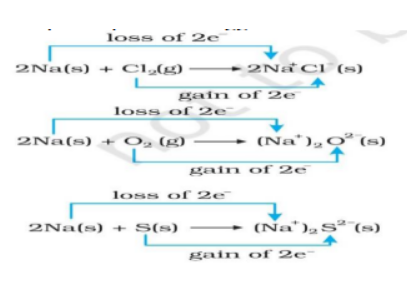 For convenience, each of the above processes can be considered as two separate steps, one involving the loss of electrons and the other the gain of electrons. As an illustration, we may further elaborate one of these, say, the formation of sodium chloride. $2\text{Na}(\text{s})\rightarrow2\text{Na}^+\text{g}+2\bar{\text{e}}$ $\text{Cl}_2\text{g}+2\bar{\text{e}}\rightarrow2\text{C}\bar{\text{I}}\text{ (g)}$ Each of the above steps is called a half reaction, which explicitly shows involvement of electrons. Sum of the half reactions gives the overall reaction $2\text{Na}(\text{s})+\text{Cl}_2\text{(g)}\rightarrow2\text{Na}^+\text{CI}(\text{s})\text{ or } 2\text{NaCI}(\text{s})$ Above Reactions suggest that half reactions that involve loss of electrons are called oxidation reactions. Similarly, the half reactions that involve gain of electrons are called reduction reactions. To summarise, we may mention that Oxidation: Loss of electron(s) by any species. Reduction: Gain of electron(s) by any species. Oxidising agent: Acceptor of electron(s). Reducing agent: Donor of electron(s).
- Addition of electronegative element to a substance is known as..
- Oxidation
- Reduction
- Redox reaction
- All the above
- Removal of electronegative element to a substance is known as ..
- Oxidation
- Reduction
- Redox reaction
- All the above
- Acceptor of electrons is …
- Reducing Agent
- Catalytic Agent
- Oxidising Agent
- None of above
- Donor of electrons is…
- Organic Agent
- Catalytic Agent
- Oxidising Agent
- Reducing Agent
- Oxidation and Reduction occurs simultaneously is known as …
- Exothermic reaction
- Endothermic reaction
- Redox reaction
- Neutralization reaction
View full solution →A less obvious example of electron transfer is realised when hydrogen combines with oxygen to form water by the reaction: $2\text{H}_2(\text{g}) + \text{O}_2 (\text{g}) → 2\text{H}_2\text{O} (\text{l})$ Though not simple in its approach, yet we can visualise the H atom as going from a Neutral (zero) state in H2 to a positive state in H2O, the O atom goes from a zero state in O2 To a dinegative state in H2O. It is assumed that There is an electron transfer from H to O and Consequently H2 is oxidised and O2 is reduced. However, as we shall see later, the charge Transfer is only partial and is perhaps better Described as an electron shift rather than a Complete loss of electron by H and gain by O. Two examples of this class Of the reactions are: $\text{H}_2 (\text{s}) + \text{Cl}_2(\text{g}) → 2\text{HCl} (\text{g})$ And, $\text{CH}_4 (\text{g}) + 4\text{Cl}_2 (\text{g}) → \text{CCl}_4(\text{l}) + 4\text{HCl (g)}$ In order to keep track of electron shifts in Chemical reactions involving formation of Covalent compounds, a more practical method Of using oxidation number has been Developed. In this method, it is always Assumed that there is a complete transfer of Electron from a less electronegative atom to a More electonegative atom. For example, we Rewrite equations to show Charge on each of the atoms forming part of The reaction:
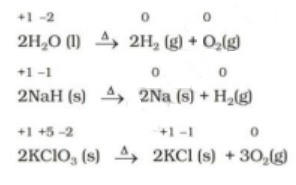
It may be emphasised that the assumption Of electron transfer is made for book-keeping Purpose only and it will become obvious at a Later stage in this unit that it leads to the simple Description of redox reactions. Oxidation number denotes the Oxidation state of an element in a Compound ascertained according to a set Of rules formulated on the basis that electron pair in a covalent bond belongs Entirely to more electronegative element. It is not always possible to remember or Make out easily in a compound/ ion, which Element is more electronegative than the other. Therefore, a set of rules has been formulated To determine the oxidation number of an Element in a compound/ion. We may at this stage, state the rules for the Calculation of oxidation number. These rules are: 1.) In elements, in the free or the uncombined State, each atom bears an oxidation Number of zero. Evidently each atom in $H _2, O _2, C _{12}, O _3, P _4, S_8, Na , Mg$, Al has the Oxidation number zero. 2.) For ions composed of only one atom, the Oxidation number is equal to the charge On the ion. Thus $Na +$ lon has an oxidation Number of $+1, Mg _2+$ ion +2 , $Fe _3+$ ion, $+3, Cl -$ Ion, $-1, O _2-$ ion, -2 ; and so on. In their Compounds all alkali metals have Oxidation number of +1 , and all alkaline Earth metals have an oxidation number of +2 . Aluminium is regarded to have an Oxidation number of +3 in all its Compounds. 3.) The oxidation number of oxygen in most Compounds is -2 . However, we come across Two kinds of exceptions here. One arises In the case of peroxides and superoxides, The compounds of oxygen in which oxygen Atoms are directly linked to each other. While in peroxides (e.g., $H _2 O _2, Na _2 O _2$ ), each Oxygen atom is assigned an oxidation Number of -1 , in superoxides (e.g., $K O _2, Rb O _2$ ) each oxygen atom is assigned an Oxidation number of $-(1 / 2)$. The second Exception appears rarely, i.e. when oxygen Is bonded to fluorine. In such compounds e.g., oxygen difluoride $\left( OF _2\right)$ and dioxygen difluoride $\left( O _2 F_2\right)$, the oxygen is assigned an oxidation number of +2 and +1 , respectively. The number assigned to oxygen will depend upon the bonding state of oxygen but this number would now be a positive figure only. 4.)The oxidation number of hydrogen is +1, Except when it is bonded to metals in binary Compounds (that is compounds containing Two elements). For example, in LiH, NaH, And $Ca H_2,$ its oxidation number is –1. 5.) In all its compounds, fluorine has an Oxidation number of –1. Other halogens (Cl, Br, and I) also have an oxidation number Of –1, when they occur as halide ions in Their compounds. Chlorine, bromine and Iodine when combined with oxygen, for Example in oxoacids and oxoanions, have Positive oxidation numbers. 6.) The algebraic sum of the oxidation number Of all the atoms in a compound must be Zero. In polyatomic ion, the algebraic sum Of all the oxidation numbers of atoms of The ion must equal the charge on the ion. Thus, the sum of oxidation number of three Oxygen atoms and one carbon atom in the Carbonate ion, $(CO_3) 2$– must equal –2. A term that is often used interchangeably With the oxidation number is the oxidation State. Thus in $CO_2,$the oxidation state of Carbon is +4 , that is also its oxidation number And similarly the oxidation state as well as Oxidation number of oxygen is -2 . This implies That the oxidation number denotes the Oxidation state of an element in a compound. The oxidation number/state of a metal in a Compound is sometimes presented according To the notation given by German chemist, Alfred Stock. It is popularly known as Stock Notation. According to this, the oxidation Number is expressed by putting a Roman Numeral representing the oxidation number In parenthesis after the symbol of the metal in The molecular formula. Thus aurous chloride And auric chloride are written as $Au ( I ) Cl$ and $Au ( III ) Cl _3$. Similarly, stannous chloride and Stannic chloride are written as $Sn ( II ) Cl _2$ and $Sn ( IV ) Cl _4$. This change in oxidation number Implies change in oxidation state, which in Turn helps to identify whether the species is Present in oxidised form or reduced form. Thus, $Hg _2( I ) Cl _2$ is the reduced form of $Hg ( II ) Cl _2$.
- H atom goes from a … state in $H_2$ to a positive state in $H_2O$ in water formation.
- Neutral
- Positive
- Negative
- All the above
- In oxidation number method, there is a complete transfer of electron from a …. electronegative atom to a … electonegative atom.
- more, less
- less, more
- non, more
- non, less
- Oxidation number of $Mg_2$ + ion is:
- -2
- -1
- +2
- +1
- In $Na2O_2$ each oxygen atom is assigned an oxidation number of …
- +1
- -2
- +2
- -1
- The algebraic sum of the oxidation number of all the atoms in a compound must be…
- 0
- 1
- 2
- -2
View full solution →The idea of oxidation number has been invariably applied to define oxidation, reduction, oxidising agent (oxidant), reducing agent (reductant) and the redox reaction. To summarise, we may say that:
Oxidation: An increase in the oxidation number of the element in the given substance.
Reduction: A decrease in the oxidation number of the element in the given substance.
Oxidising agent: A reagent which can increase the oxidation number of an element in a given substance. These reagents are called as oxidants also.
Reducing agent: A reagent which lowers the oxidation number of an element in a given substance. These reagents are also called as reductants.
Redox reactions: Reactions which involve change in oxidation number of the interacting species.
Types of Redox Reactions
1.) Combination reactions -A combination reaction may be denoted in the manner:
$A + B → C$
Either A and B or both A and B must be in the elemental form for such a reaction to be a redox reaction. All combustion reactions, which make use of elemental dioxygen, as well as other reactions involving elements other than dioxygen, are redox reactions. Some important examples of this category are:
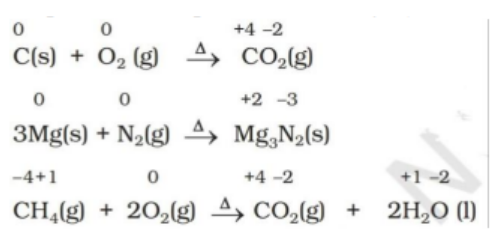
2.) Decomposition reactions- Decomposition reactions are the opposite of combination reactions. Precisely, a decomposition reaction leads to the breakdown of a compound into two or more components at least one of which must be in the elemental state.
Examples of this class of reactions are:
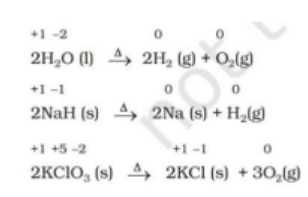
It may carefully be noted that there is no change in the oxidation number of hydrogen in methane under combination reactions and that of potassium in potassium chlorate in reaction. This may also be noted here that all decomposition reactions are not redox reactions. For example, decomposition of calcium carbonate is not a redox reaction.
3.) Displacement reactions- In a displacement reaction, an ion (or an atom) in a compound is replaced by an ion (or an atom) of another element. It may be denoted as:
$X + YZ → XZ + Y$
Displacement reactions fit into two categories: metal displacement and non-metal displacement.
(a) Metal displacement: A metal in a compound can be displaced by another metal in the uncombined state. Metal displacement reactions find many applications in metallurgical processes in which pure metals are obtained from their compounds in ores.
(b) Non-metal displacement: The non-metal displacement redox reactions include hydrogen displacement and a rarely occurring reaction involving oxygen displacement. All alkali metals and some alkaline earth metals (Ca, Sr, and Ba) which are very good reductants, will displace hydrogen from cold water. Many metals, including those which do not react with cold water, are capable of displacing hydrogen from acids. Dihydrogen from acids may even be produced by such metals which do not react with steam. Cadmium and tin are the examples of such metals.
4.) Disproportionation reactions – Disproportionation reactions are a special type of redox reactions. In a disproportionation reaction an element in one oxidation state is simultaneously oxidised and reduced. One of the reacting substances in a disproportionation reaction always contains an element that can exist in at least three oxidation states. The element in the form of reacting substance is in the intermediate oxidation state; and both higher and lower oxidation states of that element are formed in the reaction. The decomposition of hydrogen peroxide is a familiar example of the reaction, where oxygen experiences disproportionation.
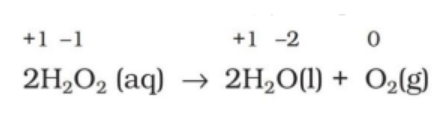
Here the oxygen of peroxide, which is present in –1 state, is converted to zero oxidation state in $O2$ and decreases to –2 oxidation state in $H_2O$.
- In … an ion (or an atom) in a compound is replaced by an ion (or an atom) of another element.
- displacement reaction
- decomposition reaction
- disproportionation reaction
- combination reaction
- leads to the breakdown of a compound into two or more components at least one of which must be in the elemental state.
- displacement reaction
- decomposition reaction
- disproportionation reaction
- combination reaction
- In …. an element in one oxidation state is simultaneously oxidised and reduced.
- displacement reaction
- decomposition reaction
- disproportionation reaction
- combination reaction
- Reactions which involve change in oxidation number of the interacting species…
- Exothermic reaction
- Endothermic reaction
- Neutralization reaction
- Redox reaction
- One of the reacting substances in a disproportionation reaction always contains an element that can exist in at least … oxidation states.
- 1
- 2
- 3
- 4
View full solution →Whenever a reaction between an oxidising agent and a reducing agent is carried out, a compound of lower oxidation state is formed if the reducing agent is in excess and a compound of higher oxidation state is formed if the oxidising agent is in excess. Justify this statement giving three illustrations.
Balance the following equations in basic medium by ion-electron method and oxidation number methods and identify the oxidising agent and the reducing agent.$\text{P}_4(\text{s})+\text{OH}^{-}(\text{aq})\rightarrow\text{PH}_3(\text{g})+\text{HPO}_2^-(\text{aq})$
View full solution →Balance the following equations in basic medium by ion-electron method and oxidation number methods and identify the oxidising agent and the reducing agent. $Cl_2O_7(g) + H_2O_2(aq) \rightarrow ClO_2^-(aq) + O_2(g) + H^+$
View full solution →Balance the following equations in basic medium by ion-electron method and oxidation number methods and identify the oxidising agent and the reducing agent.$N_2H_4(l) + ClO_3^-(aq) \rightarrow NO(g) + Cl^-(g)$
View full solution →The $Mn^{3+}$ ion is unstable in solution and undergoes disproportionation to give $Mn^{2+}, MnO_2,$ and $H^+$ ion. Write a balanced ionic equation for the reaction.
View full solution →