Question
Balance the following equations in basic medium by ion-electron method and oxidation number methods and identify the oxidising agent and the reducing agent.

$\text{P}_4(\text{s})+\text{OH}^{-}(\text{aq})\rightarrow\text{PH}_3(\text{g})+\text{HPO}_2^-(\text{aq})$

Answer


P4 acts both as an oxidising as well as a reducing agent.

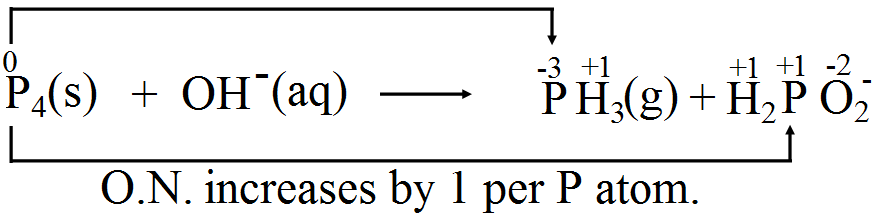
Oxidation number method:

Total decrease in O.N. of P4 in PH3 = 3 × 4 = 12

Total increase in O.N. of P4 in $\text{H}_2\text{PO}_2^{-}$ = 1 × 4 = 4

Therefore, to balance increases decreases in O.N. multiply PH3 by 1 and $\text{H}_2\text{PO}_2^{-}$ by 3, we have,

$\text{P}_4(\text{s})+\text{OH}^{-}(\text{aq})\rightarrow\text{PH}_3(\text{g})+3\text{H}_2\text{PO}_2^{-}(\text{aq})$

To balance O atoms, multiply OH- by 6, we have,

$\text{P}_4(\text{s})+6\text{OH}^{-}(\text{aq})\rightarrow\text{PH}_3(\text{g})+3\text{H}_2\text{PO}_2^{-}(\text{aq})$

To balance H atoms, add 3H2O to L.H.S. and 3OH- to the R.H.S., we have,

$\text{P}_4(\text{s})+6\text{OH}^{-}(\text{aq})+3\text{H}_2\text{O(l)}\rightarrow\\\text{PH}_3(\text{g})+3\text{H}_2\text{PO}_2^{-}(\text{aq})+3\text{OH}^-(\text{aq})$

or $\text{P}_4(\text{s})+3\text{OH}^{-}(\text{aq})+3\text{H}_2\text{O(l)}\rightarrow\\\text{PH}_3(\text{g})+3\text{H}_2\text{PO}_2^{-}(\text{aq})\ ....(\text{i})$

Thus, eq (i) represents the correct balanced equation.

Ion electron method. The two half reactions are:

Oxidation half reaction:

$\text{P}_4(\text{s})\rightarrow\text{H}_2\text{PO}^-_2(\text{aq})\ .....(\text{ii})$

Balancing P atoms, we have,

$\ \ \ \ \stackrel{{0}}{\ \ \ \ \ \ \ \hbox{P}_4(\text{s})}\rightarrow\stackrel{{+1}}{\ \ \ \ \ \ \ 4\hbox{H}_2\text{PO}^-_2(\text{aq})}$

Balance O.N. by adding electrons,

$\text{P}_4(\text{s})\rightarrow4\text{H}_2\text{PO}^-_2(\text{aq})+4\text{e}^-$

Balance charge by adding 8 OH- ions,

$\text{P}_4(\text{s})+8\text{OH}^-(\text{aq})\rightarrow4\text{H}_2\text{PO}^-_2(\text{aq})+4\text{e}^-\ .....(\text{iii})$

O and H get automatically balanced. Thus, eq. (iii) represents the balanced oxidation half reaction.

Reduction half reaction:

$\ \ \ \ \stackrel{{0}}{\ \ \ \ \ \ \ \hbox{P}_4(\text{s})}\rightarrow\stackrel{{-3}}{\ \ \ \ \ \ \ \hbox{PH}_3(\text{g})}\ .....(\text{iv})$

Balancing P atoms, we have,

$\text{P}_4(\text{s})\rightarrow4\text{PH}_3(\text{g})$

Balance O.N. by adding electrons,

$\text{P}_4(\text{s})+12\text{e}^-\rightarrow4\text{PH}_3(\text{g})$

Balance charge by adding 12OH- ions,

$\text{P}_4(\text{s})+12\text{e}^-\rightarrow4\text{PH}_3(\text{g})+12\text{OH}^-(\text{aq})$

Balance O atoms, by adding 12H2O to L.H.S. of above equation.

$\text{P}_4(\text{s})+12\text{H}_2\text{O(l)}+12\text{e}^{-}\rightarrow4\text{PH}_3(\text{g})+12\text{OH}^{-}(\text{aq})\ .....(\text{v})$

To cancel out electrons, multiply eq. (iii) by 3 and add it to eq. (v), we have,

$4\text{P}_4(\text{s})+24\text{OH}^{-}(\text{aq})+12\text{H}_2\text{O(l)}\rightarrow\\4\text{PH}_3(\text{aq})+12\text{H}_2\text{PO}_2^-(\text{aq})+12\text{H}_2\text{O(l)}+12\text{OH}^{-}(\text{aq})\ ......(\text{vi})$

Or $\text{P}_4(\text{g})+3\text{OH}^{-}(\text{aq})+3\text{H}_2\text{O(l)}\rightarrow\text{PH}_3(\text{aq})+3\text{H}_2\text{PO}_2^-(\text{aq})$

Thus, eq. (vi) represents the correct balanced equation.

Need a full question paper?

Generate a complete, print-ready paper with questions like this in minutes — across 16+ boards, with answer keys.

Start Generating Free

Similar questions

Graphically show the total work done in an expansion when the state of an ideal gas is changed reversibly and isothermally from (pi, Vi ) to (pf, Vf ). With the help of a pV plot compare the work done in the above case with that carried out against a constant external pressure pf.
  1. Show that the circumference of Bohr's orbit for the H-atom is an integral multiple of the de-Broglie wavelength of electron revolving around the orbit.
  2. Explain that the effect of the Heisenberg uncertainty principle is significant only for motion of microscopic objects and is negligible for that of macroscopic objects. [h = 6.626 × 10⁻³⁴Js, Mass of electron = 9.1 × 10⁻³¹kg].
  3. State Hund's Rule of maximum multiplicity.
A welding fuel gas contains carbon and hydrogen only. Burning a small sample of it in oxygen gives 3.38 g carbon dioxide, 0.690 g of water and no other products. A volume of 10.0 L (measured at STP) of this welding g as is found to weigh 11.6 g. Calculate (i) empirical formula, (ii) molar mass of the gas, and (iii) molecular formula.
  1. In qualitative analysis, on what basis cations are grouped?
  2. The value of Kc in the reaction:

$2\text{A}\rightleftharpoons\text{B}+\text{C}$ is 2 × 10-3. At a given time, the composition of reaction mixture is [A] = [B] = [C] = 3 × 10-4M. In which direction the reaction will proceed?

  1. The solubility of Sr(OH)2 at 298K is 19.23g/L of solution. Calculate the concentration of strontium and hydroxyl ions and the pH of the solution.
State the industrial uses of common ion effect and solubility product.
Calculate the enthalpy change for the process

$\text{CCI}_4(\text{g})\xrightarrow{ \ \ \ \ \ }\text{C}(\text{g})+4\text{CI}(\text{g})$

and calculate bond enthalpy of C – Cl in CCl4(g).

$\Delta_\text{vap}\text{H}^\ominus(\text{CCI}_4)=30.5\text{kJ} \ \text{mol}^{-1}.$

$\Delta_\text{f}\text{H}^\ominus(\text{CCI}_4)=-135.5\text{kJ} \ \text{mol}^{-1}.$

$\Delta_\text{a}\text{H}^\ominus(\text{C})=-715.0\text{kJ} \ \text{mol}^{-1},$ where $\Delta_\text{a}\text{H}^\ominus$ is enthalpy of atomisation

$\Delta_\text{a}\text{H}^\ominus(\text{CI}_2)=242\text{kJ} \ \text{mol}^{-1}$

The ionization constant of HF, HCOOH and HCN at 298K are 6.8 × 10⁻⁴, 1.8 × 10⁻⁴ and 4.8 × 10⁻⁹ respectively. Calculate the ionization constants of the corresponding conjugate base.
Briefly describe the valence bond theory of covalent bond formation by taking an example of hydrogen. How can you interpret energy changes taking place in the formation of dihydrogen?
What transition in the hydrogen spectrum would have the same wavelength as the Balmer transition n = 4 to n = 2 of He+ spectrum?
Explain Avogadro's concept.