Question
Balance the following equations in basic medium by ion-electron method and oxidation number methods and identify the oxidising agent and the reducing agent.
Cl2O7(g) + H2O2(aq) → ClO2-(aq) + O2(g) + H+
Cl2O7(g) + H2O2(aq) → ClO2-(aq) + O2(g) + H+
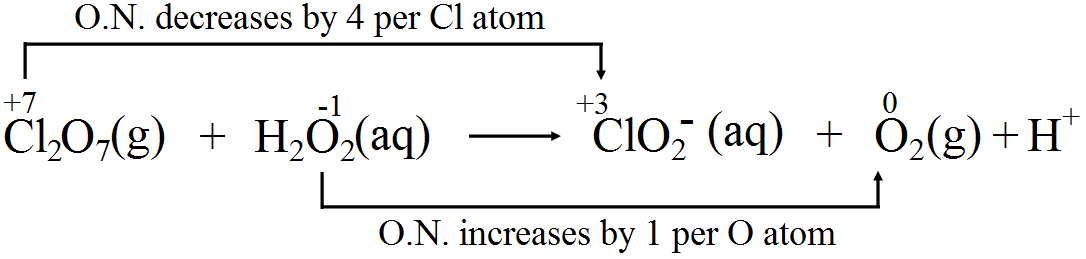
Thus, Cl2O7(g) acts an oxidising agent while H2O2(aq) as the reducing agent.
Oxidation number method:
Total decrease in O.N. of Cl2O7 = 4 × 2 = 8
Total increase in O.N. of H2O2 = 2 × 1 = 2
$\therefore$
To balance increase/ decrease in O.N. multiply H2O2 and O2 by 4, we have,$\text{Cl}_2\text{O}_7(\text{g})+4\text{H}_2\text{O}_2(\text{aq})\rightarrow\text{ClO}_2^-(\text{aq})+4\text{O}_2(\text{g})$
To balance Cl atoms, multiply ClO2- by 2, we have,
$\text{Cl}_2\text{O}_7(\text{g})+4\text{H}_2\text{O}_2(\text{aq})\rightarrow2\text{ClO}_2^-(\text{aq})+4\text{O}_2(\text{g})$
To balance O atoms, add 3H2O R.H.S., we have,
$\text{Cl}_2\text{O}_7(\text{g})+4\text{H}_2\text{O}_2(\text{aq})\rightarrow2\text{ClO}_2^-(\text{aq})+4\text{O}_2(\text{g})+3\text{H}_2\text{O(l)}$
To balance H atoms, add 2H2O to R.H.S. and 2OH- to L.H.S., we have,
$\text{Cl}_2\text{O}_7(\text{g})+4\text{H}_2\text{O}_2(\text{aq})+2\text{OH}^-(\text{aq})\rightarrow\\2\text{ClO}_2^-(\text{aq})+4\text{O}_2(\text{g})+5\text{H}_2\text{O(l)}$
This represents the balanced redox equation.
Ion electron method
Oxidation half reaction:
$\stackrel{\ \ \ \ \ \ \ \ {-1}}{\ \ \ \ \ \ \ \ \ \ \ \hbox{H}_2\text{O}_2(\text{aq})}\rightarrow\stackrel{{0}}{\ \ \ \ \ \ \ \ \hbox{O}_2{(\text{g})}}$
Balance O.N. by adding electrons,
$\text{H}_2\text{O}_2(\text{aq})\rightarrow\text{O}_2(\text{g})+2\text{e}^{-}$
Balance charge by adding 2OH- ions,
$\text{H}_2\text{O}_2(\text{aq})+2\text{OH}^-(\text{aq})\rightarrow\text{O}_2(\text{g})+2\text{e}^{-}$
Balance O atoms by adding 2H2O,
$\text{H}_2\text{O}_2(\text{aq})+2\text{OH}^-(\text{aq})\rightarrow\text{O}_2(\text{g})+2\text{H}_2\text{O(l)}+2\text{e}^{-}$
Reduction half reaction:
$\stackrel{{+7}}{\ \ \ \ \ \ \ \ \ \ \ \hbox{Cl}_2\text{O}_7(\text{g})}\rightarrow\stackrel{{+3}}{\ \ \ \ \ \ \ \ \ \ \ \ \ \ \ \text{Cl}\hbox{O}_2^-{(\text{aq})}}$
Balance Cl atoms; $\text{Cl}_2\text{O}_7(\text{g})\rightarrow2\text{ClO}_2^-(\text{aq})$
Balance O.N. by adding electrons,
$\text{Cl}_2\text{O}_7(\text{g})+8\text{e}^{-}\rightarrow2\text{ClO}_2^-(\text{aq})$
Add 6OH- ions to balance charge:
$\text{Cl}_2\text{O}_7(\text{g})+8\text{e}^{-}\rightarrow2\text{ClO}_2^-(\text{aq})+6\text{OH}^-$
Balance O atoms by adding 3H2O to L.H.S., we have,
$\text{Cl}_2\text{O}_7(\text{g})+3\text{H}_2\text{O(l)}+8\text{e}^{-}\rightarrow2\text{ClO}_2^-(\text{aq})+6\text{OH}^-(\text{aq})\ .....(\text{ii})$
To cancel out electrons, multiply eq. (i) by 4 and add it to eq. (ii), we have,
$4\text{H}_2\text{O}_2(\text{aq})+8\text{OH}^{-}(\text{aq})+\text{Cl}_2\text{O}_7(\text{g})+3\text{H}_2\text{O(l)}\rightarrow\\2\text{ClO}_2^-(\text{aq})+6\text{OH}^{-}(\text{aq})+4\text{O}_2(\text{g})+8\text{H}_2\text{O(l)}$
Or
$\text{Cl}_2\text{O}_7(\text{g})+4\text{H}_2\text{O}_2(\text{aq})+2\text{OH}^{-}(\text{aq})\rightarrow\\2\text{ClO}_2^-(\text{aq})+4\text{O}_2(\text{g})+5\text{H}_2\text{O(l)}$Generate a complete, print-ready paper with questions like this in minutes — across 16+ boards, with answer keys.