Question
Balance the following ionic equations.
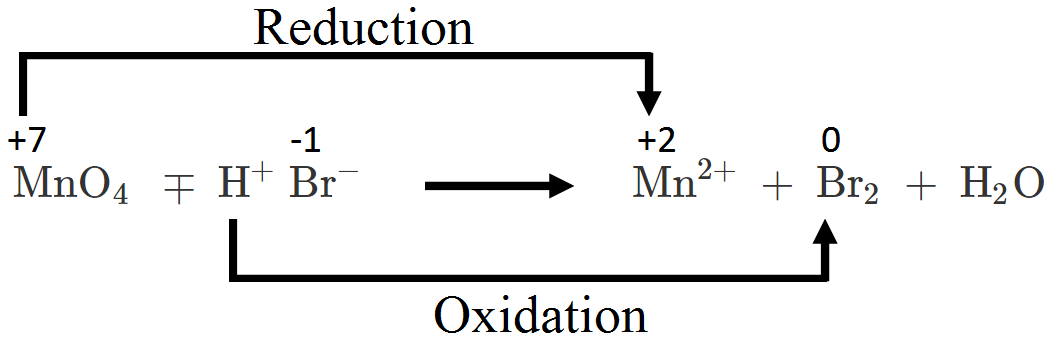
$\text{MnO}^-_4+\text{H}^++\text{Br}^-\xrightarrow{ \ \ \ \ \ \ \ \ }\text{Mn}^{2+}+\text{Br}_2+\text{H}_2\text{O}$
Answer


Dividing the equation into two half reactions:
Oxidation half reaction: $\text{Br}^-\xrightarrow{ \ \ \ \ \ \ \ \ }\text{Br}_2$
Reduction half reaction: $\text{MnO}^-_4\xrightarrow{ \ \ \ \ \ \ \ \ }\text{Mn}^{2+}$
Balancing oxidation and reduction half reactions separately as:
Oxidation half reaction
$\text{Br}^-\xrightarrow{ \ \ \ \ \ \ \ \ }\text{Br}_2$
$2\text{Br}^-\xrightarrow{ \ \ \ \ \ \ \ \ \ }\text{Br}_2$
$2\text{Br}^-\xrightarrow{ \ \ \ \ \ \ \ \ }\text{Br}_2+2\text{e}^-...(\text{i})$
Reduction half reaction
$\text{MnO}^-_4\xrightarrow{ \ \ \ \ \ \ \ }\text{Mn}^{2+}$
$\text{MnO}^-_4+5\text{e}^-\xrightarrow{ \ \ \ \ \ \ \ \ }\text{Mn}^{2+}$
$\text{MnO}^-_4+8\text{H}^++5\text{e}^-\xrightarrow{ \ \ \ \ \ \ \ }\text{Mn}^{2+}$
$\text{MnO}^-_4+8\text{H}^++5\text{e}^-\xrightarrow{ \ \ \ \ \ \ \ \ }\text{Mn}^{2+}+4\text{H}_2\text{O}...(\text{ii})$
To balance the electrons, multiply eq. (i) by 5 and eq. (ii) by 2 and add
$2\text{MnO}^-_4+10\text{Br}^-+16\text{H}^+\xrightarrow{ \ \ \ \ \ \ \ \ }2\text{Mn}^{2+}+5\text{Br}_2+8\text{H}_2\text{O}$

Need a full question paper?

Generate a complete, print-ready paper with questions like this in minutes — across 16+ boards, with answer keys.

Start Generating Free

Similar questions

What is meant by the conjugate acid-base pair? Find the conjugate acid/base for the following species:
$\text{HNO}_2,\text{CN}^-,\text{HClO}_4,\text{F}^-,\text{OH}^-,\text{CO}_3^{2-}\text{and S}^{2-}$
Why does fluorine not show disporportionation reaction?
How is the third law of thermodynamics useful in calculation of the absolute entropies? Calculate the value of $\Delta\text{S}^\circ$ for the following reaction at 400K:
2NOCl(g) → 2NO(g) + Cl2(g)
If the value of equilibrium constant for the reaction at 400K is 1.958 × 10⁻⁴ and $\Delta\text{H}^\circ=77.2\text{kJ mol}^{-1}$ (R = 8.314J K-1mol-1).
Out of elements of Group 17, 18, 1 in the sequence placed in modern periodic table.
  1. Which elements have negative electron gain enthalpy.
  2. Which elements have more metallic behaviour?
  3. Which elements have zero electronic behavior (zero valent)?
Use the following data to calculate the $\Delta\text{G}^{\circ}$ for the reaction in which PF5(g) forms from PF3(g) and F2(g) at 298K.

PF3(g) + F2(g) → PF5(g)

$\begin{matrix}\Delta \text{H}^{\circ}_{f} & -919 \text{kJ mol}^{-1} & 0 & -1577 \text{kJ} \text{ K}^{-1} \text{mol}^{-1} \ \\\text{S}^{\circ}& 273 & 203 & 301 \end{matrix}$

  1. Why entropy of steam is more than that of water at its boiling point?
  2. Out of diamond and graphite which has higher entropy?
  3. Standard heat of formation of hydrazine [N2H4(l), hydrogen peroxide [H2O2(l)] and water [H2O(l)] are -50.4, -193.2 and -242.7 kJ/ mole respectively. Calculate the standard heat of formation for the following reaction:

$\text{N}_2\text{H}_4\text{(l)}+2\text{H}_2\text{O}_2(\text{l})\overrightarrow{\ \ \ \ \ \ \ }\ \text{N}_2(\text{g})+4\text{H}_2\text{O(l)}$​​​​​​​

The pH of 0.1 M solution of cyanic acid (HCNO) is 2.34. Calculate the ionization constant of the acid and its degree of ionization in the solution.
Give the name and an atomic number of the inert gas atom in which the total number of d-electrons is equal to the difference in numbers of total p and s electrons.
  1. Classify the following processes as reversible or irreversible:
  1. Dissolution of sodium chloride.
  2. Evaporation of water at 373K and 1atm pressure.
  3. Mixing of two gases by diffusion.
  4. Melting of ice without rise in temperature.
  1. When an ideal gas expands in vacuum, there is neither absorption nor evolution of heat. Why?
On the basis of VSEPR theory, predict the shapes of the following
1. $NH _2^{-}$
2. $O _3$