Question
Why does fluorine not show disporportionation reaction?

Answer

In a disproportionation reaction, the same species is simultaneously oxidised as well as reduced. Therefore, for such a redox reaction to occur, the reacting species must contain an element which has adeast three oxidation states.
The element, in reacting species, is present in an intermediate state while lower and higher oxidation states are available for reduction and oxidation to occur (respectively). Fluorine is the strongest oxidising agent. It does not show positive oxidation state. That’s why fluorine does not show disproportionation reaction.

Need a full question paper?

Generate a complete, print-ready paper with questions like this in minutes — across 16+ boards, with answer keys.

Start Generating Free

Similar questions

The solubility of $Sr ( OH )_2$ at 298 K is $19.23 g / L$ of solution. Calculate the concentration of strontium and hydroxyl ions and the pH of the solution.
1. Two ideal gases under the same pressure and temperature are allowed to mix in an isolated system.
What will be the sign of entropy change?
2. Water can be lifted into the water tank at the top of the house with the help of a pump. Then why is it not considered to be spontaneous?
3. What is the enthalpy change for an adiabatic process?
Consider the reactions:

O3(g) + H2O2(l) → H2O(l) + 2O2(g)

Why it is more appropriate to write these reactions as:

O3(g) + H2O2(l) → H2O(l) + O2(g) + O2(g)

Also suggest a technique to investigate the path of the above redox reactions.
Discuss the concept of hybridisation. What are the different types of hybridization that carbon can exhibit?
1. The fact that the enthalpy is a state function forms the basis of a very useful law. Name the law.
2. Two liters of an ideal gas at a pressure of 10 atm expands isothermally at $25^{\circ} C$ into a vacuum until its total volume is 10 liters. How much heat is absorbed and how much work is done in the expansion?
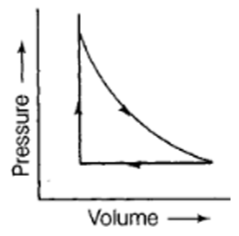
3. A sample of 1.0 mole of a monoatomic ideal gas is taken through a cyclic process of expansion and compression as shown in the figure. What will be the value of $\Delta H$ for the cycle as a whole?
Image
When electromagnetic radiation of wavelength 300nm falls on the surface of sodium, electrons are emitted with a kinetic energy of 1.68 ×10⁵J mol-1. What is the minimum energy needed to remove an electron from sodium? What is the maximum wavelength that will cause a photo-electron to be emitted?
(h = 6.626 × 10⁻³⁴Js)
Determine the molecular formula of an oxide of iron, in which the mass per cent of iron and oxygen are 69.9 and 30.1, respectively.
Note: Given that the molar mass of the oxide is 159.69g mol-1
What is an ionic bond? Give two suitable examples explain the difference between ionic and covalent bond.
Threshold frequency, ν0 is the minimum frequency which a photon must possess to eject an electron from a metal. It is different for different metals. When a photon of frequency 1.0 × 10¹⁵s-1 was allowed to hit a metal surface, an electron having 1.988 × 10⁻¹⁹J of kinetic energy was emitted. Calculate the threshold frequency of this metal. Show that an electron will not be emitted if a photon with a wavelength equal to 600 nm hits the metal surface.
If the speed of light is 3.0 × 10⁸ ms-1, calculate the distance covered by light in 2.00ns.