MCQ
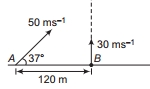
Balls $A$ and $B$ are thrown from two points lying on the same horizontal plane separated by a distance $120\,m$. Which of the following statement$(s)$ is/are correct.
  • A
    The two balls can never meet
  • B
    The balls can meet, if the ball $B$ is thrown $1\,s$ later
  • The two balls meet at a height of $45\,m$
  • D
    None of the above

Answer

Correct option: C.
The two balls meet at a height of $45\,m$
c
(c)

Two balls will meet if,

$\left(50 \cos 37^{\circ}\right) t_A=120 \text { or } t_A=3\,s$

Vertical component of $A$ is also $50 \sin 37^{\circ}$ or $30\,m / s$, so they will meet if thrown simultaneously.

$h_A=h_B$

$=30 \times 3-\frac{1}{2} \times 10 \times(3)^2$

$=45\,m$

Need a full question paper?

Generate a complete, print-ready paper with questions like this in minutes — across 16+ boards, with answer keys.

Start Generating Free

Similar questions

Two moles of ideal helium gas are in a rubber balloon at $30^{\circ} C$. The balloon is fully expandable and can be assumed to require no energy in its expansion. The temperature of the gas in the balloon is slowly changed to $35^{\circ} C$. The amount of heat required in raising the temperature is nearly (take $R =8.31 J / mol$. $K$)
Water enters through end $A$  with speed ${v_1}$ and leaves through end $B$ with speed ${v_2}$ of a cylindrical tube $AB$. The tube is always completely filled with water. In case $I$  tube is horizontal and in case $ II$  it is vertical with end $ A $ upwards and in case $ III $ it is vertical with end $B$ upwards. We have ${v_1} = {v_2}$ for
The general displacement of a simple harmonic oscillator is $x = A \sin \omega t$. Let $T$ be its time period. The slope of its potential energy (U) - time (t) curve will be maximum when $t=\frac{T}{\beta}$. The value of $\beta$ is $.........$
A $60\, kg$ man stands on a spring scale in the lift. At some instant he finds, scale reading has changed from $60\, kg$ to $50\,kg$ for a while and then comes back to the original mark. What should we conclude ?
If a force $F $ is applied on a body and it moves with a velocity $v$, the power will be
In which of the following process, convection does not take place primarily?
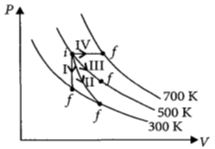
Thermodynamic processes are indicated in the following diagram. 

Match the following

 $\begin{array}{|l|l|} \hline Column\,\,-\,\,1 & Column\,\,-\,\,2 \\ \hline P\,:\,Process\,\,-\,\,I & \,\,A\,\,:\,\,Adiabatic \\ \hline Q\,:\,Process\,\,-\,\,II & \,\,B\,\,:\,\,Isobaric \\ \hline R\,:\,Process\,\,-\,\,III & \,\,C\,\,:\,\,Isochoric \\ \hline S\,:\,Process\,\,-\,\,IV & \,\,D\,\,:\,\,Isothermal \\ \hline \end{array}$


A metal wire has mass $(0.4 \pm 0.002)\,g$, radius $(0.3 \pm 0.001)\,mm$ and length $(5 \pm 0.02) \,cm$. The maximum possible percentage error in the measurement of density will nearly be $.......\%$
If e is the electronic charge, $c$ is the speed of light in free space and $h$ is Planck's constant, the quantity $\frac{1}{4 \pi \varepsilon_{0}} \frac{| e |^{2}}{h c}$ has dimensions of .......
Before jumping in water from above, a swimmer bends his body to