Question
Basicity of $H_3BO_3$ is :

Answer

Protic acid is an acid that can undergo ionization and produce hydrogen ions/protons. However, aprotic acids do not produce any hydrogen ions/protons.

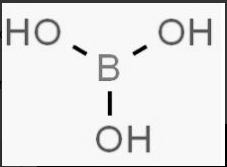
Although Boric acid contains 3 OH groups yet it can act as monobasic acid rather than tribasic acid. This is because boric acid does not act as a proton donor rather it accepts a pair of

electrons from $\mathrm{OH}^{-}$ ions.

It does not donate $\mathrm{H}^{+}$ rather it accepts an electron pair from the solution or the donor i.e. $\mathrm{OH}^{-}$

Thus, Boric acid is an aprotic acid (like lewis acid) and monobasic acid.
Need a full question paper?

Generate a complete, print-ready paper with questions like this in minutes — across 16+ boards, with answer keys.

Start Generating Free

Similar questions

20 mL of 2 M NaOH solution is added to 400 mL of 0.5 M NaOH solution. The final concentration of the solution is _________$\times 10^{-2} M$. (Nearest integer).
Thermal decomposition of $AgNO _3$ produces two paramagnetic gases. The total number of electrons present in the antibonding molecular orbitals of the gas that has the higher number of unpaired electrons is. . . . .
Concentration of $H _2 SO _4$ and $Na _2 SO _4$ in a solution is $1 M$ and $1.8 \times 10^{-2} M$, respectively. Molar solubility of $PbSO _4$ in the same solution is $X \times 10^{- Y } M$ (expressed in scientific notation). The value of $Y$ is. . . .[Given: Solubility product of $PbSO _4\left(K_{s p}\right)=1.6 \times 10^{-8}$. For $H _2 SO _4, K_{a l}$ is very large and $\left.K_{a 2}=1.2 \times 10^{-2}\right]$
$CH_2 = CH - CH = CH - CH = CH_2$
How many geometrical isomers are possible for this compound ?
Effective atomic number of iron in brown ring complex is
Oxidation number of $C$ in $HNC$ is
The osmotic pressure exerted by a solution prepared by dissolving $2.0\, g$ of protein of molar mass $60\, kg\, mol ^{-1}$ in $200\, mL$ of water at $27^{\circ} C$ is $.....Pa$. [integer value]

(use $R =0.083 L\,bar\,mol ^{-1}\, K ^{-1}$ )

One mole of ${N_2}{H_4}$ loses $10\, mol$ of electrons to form a new compound $Y$. Assuming that all nitrogen appear in the new compound, what is the oxidation state of ${N_2}$ in $Y$ ? (There is no change in the oxidation state of hydrogen)
How many ionisation energies can carbon have