Question
Bayes' theorem is also called the __________ for the probability of "causes".

Answer

formula

Need a full question paper?

Generate a complete, print-ready paper with questions like this in minutes — across 16+ boards, with answer keys.
Start Generating Free

Similar questions

Fill in the blank.
If A and B are square matrices of the same order, then:
  1. (AB)' = _________.
  2. (kA)' = _________. (k is any scalar)
  3. [k(A - B)]' = _________.
If a line makes equal angles with direction axes, then the direction cosines of that line will be_______
Fill in the blanks:
If A is a matrix of order 3 × 3, then number of minors in determinant of A are ________.
The approximate value of $\sqrt{26}$ will be……..
The number of arbitrary constants present in the general solution of any differential equation of order three will be ____________ .
If $2 P ( A )= P ( B )=\frac{5}{12}$ and $P \left(\frac{A}{B}\right)=\frac{1}{5}$, then $P(A \cup B)$=______.
Fill in the blank.
Let the relation R be defined in N by aRb if 2a + 3b = 30. Then R = ______.
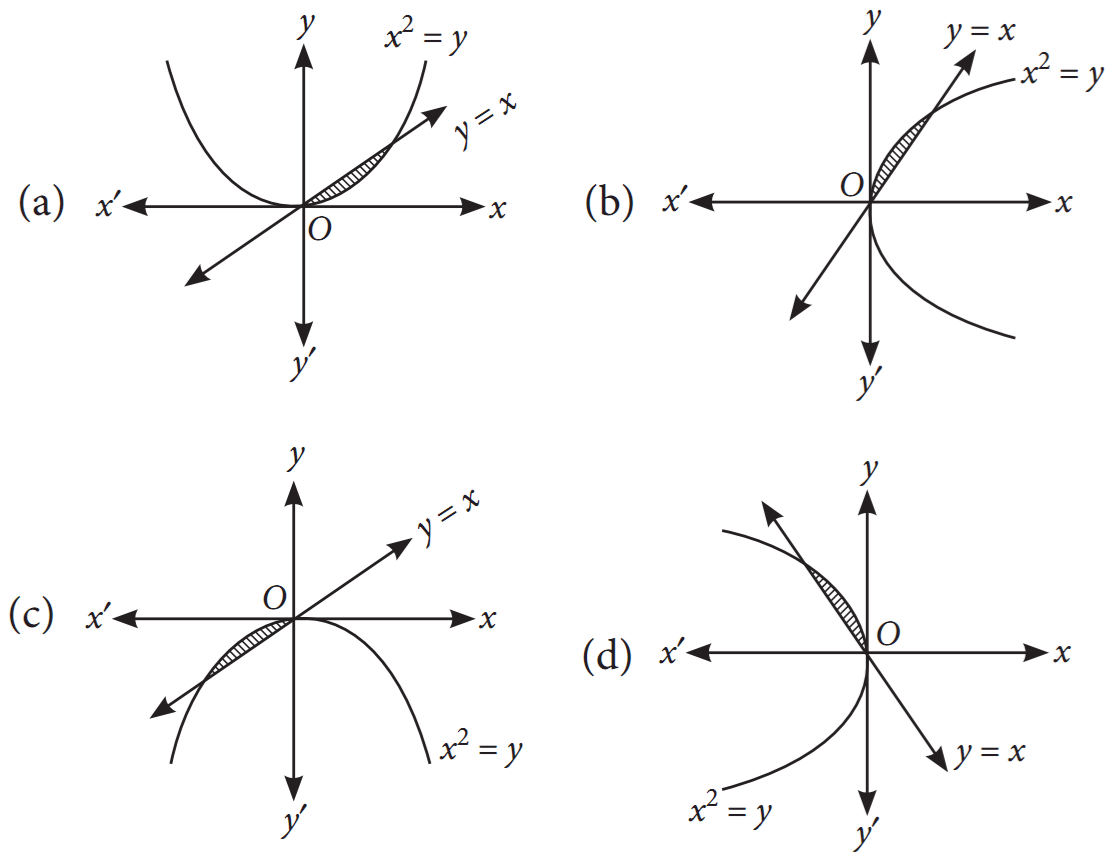
Consider the following equations of curves $x^2= y$ and $y = x.$
On the basis of above information, answer the following questions.
  1. The point(s) of intersection of both the curves is (are).
  1. (0, 0)(2, 2)
  2. (0, 0)(1, 1)
  3. (0, 0)(-1, -1)
  4. (0, 0)(-2, -2)
  1. Area bounded by the curves is represented by which of the following graph?
  1. The value of the integral $\int\limits_{1}^{0}\text{x}\ \text{dx}$ is.
  1. $\frac{1}{4}$
  2. $\frac{1}{3}$
  3. $\frac{1}{2}$
  4. $1$
  1. The value of the integral $\int\limits_{0}^{1}\text{x}^2\ \text{dx}$ is.
  1. $\frac{1}{4}$
  2. $\frac{1}{3}$
  3. $\frac{1}{2}$
  4. $1$
  1. The value of area bounded by the curves $x^2= y$ and $x = y$ is.
  1. $\frac{1}{6}\text{ sq}.\text{unit}$
  2. $\frac{1}{3}\text{ sq}.\text{unit}$
  3. $\frac{1}{2}\text{ sq}.\text{unit}$
  4. ${1}\text{ sq}.\text{unit}$
Dfferentiation of $\cos (\sqrt{x})$ w.r.t. $x$ is ________ .
Fill in the blanks: If $\text{f(x)}=\begin{vmatrix}(1+\text{x})^{17}&(1+\text{x})^{19}&(1+\text{x})^{23}\\(1+\text{x})^{23}&(1+\text{x})^{29}&(1+\text{x})^{34}\\(1+\text{x})^{41}&(1+\text{x})^{43}&(1+\text{x})^{47}\end{vmatrix}=\text{A}+\text{Bx}+\text{Cx}^2+\ \dots,$ then A = ________.