MCQ
$Be$ and $Al$ exhibit many properties which are similar, but the two elements differ in :
  • A
    Exhibiting amphoteric nature in their oxides
  • Forming polymeric hydrides
  • C
    Exhibiting maximum covalency in compounds
  • D
    Forming covalent halides

Answer

Correct option: B.
Forming polymeric hydrides
b

Need a full question paper?

Generate a complete, print-ready paper with questions like this in minutes — across 16+ boards, with answer keys.

Start Generating Free

Similar questions

Solution of $0.01$ $M$ $MgCl_2$ will form precipitate of $Mg(OH)_2$ at limiting $pH$ of Given : $K_{sp}$ of $Mg(OH)_2$ is $1 × 10^{-12}$
If $\ce{PCl_5}$​ is heated in two seperate vessels of volume $5$ lit and $10$ lit respectively at $27^\circ C$ The extent of dissociation of $\ce{PCl_5}$ will be :
All bonds in benzene are equal due to
The expression for solubility product of mercurous iodide $(Hg_2I_2)$ is
A $100\, ml$ solution of $0.1 \,N$ $HCl$ was titrated with $0.2\, N$ $NaOH$ solution. The titration was discontinued after adding $30\, ml $ of $NaOH$ solution. The remaining titration was completed by adding $0.25\, N$ $KOH$ solution. The volume of $KOH$ required for completing the titration is ............ $\mathrm{ml}$
Which of the following salts on dissolution in water gives $pH$ less than $7$ at $298\, K $?
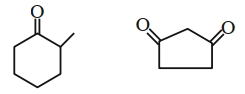
Total number of compounds with Chiral carbon atoms from following is___________.   $IMAGE$

$ \mathrm{CH}_3-\mathrm{CH}_2-\mathrm{CH}\left(\mathrm{NO}_2\right)-\mathrm{COOH} $

$ \mathrm{CH}_3-\mathrm{CH}_2-\mathrm{CHBr}-\mathrm{CH}_2-\mathrm{CH}_3 $

$ \mathrm{CH}_3-\mathrm{CH}(\mathrm{I})-\mathrm{CH}_2-\mathrm{NO}_2 $

$ \mathrm{CH}_3-\mathrm{CH}_2-\mathrm{CH}(\mathrm{OH})-\mathrm{CH}_2 \mathrm{OH} $

$ \mathrm{CH}_3-\mathrm{CH}-\mathrm{CH}(\mathrm{I})-\mathrm{C}_2 \mathrm{H}_5 $
Which of the following is only acidic in nature
Identify disproportionation reaction :
Given below are two statement: one is labelled as Assertion $A$ and the other is labelled as Reason $R$

Assertion $A:$ $5 f$ electrons can participate in bonding to a far greater extent than $4 f$ electrons

Reason $R:$ $5 f$ orbitals are not as buried as $4 f$ orbitals

In the light of the above statements, choose the correct answer from the options given below