MCQ
Beats are the result of
  • A
    Diffraction
  • B
    Destructive interference
  • C
    Constructive and destructive interference
  • Superposition of two waves of nearly equal frequency

Answer

Correct option: D.
Superposition of two waves of nearly equal frequency
d
(d) Beats is the superposition of two waves of nearly equal frequencies. When the two tones are close in pitch but not identical, the difference in frequency generates the beating The volume varies like in a tremolo as the sounds alternately interfere constructively and destructively.

Need a full question paper?

Generate a complete, print-ready paper with questions like this in minutes — across 16+ boards, with answer keys.
Start Generating Free

Similar questions

Photoelectric effect was successfully explained first by
If energy $(E)$, velocity $(v)$and force $(F)$ be taken as fundamental quantity, then what are the dimensions of mass
A barometer tube reads $75 \,cm$ of $Hg$. If tube is gradually inclined at an angle of $30^{\circ}$ with horizontal, keeping the open end in the mercury container, then find the length of mercury column in the barometer tube ......... $cm$
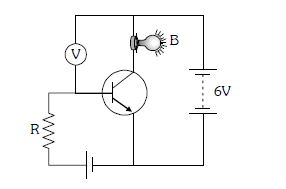
In the given circuit, a voltmeter $'V'$ is connected across a bulb $'B'$ . If the resistor $'R'$ is increased in value ?
A thin rod of length$f/3$ lies along the axis of a concave mirror of focal length $f.$ One end of its magnified image touches an end of the rod. The length of the image is
An unpolarised beam of intensity $2 a^{2}$ passes through a thin polaroid. Assuming zero absorption in the polaroid, the intensity of emergent plane polarised light is
A block of mass $10\, kg$ is placed on an inclined plane. When the angle of inclination is $30°$, the block just begins to slide down the plane. The force of static friction is ....... $kg\, wt$
Two mutually perpendicular simple harmonic vibrations have same amplitude, frequency and phase. When they superimpose, the resultant form of vibration will be
Assertion : The resistivity of a semi-conductor increases with temperature.
Reason : The atoms of semi-conductor vibrate with larger amplitude at higher temperatures thereby increasing its resistivity
${T}_{0}$ is the time period of a simple pendulum at a place. If the length of the pendulum is reduced to $\frac{1}{16}$ times of its initial value, the modified time