Question
Before using the tangent galvanometer, its coil is set in

Answer

(a) The tangent magnetometer, works on the tangent law, which in mathematical form states,

$F=H \tan \theta$

where,

$F$, and $H$ are two uniform magnetic fields. Of the two uniform magnetic fields, one is the horizontal component of the earth's magnetic field, the other field is produced by a bar magnet The horizontal component of the earth's magnetic field is along the magnetic meridian i.e. the north south direction. So we first mark the magnetic meridian at the place where we are to do the experiment. We then place the magnetometer box such that the magnetic needle is also $g$ $N-S$ direction. The magnetometer is used in two positions $\tan A$ and $\tan B$

In the tan $A$ position the magnetometer arm is in the east west direction. And the needles points in the $N-S$ direction. The bar magnet is placed on the magnetometer arms with its axis along the $E-W$ direction.

In the tan $B$ position of the magnetometer, the arms are along $N-S$ direction. The bar magnet is placed on the arms of the instrument with its axis along $E-W$ direction.

Need a full question paper?

Generate a complete, print-ready paper with questions like this in minutes — across 16+ boards, with answer keys.
Start Generating Free

Similar questions

A thin rod of length $L$ is bent to form a semicircle. The mass of rod is $M$. What will be the gravitational potential at the centre of the circle?
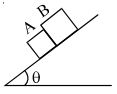
The two blocks $A$ and $B$ of equal mass are initially in contact when released from rest on the inclined plane. The coefficients of friction between the inclined plane $A$ and $B$ are $\mu_1$ and $\mu_2$ respectively.
A uniform metal chain is placed on a rough table such that one end of chain hangs down over the edge of the table. When one-third of its length hangs over the edge, the chain starts sliding. Then, the coefficient of static friction is
The potential energy between two atoms in a molecule is given by $U(x) = \frac{a}{{{x^{12}}}} - \frac{b}{{{x^6}}}$; where $a$ and $b$ are positive constants and $x$  is the distance between the atoms. The atom is in stable equilibrium when
The potential energy of a particle $\left(U_x\right)$ executing $S.H.M$. is given by
Assertion : No interference pattern is detected when two coherent sources are infinitely close to each other.

Reason : The fringe width is inversely proportional to the distance between the two slits.
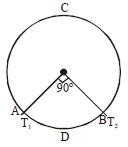
For the figure shown, when arc $ACD$ and $ADB$ are made of same material, the heat carried between $A$ and $B$ is $H$ . If $ADB$ is replaced with another material, the heat carried becomes $2H$ . If the temperatures at $A$ and $B$ are fixed at $T_1$ and $T_2$ , what is the ratio of the new conductivity to the old one of $ADB$
How many aldol products (excluding stereoisomers) are obtained in given reaction-

$CH_3-CH_2-CHO \, + $ (image) $\xrightarrow[{0 - 5{}^ \circ C}]{{O\mathop H\limits^ \ominus  }} \, ?$

The angle between vectors $\vec a$ and $\vec b$ is $\frac{\pi }{6}$. The angle between vectors $ - 3\vec a$ and $ 2\vec b$ is
Refractive index of glass is $\frac{3}{2}$ and refractive index of water is $\frac{4}{3}$. If the speed of light in glass is $2.00 \times {10^8} m/s,$ the speed in water will be