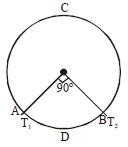
For the figure shown, when arc $ACD$ and $ADB$ are made of same material, the heat carried between $A$ and $B$ is $H$ . If $ADB$ is replaced with another material, the heat carried becomes $2H$ . If the temperatures at $A$ and $B$ are fixed at $T_1$ and $T_2$ , what is the ratio of the new conductivity to the old one of $ADB$
Medium
Download our app for free and get started
$\left(\frac{\mathrm{KA}(\Delta \mathrm{T})}{3 \ell}+\frac{(\mathrm{KA}) \Delta \mathrm{T}}{\ell}\right) \times 2$
$=\left(\frac{(\mathrm{KA}) \Delta \mathrm{T}}{3 \ell}+\frac{\left(\mathrm{K}^{\prime}\right) \mathrm{A} \Delta \mathrm{T}}{\ell}\right)$
$\frac{4 \mathrm{K}}{3} \times 2=\frac{\mathrm{K}}{3}+\mathrm{K}^{\prime}$
$K^{\prime}=\frac{7 K}{3}$

Download our appand get started for free
Experience the future of education. Simply download our apps or reach out to us for more information. Let's shape the future of learning together!No signup needed.*
Similar Questions
- 1If temperature of a black body increases from ${7^o}C$ to ${287^o}C$, then the rate of energy radiation increases byView Solution
- 2View SolutionWhen red glass is heated in dark room it will seem
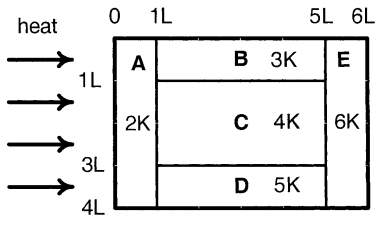
- 3A composite block is made of slabs $A, B, C, D$ and $E$ of different thermal conductivities (given in terms of a constant $K$ ) and sizes (given in terms of length, $L$ ) as shown in the figure. All slabs are of same width. Heat $'Q'$ flows only from left to right through the blocks. Then in steady state $Image$View Solution
$(A)$ heat flow through $A$ and $E$ slabs are same.
$(B)$ heat flow through slab $E$ is maximum.
$(C)$ temperature difference across slab $E$ is smallest.
$(D)$ heat flow through $C =$ heat flow through $B +$ heat flow through $D$.
- 4A particular star (assuming it as a black body) has a surface temperature of about $5 \times {10^4}K.$The wavelength in nanometers at which its radiation becomes maximum is $(b = 0.0029 mK)$View Solution
- 5A human body has a surface area of approximately $1 \mathrm{~m}^2$. The normal body temperature is $10 \mathrm{~K}$ above the surrounding room temperature $T_0$. Take the room temperature to be $T_0=300 \mathrm{~K}$. For $T_0=300 \mathrm{~K}$, and the value of $\sigma \mathrm{T}_0^4=460 \mathrm{Wm}^{-2}$ (where $\sigma$ is the Stefan-Boltzmann constant). Which of the following option is/are correct?View Solution
[$A$] The amount of energy radiated by the body in $1$ second is close to $60$ Joules.
[$B$] If the surrounding temperature reduces by a small amount $\Delta \mathrm{T}_0<<\mathrm{T}_0$, then to maintain the same body temperature the same (living) human being needs to radiate $\Delta \mathrm{W}=4 \sigma \mathrm{T}_0^3 \Delta \mathrm{T}_0$ more energy per unit time.
[$C$] Reducing the exposed surface area of the body ($e.g$ by curling up) allows humans to maintain the same body temperature while reducing the energy lost by radiation.
[$D$] If the body temperature rises significantly then the peak in the spectrum of electromagnetic radiation emitted by the body would shift to longer wavelengths.
- 6The radiation energy density per unit wavelength at a temperature $T$ has a maximum at a wavelength $\lambda _0$. At temperature $2T$, it will have a maximum at a wavelengthView Solution
- 7If the temperature of a hot body is increased by $50\%$ then the increase in the quantity of emitted heat radiation will be ..... $\%$View Solution
- 8A body cools in $7$ minutes from ${60^o}C$ to ${40^o}C$ What time (in minutes) does it take to cool from ${40^o}C$ to ${28^o}C$ if the surrounding temperature is ${10^o}C$? Assume Newton’s Law of cooling holdsView Solution
- 9Rate of cooling at $600K$ , if surrounding temperature is $300K$ is $R$ . The rate of cooling at $900K$ isView Solution
- 10View SolutionWhich of the following is the example of ideal black body