MCQ
$\begin{array}{*{20}{c}}
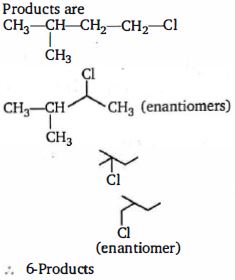
  {C{H_3} - CH - C{H_2} - C{H_3}\xrightarrow[{hv}]{{C{l_2}}}(x)} \\ 
  {|\,\,\,\,\,\,\,\,\,\,\,\,\,\,\,\,\,\,\,\,\,\,\,\,\,\,\,\,\,\,\,\,\,\,\,\,\,\,\,\,\,} \\ 
  {C{H_3}\,\,\,\,\,\,\,\,\,\,\,\,\,\,\,\,\,\,\,\,\,\,\,\,\,\,\,\,\,\,\,\,\,\,\,\,} 
\end{array} =$ Number of monochloro product including stereoisomers.
  • A
    $4$
  • B
    $5$
  • $6$
  • D
    $7$

Answer

Correct option: C.
$6$
c

Need a full question paper?

Generate a complete, print-ready paper with questions like this in minutes — across 16+ boards, with answer keys.

Start Generating Free

Similar questions

The difference between the radii of $3^{\text {rd }}$ and $4^{\text {th }}$ orbits of $Li ^{2+}$ is $\Delta R _{1}$. The difference between the radii of $3^{\text {rd }}$ and $4^{\text {th }}$ orbits of $He ^{+}$ is $\Delta R _{2}$. Ratio $\Delta R _{1}: \Delta R _{2}$ is :
The electron probability distribution around a group of nuclei in a molecule is given by :
How many electrons can be fit into the orbitals that comprise the ${3^{rd}}$ quantum shell $n = 3$
An average person needs about $10000\, \mathrm{~kJ}$ energy per day. The amount of glucose (molar mass $=180.0\, \mathrm{~g} \,\mathrm{~mol}^{-1}$ ) needed to meet this energy requirement is $.....\,\mathrm{g}$.

(Nearest integer)

(Use : $\Delta_{\mathrm{c}} \mathrm{H}($ glucose $)=-2700\, \mathrm{~kJ}\, \mathrm{~mol}^{-1}$ )

What is the separation energy (in $eV$ ) for $Be^{3+}$ in the first excited state in ...............  $\mathrm{eV}$ ?
Minimum de-Broglie wavelength is associated with
Match the column
Column $-I$ Column $-II$
$(A)$   Ionisation potential $(P)$   $O < F < N$
$(B)$   Electronegativity $(Q)$   $N < O < F$
$(C)$  $Z_{eff}$ $(R)$   $O < N < F$ 
$(D)$   Electron affinity $(S)$    $N < C< O$
For $CaC{O_3}(s)$ $\rightleftharpoons$ $CaO(s) + C{O_2}(g)$ at ${977\,^o}C$; $\Delta H = 176$ $kJ \,\,mol$, then $\Delta E$ is ............. $\mathrm{kJ}$
Addition of which chemical will decrease the hydrogen ion concentration of an acetic acid solution
Experiment shows that ${H_2}O$ has a dipole moment while $C{O_2}$ has not. Point out the structures which best illustrate these facts