MCQ
$\begin{array}{*{20}{c}}
  {HN = C - linkage\,?} \\ 
  {\,\,\,\,\,\,\,\,\,\,\,\,\,\,\,\,\,\,\,\,|\,\,\,\,\,\,\,\,\,\,\,\,\,\,\,\,\,\,\,\,\,\,\,\,\,\,\,\,\,\,\,} \\ 
  {\,\,\,\,\,\,\,\,\,\,\,\,\,\,\,\,\,\,\,N{H_2}\,\,\,\,\,\,\,\,\,\,\,\,\,\,\,\,\,\,\,\,\,\,\,\,\,} 
\end{array}$
  • A
    Tyrosine
  • B
    Tryptophan
  • Arginine
  • D
    Asparagine

Answer

Correct option: C.
Arginine
c

Need a full question paper?

Generate a complete, print-ready paper with questions like this in minutes — across 16+ boards, with answer keys.

Start Generating Free

Similar questions

Amongst the following, $HBr$ reacts fastest with
Aniline is soluble in which of the following organic reagents?
All the energy released from the reaction $X \rightarrow Y \cdot \Delta_{ T } G ^0=-193 \ kJ \ mol ^{-1}$ is used for oxidizing $M ^{+}$as $M ^{+} \rightarrow M ^{3+}+2 e ^{-}, E ^0=-0.25 \ V$.

Under standard conditions, the number of moles of $M ^{+}$oxidized when one mole of $X$ is converted to $Y$ is $\left[ F =96500 \ C \ mol ^{-1}\right]$

How many ions are produced from $[Co{\left( {N{H_3}} \right)_6}]C{l_3}$ in solution
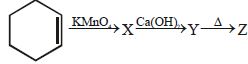
$Z$ is
For the reaction $A + B \to $products, doubling the concentration of $A$ the rate of the reaction is doubled, but on doubling the concentration of $B$ rate remains unaltered. The over all order of the reaction is
Which of the following alkali metal ions has lowest ionic mobility in aqueous solutions
Relationship between products $(Q)$ and $(S)$ is

$\mathrm{CH}_{3}-\mathrm{CH}=\mathrm{CH}_{2}$ $\xrightarrow[{{\text{H}}_{2}}{{\text{O}}_{2}},\bar{O}\text{H}]{\text{B}{{\text{H}}_{3}},\text{THF}}(P)$ $\xrightarrow[\text{C}{{\text{H}}_{2}}\text{C}{{\text{l}}_{2}}]{\text{ Pyridinium Chloro Chromate }(\text{PCC})}$ $(Q)$

$\mathrm{CH}_{3}-\mathrm{CH}=\mathrm{CH}_{2}$ $\xrightarrow[NaB{{H}_{4}}\,,\,H{{O}^{\Theta }}]{Hg\,{{(OAc)}_{2}}\,,\,{{H}_{2}}O}(R)$ $\xrightarrow[\text{C}{{\text{H}}_{2}}\text{C}{{\text{l}}_{2}}]{\text{ Pyridinium Chloro Chromate }(\text{PCC})}$ $(S)$

Which base is strong enough to convert $(CH_3)_3COH$ into $(CH_3)_3CONa$ in a reaction that goes to completion ?
The van't Hoff factor for a solute which does not dissociate or associate in solution is: