MCQ
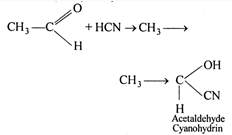
$\begin{matrix}
   \begin{matrix}
   \,\,\,OH  \\
   |  \\
\end{matrix}  \\
   C{{H}_{3}}-C-CN  \\
   \,|  \\
   \,\,\,H  \\
\end{matrix}$ is
  • Acetaldehyde cyanohydrin
  • B
    Acetone cyanohydrin
  • C
    Cyanoethanol
  • D
    Ethanol nitrile

Answer

Correct option: A.
Acetaldehyde cyanohydrin
a

Need a full question paper?

Generate a complete, print-ready paper with questions like this in minutes — across 16+ boards, with answer keys.

Start Generating Free

Similar questions

Which one of the following undergoes reaction with $50\%$ sodium hydroxide solution to give the corresponding alcohol and acid
Inertness of ${N_2}$ gas is due to
All the compounds listed in Column $I$ react with water. Match the result of the respective reactions with the appropriate options listed in Column $II$.
Column $I$ Column $II$
$(A)$ $\left(\mathrm{CH}_3\right)_2 \mathrm{SiCl}_2$ $(p)$ Hydrogen halide formation
$(B)$ $\mathrm{XeF}_4$ $(q)$ Redox reaction
$(C)$ $\mathrm{Cl}_2$ $(r)$ Reacts with glass
$(D)$ $\mathrm{VCl}_5$ $(s)$ Polymerization
  $(t)$ $\mathrm{O}_2$ formation
Which one of the following is not an intermediate in the generally accepted  mechanism for the reaction shown below ?

$\begin{matrix}
   O\,\,\,\,\,\,\,\,\,\,\,\,\,\,\,\,\,\,\,\,\,\,\,\,\,\,\,\,\,\,\,\,\,\,\,\,\,\,  \\
   ||\,\,\,\,\,\,\,\,\,\,\,\,\,\,\,\,\,\,\,\,\,\,\,\,\,\,\,\,\,\,\,\,\,\,\,\,\,\,\,\,  \\
   C{{F}_{3}}\,C\,OH+C{{H}_{3}}\,CH\,C{{H}_{3}}  \\
   \,\,\,\,\,\,\,\,\,\,\,\,\,\,\,\,\,\,\,\,\,\,\,\,\,\,\,\,\,\,|  \\
   \,\,\,\,\,\,\,\,\,\,\,\,\,\,\,\,\,\,\,\,\,\,\,\,\,\,\,\,\,\,\,\,\,OH  \\
\end{matrix}\xrightarrow{{{H}_{2}}S{{O}_{4}}}\begin{matrix}
   O\,\,\,\,\,\,\,\,\,\,\,\,\,\,\,\,\,\,\,\,\,\,\,\,\,\,\,\,\,\,\,  \\
   ||\,\,\,\,\,\,\,\,\,\,\,\,\,\,\,\,\,\,\,\,\,\,\,\,\,\,\,\,\,\,\,\,\,  \\
   C{{F}_{3}}\,C\,OCH\,C{{H}_{3}}+{{H}_{2}}O  \\
   |\,\,\,\,\,\,\,\,\,\,\,\, \,\,\,\, \\
   C{{H}_{3}}\,\,\,\,\,\,\,\,\,\,\,  \\
\end{matrix}$
The metal ion which does not form coloured compound is
Oxidation state of $"S"$ in Peroxodisulphuric acid and Sodium tetrathionate are
Which of the following is wrong statement
$\begin{matrix}
   O\,\,\,\,\,\,\,\,\,\,\,\,\,\,\,\,\,\,\,\,\,\,\,\,\,\,\,\,\,\,\,\,\,\,\,\,\,\,\,\,\,\,\,\,\,\,\,\,\,\,\,\,\,\,\,\,\,\,\,\,\,\,\,\,\,\,\,\,\,\,\,\,\,\,\,\,\,\,\,\,\,\,\,\,\,\,  \\
   ||\,\,\,\,\,\,\,\,\,\,\,\,\,\,\,\,\,\,\,\,\,\,\,\,\,\,\,\,\,\,\,\,\,\,\,\,\,\,\,\,\,\,\,\,\,\,\,\,\,\,\,\,\,\,\,\,\,\,\,\,\,\,\,\,\,\,\,\,\,\,\,\,\,\,\,\,\,\,\,\,\,\,\,\,\,\,\,  \\
   C{{H}_{3}}-C-O-C{{H}_{2}}-C{{H}_{3}}+H-{{\bullet }^{-}}\to (\bullet ={{O}^{18}})  \\
\end{matrix}$ One of the product of the reaction is
Which of the following will not give Hoffmann bromamide reaction ?
Which $d-$ block element is expected to have highest enthalpy of atomisation, among the following ?