Question
$\begin{matrix}\text{A }\rightleftharpoons\text{ B }&\text{K}_1=1&\text{B }\rightleftharpoons\text{ C}&\text{K}_2=2\\\text{C }\rightleftharpoons\text{ D}&\text{K}_3=3&\text{D }\rightleftharpoons\text{ E}&\text{K}_4=4\end{matrix}$
What is value of K for $\text{A }\rightleftharpoons\text{ E}?$
Answer

$\text{A }\rightleftharpoons\text{ E K}=\frac{[\text{E}]}{[\text{A}]}$

$\text{K}_1=\frac{[\text{B}]}{[\text{A}]},\text{K}_2=\frac{[\text{C}]}{[\text{B}]},$

$\text{K}_3=\frac{[\text{D}]}{[\text{C}]}\text{ and }\text{K}_4=\frac{[\text{E}]}{[\text{D}]}$

$\because\text{K}=\text{K}_1\times\text{K}_2\times\text{K}_3\times\text{K}_4=\frac{[\text{E}]}{[\text{A}]}$

$=1\times2\times3\times4=24$

Need a full question paper?

Generate a complete, print-ready paper with questions like this in minutes — across 16+ boards, with answer keys.

Start Generating Free

Similar questions

Indicate the type of bonds present in NH4NO3 and state the mode of hybridisation of two N-atoms in it.
Consider the reactions:

  1. H3PO2(aq) + 4AgNO3(aq) + 2H2O(l) → H3PO4(aq) + 4Ag(s) + 4HNO3(aq)
  2. H3PO2(aq) + 2CuSO4(aq) + 2 H2O(l) → H3PO4(aq) + 2Cu(s) + H2SO4(aq)
  3. C6H5CHO(l) + 2[Ag(NH3)2]+(aq) + 3OH-(aq) → C6H5COO-(aq) + 2Ag(s) + 4NH3(aq) + 2H2O(l)
  4. C6H5CHO(l) + 2Cu2+(aq) + 5OH-(aq) → No change observed.

What inference do you draw about the behaviour of Ag+ and Cu2+ from these reactions?

State the law of thermodynamics that was first formulated by Nernst in 1906. What is the utility of this law? The equilibrium constant for the reaction $\text{A}\rightleftharpoons\text{B}$ is 1.8 × 10-7 at 298K. Calculate the value of $\Delta\text{G}^\circ$ for the reaction (R = 8.314JK-1mol-1). Predict the feasibility of the reaction under standard states.
What is the number of photons of light with a wavelength of 4000 pm that provide 1J of energy?
Calculate the entropy change in surroundings when 1.00 mol of H2O(l) is formed under standard conditions. $ \Delta_{\text{f}}\text{H}^\ominus=-286\text{kJ} \ \text{mol}^{-1}.$
2 Arrange the following set of compounds in order of their decreasing relative reactivity with an electrophile, E+.
Chlorobenzene, 2,4-dinitrochlorobenzene, p-nitrochlorobenzene.
  1. The mass of an electron is 9.1 × 10⁻²⁸g. If its K.E. is 3.0 × 10⁻²⁵J, calculate its wave-length in Angstrom. [h = 6.6 × 10⁻³⁴Js]
  2. What is photoelectric effect?
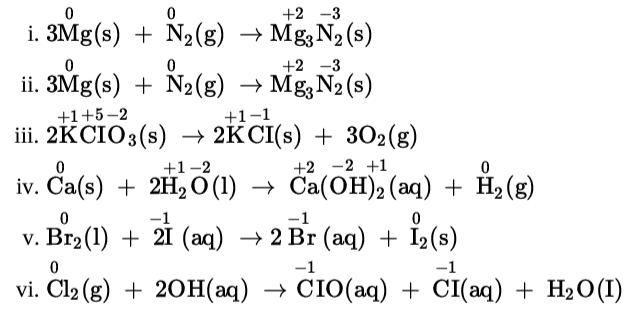
Identify the type of redox reaction taking place in the following.
Image
Explain the important aspect of resonance with reference to the $CO _3^{2-}$ ion.
Calculate the mass of ferric oxide that will be obtained by complete oxidation of 2g of Fe. [Atomic weights of Fe = 56u, 0 = 16u]