Question 13 Marks
Equilibrium constant, Kc for the reaction
$\text{N}_2\text{ (g) + 3H}_2\text{ (g)}\rightleftharpoons2\text{NH}_3\text{ (g) at 500k is 0.061}$
At a particular time, the analysis shows that composition of the reaction mixture is 3.0mol L–1 N2, 2.0mol L–1 H2 and 0.5mol L–1 NH3. Is the reaction at equilibrium? If not in which direction does the reaction tend to proceed to reach equilibrium?
AnswerThe given reaction is: $\text{N}_2\text{ (g) + 3H}_2\text{ (g)}\rightleftharpoons2\text{NH}_3\text{ (g)}$
According to available data.
$\text{N}_2=[3.0];\text{H}_2=[2.0];\text{NH}_3=[0.50]$
$\text{Q}_{\text{c}}=\frac{[\text{NH}_3\text{(g)]}^2}{[\text{N}_2\text{(g)][H}_2\text{(g)}]^3}=\frac{[0.50]^2}{[3.0][2.0]^3}=\frac{0.25}{24}=0.0104.$
Since the value of Qc is less than that of kc (0.061), the reaction is not is a state of equilibrium. It will proceed in the forward direction till Qc becomes the same as kc.
View full question & answer→Question 23 Marks
Calculate the pH of the following solutions:
0.3g of NaOH dissolved in water to give 200mL of solution.
AnswerFor 0.3 g of NaOH dissolved in water to give 200 mL of solution:
$\text{NaOH}\rightarrow\text{Na}^+_\text{(aq)}+\text{OH}^-_\text{(aq)}$
$[\text{NaOH]}=0.3\times\frac{1000}{200}=0.5\text{M}$
$[\text{OH}^-_\text{aq}]=1.5\text{M}$
$\text{Then, [H}^+]=\frac{10^{-14}}{1.5}$
$=6.66\times10^{-13}$
$\text{pH}=-\log(6.66\times10^{-13})$
$=12.18$
View full question & answer→Question 33 Marks
The concentration of hydrogen ion in a sample of soft drink is 3.8 × 10⁻³M. what is its pH?
AnswerGiven,
$[\text{H}^+]=3.8\times10^{-3}\text{M}$
$=-\log[\text{H}^+]$
$=-\log(3.8\times10^{-3})$
$=-\log3.8-\log10^{-3}$
$=-\log3.8+3$
$=-0.58+3$
$=2.42$
View full question & answer→Question 43 Marks
Calculate the pH of the following solutions:
1mL of 13.6M HCl is diluted with water to give 1litre of solution.
AnswerFor 1mL of 13.6M HCl diluted with water to give 1L of solution:
13.6 × 1mL = M2 × 1000mL
(Before dilution) (After dilution)
13.6 × 10–3 = M2 × 1L
M2 = 1.36 × 10⁻²
[H+] = 1.36 × 10⁻²
pH = – log (1.36 × 10⁻²)
= (– 0.1335 + 2)
= 1.866 ∼ 1.87
View full question & answer→Question 53 Marks
The solubility of Sr(OH)2 at 298K is 19.23g/L of solution. Calculate the concentrations of strontium and hydroxyl ions and the pH of the solution.
Answer$\text{Molar mass of Sr(OH})_2=87.6+34$
$=121.6\text{g mol}^{-1}$
$\text{Solubility of Sr(OH)}_2\text{ in moles L}^{-1}$
$=\frac{19.23\text{g L}^{-1}}{121.6\text{g mol}^{-1}}=0.1581\text{M}$
Assuming complete dissociation,
$\text{Sr(OH)}_2\rightarrow\text{Sr}^{2+}+2\text{OH}^-$
$\therefore\ [\text{Sr}^{2+}]=0.1581\text{M},$
$[\text{OH}^-]=2\times0.1581=0.3162\text{M}$
$\text{pOH}=-\log(0.3162)=0.5,$
$\therefore\ \text{pH}=14-0.5=13.5$
View full question & answer→Question 63 Marks
A sample of HI(g) is placed in flask at a pressure of 0.2 atm. At equilibrium the
partial pressure of HI(g) is 0.04 atm.
What is Kp for the given equilibrium?
$\text{2HI (g)}\rightleftharpoons\text{H}_2\text{ (g) + I}_2\text{ (g)}$
Answer$\begin{matrix}&2\text{HI}_{\text{(g)}}&\rightleftharpoons&\text{H}_{2\text{(g)}}&+&\text{I}_{2\text{(g)}}\\\text{Initial pressure}&0.2\text{ atm}&&0&&0\\\text{Pressure at eqm.}&0.04\text{ atm}&&\frac{0.16}{2}&&\frac{0.16}{2}\\&&&=0.08\text{ atm}&&=0.08\text{ atm}\end{matrix}$
According to law of chemical equilibrium,
$\text{K}_{\text{p}}=\frac{\text{p}_{\text{H}_2}}{\text{p}^2_\text{HI}}=\frac{0.08\times0.08}{(0.04)^2}=\frac{0.0064}{0.0016}=4$
$\therefore\ \text{K}_{\text{p}}=4$
View full question & answer→Question 73 Marks
Calculate the pH of the resultant mixtures:
10mL of 0.2M Ca(OH)2 + 25mL of 0.1M HCl
Answer$\text{Moles of H}_3\text{O}^+=\frac{25\times0.1}{1000}=.0025\text{mol}$
$\text{Moles of OH}^-=\frac{10\times0.2\times2}{1000}=.0040\text{mol}$
Thus, excess of $\text{OH}^-=.0015\text{mol}$
$[\text{OH}^-]=\frac{.0015}{35\times10^{-3}}\text{mol/L}=.0428$
$\text{pOH}=-\log[\text{OH}]$
$=1.36$
$\text{pH}=14-1.36$
$=12.63$ (not matched)
View full question & answer→Question 83 Marks
A sample of pure PCl5 was introduced into an evacuated vessel at 473K. After equilibrium was attained, concentration of PCl5 was found to be 0.5 × 10⁻¹mol L–1. If value of Kc is 8.3 × 10⁻³, what are the concentrations of PCl3 and Cl2 at equilibrium?
$\text{PCl}_5\text{ (g)}\rightleftharpoons\text{PCl}_3\text{ (g) + Cl} _2\text{ (g)}$
AnswerLet the concentrations of both PCl3 and Cl2 at equilibrium be x molL–1. The given reaction is: | | $\text{PCl}_{5\text{(g)}}$ | $\rightleftharpoons$ | $\text{PCl}_{3\text{(g)}}$ | $+$ | $\text{Cl}_{2\text{(g)}}$ |
| At equilibrium | $0.5\times10^{-1}\text{mol L}^{-1}$ | | $\text{xmol L}^{-1}$ | | $\text{xmol L}^{-1}$ |
| It is given that the value of equilibrium constant, $\text{K}_{\text{c}}\text{ is }8.3\times10^{-3}.$ |
Now we can write the expression for equilibrium as:
$\frac{[\text{PCl}_2][\text{Cl}_2]}{[\text{PCl}_2]}=\text{ K}_{\text{c}}$
$\Rightarrow\frac{\text{x}\times\text{x}}{0.5\times10^{-1}}=8.3\times10^{-3}$ $\Rightarrow\text{x}^2=4.15\times10^{-4}$ $\Rightarrow\text{x}=2.04\times10^{-2}$
$=0.0204$ $=0.02$ (approximately)
Therefore, at equilibrium, $[\text{PCl}_3]=[\text{Cl}_2]=0.02\text{mol L}^{-1}.$ View full question & answer→Question 93 Marks
A 0.02M solution of pyridinium hydrochloride has pH = 3.44. Calculate the ionization constant of pyridine.
AnswerpH = 3.44
We know that,
$\text{pH}=-\log\text{[H}^+]$
$\therefore\ [\text{H}^+]=3.63\times10^{-6}$
Then,
$\text{K}_\text{h}=\frac{(3.63\times10^{-4})^2}{0.02}$ $(\because\ \text{concentration = 0.02M})$
$\Rightarrow\text{K}_\text{h}=6.6\times10^{-6}$
Now,
$\text{K}_\text{h}=\frac{\text{K}_\text{w}}{\text{K}_\text{a}}$
$\Rightarrow\text{K}_\text{a}=\frac{\text{K}_\text{w}}{\text{K}_\text{h}}=\frac{10^{-14}}{6.6\times10^{-6}}$
$=1.51\times10^{-9}$
View full question & answer→Question 103 Marks
The degree of ionization of a 0.1M bromoacetic acid solution is 0.132. Calculate the pH of the solution and the pKa of bromoacetic acid.
AnswerDegree of ionization, α = 0.132
Concentration, c = 0.1M
Thus, the concentration of H3O+ = c.α
= 0.1 × 0.132
= 0.0132
$\text{pH}=-\log[\text{H}^+]$
$=-\log(0.0132)$
$=1.879:1.88$
Now,
$\text{K}_\text{a}=\text{C}\alpha^2$
$=0.1\times(0.132)^2$
$\text{K}_\text{a}=.0017$
$\text{pK}_\text{a}=2.75$
View full question & answer→Question 113 Marks
The pH of a sample of vinegar is 3.76. Calculate the concentration of hydrogen ion in it.
AnswerGiven,
pH = 3.76
It is known that,
$\text{pH}=-\log[\text{H}^+]$
$\Rightarrow\log[\text{H}^+]=-\text{pH}$
$\Rightarrow[\text{H}^+]=\text{antilog}(-\text{pH})$
$=\text{antilog}(-3.76)$
$=1.74\times10^{-4}\text{M}$
Hence, the concentration of hydrogen ion in the given sample of vinegar is 1.74 × 10⁻⁴M.
View full question & answer→Question 123 Marks
The reaction, $\text{CO (g) + 3H}_2\text{ (g)}\rightleftharpoons\text{CH}_4\text{ (g) + }\text{H}_2\text{O (g)}$ is at equilibrium at 1300K in a 1L flask. It also contain 0.30mol of CO, 0.10molof H2 and 0.02mol of H2O and an unknown amount of CH4 in the flask. Determine the concentration of CH4 in the mixture. The equilibrium constant, Kc for the reaction at the given temperature is 3.90.
AnswerLet the concentration of methane at equilibrium be x.
| | $\text{CO}_\text{(g)}$ | $+$ | $\text{3H}_{2\text{(g)}}$ | $\leftrightarrow$ | $\text{CH}_{4\text{(g)}}$ | $+$ | $\text{H}_2\text{O}_\text{(g)}$ |
| At equilibrium | $\frac{0.3}{1}=0.3\text{M}$ | | $\frac{0.1}{1}=0.1\text{M}$ | | $\text{x}$ | | $\frac{0.02}{1}=0.02\text{M}$ |
It is given that $\text{K}_\text{c}=3.90.$
Therefore,
$\frac{[\text{CH}_{4\text{(g)}}][\text{H}_2\text{O}_\text{(g)}]}{[\text{CO}_\text{(g)}][\text{H}_{2\text{(g)}}]}=\text{K}_\text{c}$
$\Rightarrow\frac{\text{x}\times0.02}{0.3\times(0.1)^3}=3.90$
$\Rightarrow\text{x}=\frac{3.90\times0.3\times(0.1)^3}{0.02}$
$=\frac{0.00117}{0.02}$
$=0.0585\text{M}$
$=5.85\times10^{-2}\text{M}$
Hence, the concentration of CH4 at equilibrium is $5.85\times10^{-2}\text{M}$
View full question & answer→Question 133 Marks
Find out the value of Kc for each of the following equilibria from the value of Kp:
$2\text{CaCO}_3\text{ (S)}\rightleftharpoons\text{CaO(S) + CO}_2\text{ (g)};\text{ k}_{\text{p}}=167\text{ at }1073\text{K}$
AnswerThe relation between Kp and Kc is given as:
$\text{K}_\text{p}=\text{K}_{\text{c}}\text{(RT})^{\Delta\text{n}}$
Here,
$\Delta\text{n}=2-1=1$
$\text{R}=0.0831\text{ bar L mol}^{-1}\text{K}^{-1}$
$\text{T}=1073\text{K}$
$\text{K}_{\text{p}}=167$
Now,
$\text{K}_\text{p}=\text{K}_{\text{c}}\text{(RT})^{\Delta\text{n}}$
$\Rightarrow167=\text{K}_{\text{c}}(0.0831\times1073)^{\Delta\text{n}}$
$\Rightarrow\text{K}_{\text{c}}=\frac{167}{0.0831\times1073}$
$=1.87(\text{approximately})$
View full question & answer→Question 143 Marks
The value of Kc for the reaction $\text{3O}_2\text{ (g)}\rightleftharpoons2\text{O}_3\text{ (g)}$ is 2.0 ×10–50 at 25°C. If the equilibrium concentration of O2 in air at 25°C is 1.6 ×10⁻², what is the concentration of O3?
AnswerThe given reaction is:$3\text{O}_{2\text{(g)}}\leftrightarrow2\text{O}_{3\text{(g)}}$
Then, $\text{K}_\text{c}=\frac{[\text{O}_{3\text{(g)}}]^2}{[\text{O}_{2\text{(g)}}]^3}$
It is given that $\text{K}_\text{C}=2.0\times10^{-50}\text{ and }[\text{O}_{2\text{(g)}}]=1.6\times10^{-2}.$
Then, we have,
$2.0\times10^{-50}=\frac{[\text{O}_{3\text{(g)}}]^2}{[1.6\times10^{-2}]^3}$
$\Rightarrow[\text{O}_{3\text{(g)}}]^2=2.0\times10^{-50}\times(1.6\times10^{-2})^3$
$\Rightarrow[\text{O}_{3\text{(g)}}]^2=8.192\times10^{-56}$
$\Rightarrow[\text{O}_{3\text{(g)}}]=2.86\times10^{-28}\text{ M}$
Hence, the concentration of $\text{O}_3\text{ is }2.86\times10^{-28}\text{ M}.$
View full question & answer→Question 153 Marks
Find out the value of Kc for each of the following equilibria from the value of Kp:
$2\text{NOCl (g)}\rightleftharpoons2\text{NO (g) + Cl}_2\text{ (g)};\text{ k}_{\text{p}}=1.8\times10^{-2}\text{ at }500\text{K}$
AnswerThe relation between Kp and Kc is given as:
$\text{K}_\text{p}=\text{K}_{\text{c}}\text{(RT})^{\Delta\text{n}}$
Here,
$\Delta\text{n}=3-2=1$
$\text{R}=0.0831\text{ bar L mol}^{-1}\text{K}^{-1}$
$\text{T}=500\text{K}$
$\text{K}_{\text{p}}=1.8\times10^{-2}$
Now,
$\text{K}_\text{p}=\text{K}_{\text{c}}\text{(RT})^{\Delta\text{n}}$
$\Rightarrow1.8\times10^{-2}=\text{K}_{\text{c}}(0.0831\times500)^1$
$\Rightarrow\text{K}_{\text{c}}=\frac{1.8\times10^{-2}}{0.0831\times500}$
$=4.33\times10^{-4}(\text{approximately})$
View full question & answer→Question 163 Marks
If 0.561g of KOH is dissolved in water to give 200mL of solution at 298K. Calculate the concentrations of potassium, hydrogen and hydroxyl ions. What is its pH?
Answer$\text{Molar mass of KOH}=56.0\text{g mol}^{-1}$
$\therefore\ \text{No. of moles of KOH}$
$=\frac{0.561\text{g}}{56.0\text{g mol}^{-1}}=0.01\text{mol}$
$\text{and conc. of KOH}$
$=\frac{0.01}{0.2\text{L}}\text{mol}=0.05\text{mol/L}$
$\text{KOH}_\text{(aq)}\rightarrow\text{K}^+_\text{(aq)}+\text{OH}^-_\text{(aq)}$
$[\text{K}^+]=[\text{OH}^-]=0.05\text{M}$
$\text{and }[\text{H}^+]=\frac{\text{K}_\text{w}}{[\text{OH}^-]}=\frac{1.0\times10^{-14}}{0.05}=2.0\times10^{-13}$
$\therefore\ \text{pH}=-\log(2.0\times10^{-13})=12.70$
View full question & answer→Question 173 Marks
What is meant by the conjugate acid-base pair? Find the conjugate acid/base for the following species:
$\text{HNO}_2,\text{CN}^-,\text{HClO}_4,\text{F}^-,\text{OH}^-,\text{CO}_3^{2-}\text{and S}^{2-}$
AnswerA conjugate acid-base pair is a pair that differs only by one proton. The conjugate acid-base for the given species is mentioned in the table below.
| $\text{Species Conjugate acid-base}$ |
| $\text{HNO}_2$ | $\text{NO}_2^-\text{(base)}$ |
| $\text{CN}-$ | $\text{HCN}\text{(acid)}$ |
| $\text{HClO}_4$ | $\text{ClO}_4^-\text{(base)}$ |
| $\text{F}-$ | $\text{HF}\text{(acid)}$ |
| $\text{OH}-$ | $\text{H}_2\text{O}\text{(acid)}/\text{O}^{2-}\text{(base)}$ |
| $\text{CO}_3^{2-}$ | $\text{HCO}^-_3\text{(acid)}$ |
| $\text{S}^{2-}$ | $\text{HS}^-\text{(acid)}$ |
View full question & answer→Question 183 Marks
Match standard free energy of the reaction with the corresponding equilibrium constant. | Column I | Column II |
| i. | $\Delta\text{G}^\ominus>0$ | a. | $\text{K}>1$ |
| ii. | $\Delta\text{G}^\ominus<0$ | b. | $\text{K}=1$ |
| iii. | $\Delta\text{G}^\ominus=0$ | c. | $\text{K}=0$ |
| | | d. | $\text{K}<1$ |
Answer | Column I | Column II |
| i. | $\Delta\text{G}^\ominus>0$ | d. | $\text{K}<1$ |
| ii. | $\Delta\text{G}^\ominus<0$ | a. | $\text{K}>1$ |
| iii. | $\Delta\text{G}^\ominus=0$ | b. | $\text{K}=1$ |
View full question & answer→Question 193 Marks
Some processes are given below. What happens to the process if it is subjected to a change given in the brackets? -

(Pressure is increased)
- Dissolution of NaOH in water (Temperature is increased.)
- $\text{N}_2(\text{g})+\text{O}_2(\text{g})\rightleftharpoons2\text{NO}(\text{g})-180.7\text{KJ}$ (Pressure is increased and temperature is decreased.)
Answer - Equilibrium will shift in the forward direction, i.e. more of ice will melt.
- Solubility will decrease because it is an exothermic process.
- Pressure has no effect. Decrease of temperature will shift the equilibrium in the backward direction.
View full question & answer→Question 203 Marks
For the reaction : $\text{N}_2\text{(g)}+\text{3H}_2\text{(g)}\rightleftharpoons\text{2NH}_3\text{(g)}$ Equilibrium constant $\text{K}_\text{c}=\frac{[\text{NH}_3]^2}{[\text{N}_2][\text{H}_2]^3}$ Some reactions are written below in Column I and their equilibrium constants in terms of Kc are written in Column II. Match the following reactions with the corresponding equilibrium constant. | Column I (Reaction) | Column II (Equilibrium constant) |
| i. | $2\text{N}_2\text{(g)}+\text{6H}_2\text{(g)}\rightleftharpoons\text{4NH}_3\text{(g)}$ | a. | $2\text{K}_\text{c}$ |
| ii. | $2\text{NH}_3\text{(g)}\rightleftharpoons\text{N}_2\text{(g)}+\text{3H}_2\text{(g)}$ | b. | $\text{K}_\text{c}^\frac{1}{2}$ |
| iii. | $\frac{1}{2}\text{N}_2\text{(g)}+\frac{3}{2}\text{H}_2\text{(g)}\rightleftharpoons\text{NH}_3\text{(g)}$ | c. | $\frac{1}{\text{K}_\text{c}}$ |
| | | d. | $\text{K}_\text{c}^2$ |
Answer | Column I (Reaction) | Column II (Equilibrium constant) |
| i. | $2\text{N}_2\text{(g)}+\text{6H}_2\text{(g)}\rightleftharpoons\text{4NH}_3\text{(g)}$ | d. | $\text{K}_\text{c}^2$ |
| ii. | $2\text{NH}_3\text{(g)}\rightleftharpoons\text{N}_2\text{(g)}+\text{3H}_2\text{(g)}$ | c. | $\frac{1}{\text{K}_\text{c}}$ |
| iii. | $\frac{1}{2}\text{N}_2\text{(g)}+\frac{3}{2}\text{H}_2\text{(g)}\rightleftharpoons\text{NH}_3\text{(g)}$ | b. | $\text{K}_\text{c}^\frac{1}{2}$ |
View full question & answer→Question 213 Marks
Which of the following reactions involve homogeneous equilibrium and which involve heterogeneous equilibrium?
- $\text{Ag}_2\text{O}(\text{s})+2\text{HNO}_3(\text{aq})\rightleftharpoons2\text{AgNO}_3(\text{aq})+\text{H}_2\text{O}(\text{l})$
- $\text{C(s)}+\text{CO(}_2(\text{g})\rightleftharpoons2\text{CO(g)}$
- $\text{CH}_3\text{COOC}_2\text{H}_5(\text{aq})+\text{H}_2\text{O}(\text{l})\\\rightleftharpoons\text{CH}_3\text{COOH}(\text{aq})+\text{C}_2\text{H}_5\text{OH}(\text{aq})$
- $2\text{SO}_2(\text{g})+\text{O}_2(\text{g})\rightleftharpoons2\text{SO}_3(\text{g})$
Answer - Heterogeneous equilibrium.
- Heterogeneous equilibrium.
- Homogeneous equilibrium.
- Homogeneous equilibrium.
View full question & answer→Question 223 Marks
Explain the following:
- Common ion effect.
- Bronsted Lowry concepts of acids and bases.
Answer - Common Ion Effect: The decrease in concentration of one of the ions by adding other ion as common ion is called common ion effect, e.g.
$\text{H}_2\text{S}\rightleftharpoons\text{2H}^++\text{S}^{2-}$
$\text{HCl}\xrightarrow{\ \ \ \ \ \ \ \ }\text{H}^++\text{Cl}^-$
In presence of HCl conc. of S2- will decrease due to common ion effect.
- According to Bronsted theory: Acids are proton donors whereas bases are proton acceptors, e.g., HCl is an acid whereas Cl- is a base.
View full question & answer→Question 233 Marks
Match the following graphical variation with their description.
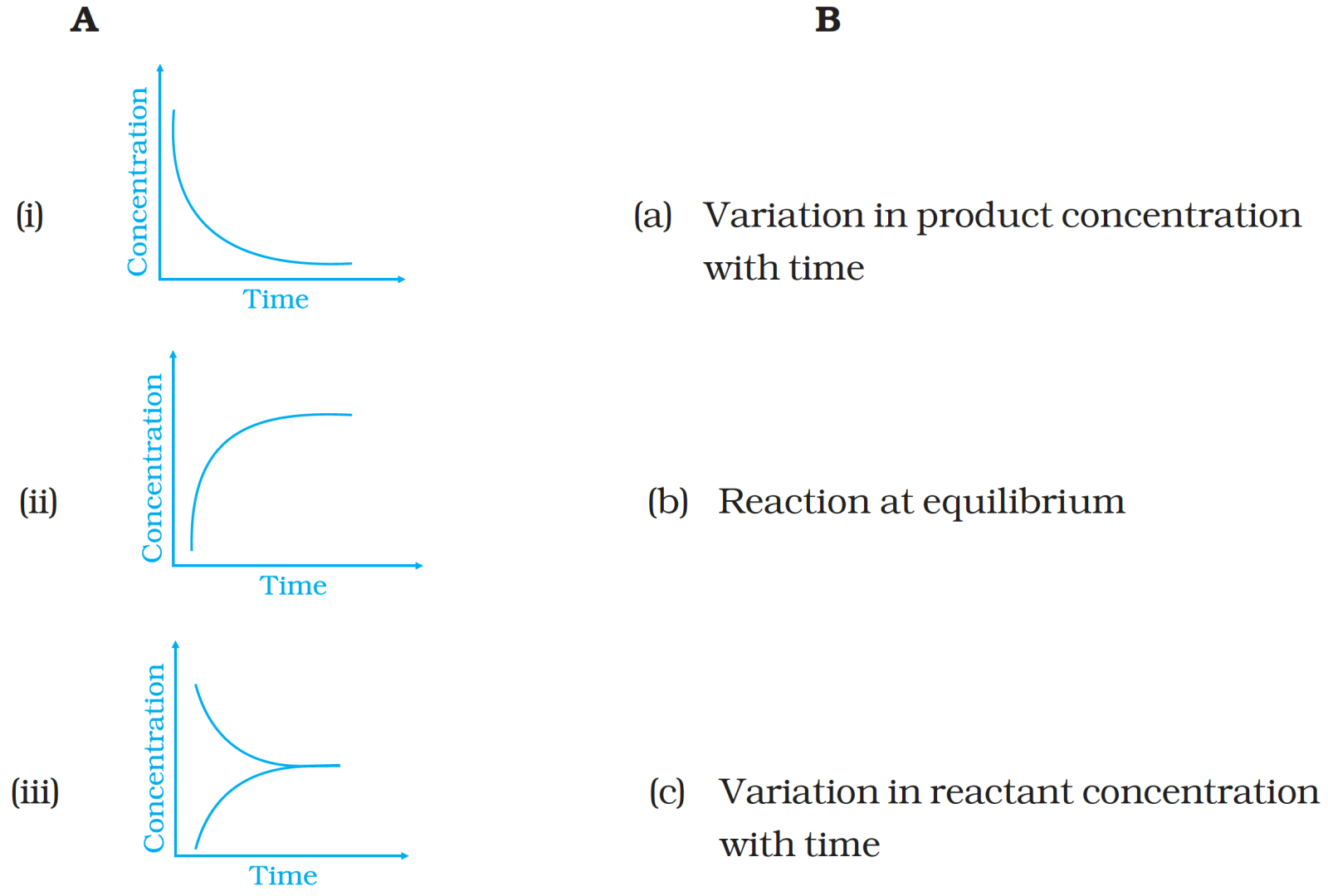
Question 243 Marks
For the reaction, $\text{CH}_4(\text{g})+2\text{H}_2\text{S(g)}\rightleftharpoons\text{CS}_2\text{(g)}+4\text{H}_2(\text{g})$ at 1173K, the magnitude of the equilibrium constant, Kc is 3.6. For each of the following compositions, decide whether reaction mixture is at equilibrium. If it is not, decide in which direction the reaction should go? - $[\text{CH}_4]=1.07\text{M},[\text{H}_2\text{S}]=1.20\text{M},[\text{CS}_2]$
$=0.90\text{M},[\text{H}_2]=1.78\text{M}$
- $[\text{CH}_4]=1.45\text{M},[\text{H}_2\text{S}]=1.29\text{M},[\text{CS}_2]$
$=1.25\text{M},[\text{H}_2]=1.75\text{M}$
Answer - $\text{CH}_4(\text{g})+2\text{H}_2\text{S(g)}\rightleftharpoons\text{CS}_2\text{(g)}+4\text{H}_2(\text{g})$
$\text{Q}_{\text{c}}=\frac{[\text{CS}_4][\text{H}_2]^4}{[\text{CH}_4][\text{H}_2\text{S}]^2}=\frac{[0.90][1.78]^4}{[1.07][1.20]^2}$
$=\frac{10.03\times0.9}{1.44\times1.07}=\frac{9.027}{1.54}$
$=5.86\text{ K}_{\text{c}}=3.6$
Since Qc > Kc, the equilibrium will shift in backward direction.
-
$\text{Q}_{\text{c}}=\frac{[1.25][1.75]^4}{[1.45][1.29]^2}$
$=\frac{9.38\times1.25}{1.45\times1.66}=\frac{11.725}{2.407}=4.87$
Since Qc > Kc, the equilibrium will shift in backward direction.
View full question & answer→Question 253 Marks
How can you predict the following stages of a reaction by comparing the value of K
c and Q
c?
- Net reaction proceeds in the forward direction.
- Net reaction proceeds in the backward direction.
- No net reaction occurs.
AnswerThe values of Kc and Qc are self explanatory and less than or greater than one another decides the direction in which reaction will proceed as follows:
-
As $\text{Q}_\text{c}<\text{K}_\text{c},$ the reaction proceeds in the forward direction.
-
If $\text{Q}_\text{c}<\text{K}_\text{c},$ the reaction will proceed in the direction of reactants (reverse reaction).
-
If $\text{Q}_\text{c}<\text{K}_\text{c},$ no net reaction occurs.
View full question & answer→Question 263 Marks
Calculate
- Dissociation constant of conjugate base of HF, Ka = 6.8 × 10⁻⁴.
- Dissociation constant of conjugate acid of $\text{CO}^{2-}_3,\text{K}_{\text{b}}=2.1\times10^{-4}$
Answer - $\text{HF}\rightleftharpoons\text{H}^++\text{F}^-$
Ka (acid) × kb (conjugate base) = 1.0 × 10⁻¹⁴
$\text{K}_{\text{b}}(\text{F}^-)=\frac{1.0\times10^{-14}}{6.8\times10^{-14}}$
$=1.47\times10^{-11}$
- $\text{CO}^{2-}_3+\text{H}^+\rightleftharpoons\text{HCO}_3^-$
$\text{K}_{\text{b}}(\text{CO}^{2-}_3)\times\text{K}_{\text{a}}(\text{HCO}^-_3)=1\times10^{-14}$
$\text{K}_{\text{a}}(\text{HCO}^-_3)=\frac{1\times10^{-14}}{2.1\times10^{-4}}=4.76\times10^-11{}$
View full question & answer→Question 273 Marks
- Give the relationship between Ka, c and $('\alpha')$ where 'Ka' is acid dissociation constant, 'c’ is molar concentration, $'\alpha'$ is degree of dissociation.
- If the solubility of Ca(IO3)2 in water at 18°C is 2.1g/ litre. Calculate the value of solubility product.
[Molecular mass of Ca(IO3)2 = 390]
Answer - $\text{K}_{\text{a}}=\frac{\text{c}\alpha^2}{1-\alpha}\text{ if }\alpha<<<<1\text{ then }\text{K}_{\text{a}}=\text{c}\alpha^2$
$\because1-\alpha=1$
- Solubility in mol L-1 $=\frac{2.1\text{g L}^{-1}}{390\text{g mol}^{-1}}$
$=5.4\times10^{-3}\text{mol L}^{-1}$
$\text{Ca}(\text{IO}_3)_2\rightleftharpoons\text{Ca}^{2+}+2\text{IO}^-_3$
$\text{K}_{\text{sp}}=[\text{Ca}^{2+}][\text{IO}^-_3]^2$
$\text{K}_{\text{sp}}=(5.4\times10^{-3})(2\times5.4\times10^{-3})^2$
$\text{K}_{\text{sp}}=-629.856\times10^{-9}\text{mol}^3\text{L}^{-3}$
$=6.6\times10^{-7}\text{mol}^3\text{L}^{-3}$
View full question & answer→Question 283 Marks
- Why is NH4Cl added before addition of NH4OH in qualitative analysis of 3rd group?
- Which will be added to precipitate soap
(RCOONa)? NaCl or KCl and why?'
Answer - It is done so as to decrease conc. of OH- due to common ion effect so that only group 3 radicals get precipitated and higher group radicals do not.
- NaCl will be added to precipitate soap.
$\text{RCOO}^-+\text{Na}^+\rightleftharpoons\text{RCOONa}$
$\text{Na}^++\text{Cl}^-\rightleftharpoons\text{NaCl}$
Due to common ion effect of Na+, soap (RCOONa) will get precipitated completely.
View full question & answer→Question 293 Marks
- Sulphuric acid is a very strong acid, yet it can also act as base in some reactions. Explain how?
- All Bronsted acids are not Lewis acids. Explain.
Answer - Sulphuric acid (H2SO4) is weaker acid with respect to perchloric acid (HClO4). H2SO4 can take up a proton from HClO4 to form H2SO4. Hence, it acts as a base in this reaction.
- Bronsted acids can donate H+ easily but they may not be able to donate electrons e.g. HCl, H2SO4, HNO3.
Therefore all Bronsted acids are not Lewis acids.
View full question & answer→Question 303 Marks
What is the effect of temperature on the reactions? Give reason.
- $\text{N}_2\text{(g)+3}\text{H}_2(\text{g})\rightleftharpoons2\text{NH}_3(\text{g})+\text{Heat}$
- $\text{N}_2\text{(g)+}\text{O}_2(\text{g})\rightleftharpoons2\text{NO}(\text{g})+\text{Heat}$
Answer - The increase in temperature will favour backward reaction because the reaction is exothermic. On increasing temperature, equilibrium will shift in opposite direction to counter balance the effect of increasing temperature, i.e., backward reaction.
- The increase in temperature favours forward reaction because the reaction is endothermic.
View full question & answer→Question 313 Marks
Urine has a pH of 6.0. If a patient eliminates 1300mL of urine per day, how many gram equivalents of the acid he eliminates per day?
Answer$\because$ pH = 6.0 $\therefore$ [H3O+] = 10-6M
i.e. [Acid] = 10-6M = 10-6N
Thus, 1000mL of the urine contain acid = 10-6g e.q
$\therefore$
1300mL pf the urine will contain acid = 1.3 × 10⁻⁶g eq. View full question & answer→Question 323 Marks
What is meant by reaction quotient? Give its expression.
AnswerReaction quotient: It is defined as product of molar concentration of products each raised to the power equal to their respective stoichiometric coefficients in balanced chemical equation divided by the product of molar concentration of the reactants raised to the power equal to their individual stoichiometric coffecients at any stage of reaction,
$\text{e.g.}\text{ aA}+\text{bB}\rightleftharpoons\text{cC}+\text{dD}$
$\text{Q}_{\text{c}}=\frac{[\text{C}^{\text{c}}][\text{D}]^{\text{d}}}{[\text{A}]^{\text{a}}[\text{B}]^{\text{b}}}$
View full question & answer→Question 333 Marks
pH of 0.08mol dm–3 HOCl solution is 2.85. Calculate its ionisation constant.
AnswerpH of HOCl = 2.85
But, $-\text{pH}=\log\text{[H}^+]$
$\therefore-2.85=\log\text{[H}^+]$
$\Rightarrow\overline{3}.15=\log\text{[H}^+]$
$\Rightarrow\log\text{[H}^+]=1.413\times10^{-3}$
For weak mono basic acid $[\text{H}^+]=\sqrt{\text{K}_\text{a}\times\text{C}}$
$\Rightarrow\text{K}_\text{}a=\frac{[\text{H}^+]^2}{\text{C}}=\frac{(1.413\times10^{-3})^2}{0.08}$
$=24.957\times10^{-6}=2.4957\times10^{-5}$
View full question & answer→Question 343 Marks
Calculate the pH of a solution containing 0.1M acetic acid and 0.1M benzoic acid, Ka for CH3COOH and C6H5COOH are 1.8 × 10⁻⁵ and 6.5 × 10⁻⁵ respectively.
Answer$[\text{H}_3\text{O}^+]=\sqrt{\text{K}_{\text{a}_1}\text{C}_1+\text{K}_{\text{a}_2}\text{C}_2}$]
$=\sqrt{(1.8\times10^{-5})(0.1)+(6.5\times10^{-5})(0.1)}$
$=\sqrt{1.8\times10^{-6}+6.5\times10^{-6}}$
$=\sqrt{8.3\times10^{-6}}$
$=2.88\times10^{-3}\text{M}$
$\text{pH}=-\log[\text{H}_3\text{O}^+]$
$=-\log(2.88\times10^{-3})$
$=3-0.4594=2.5406$
View full question & answer→Question 353 Marks
Following data is given for the reaction: $\text{CaCO}_3\text{(s)}\xrightarrow{ \ \ \ \ \ \ \ \ \ \ \ }\text{CaO(s)}+\text{CO}_2\text{(g)}$
$\Delta_\text{f}\text{H}^\ominus[\text{CaO}\text{(s)}]=-635.1\text{KJ mol}^{-1}$
$\Delta_\text{f}\text{H}^\ominus[\text{CO}_2\text{(g)}]=-393.5\text{KJ mol}^{-1}$
$\Delta_\text{f}\text{H}^\ominus[\text{CaCO}_3\text{(s)}]=-1206.9\text{KJ mol}^{-1}$
Predict the effect of temperature on the equilibrium constant of the above reaction.
Answer$\Delta_\text{f}\text{H}^\circ=\Delta_\text{r}\text{H}^\circ[\text{CaO}]+\Delta_\text{f}\text{H}^\circ[\text{CO}_2]-\Delta_\text{f}\text{H}^\circ[\text{CaCO}_3]$
$=[-635.1]+[-393.5]-[-1206.9]=178.3\text{KJ mol}^{-1}$
Thus, the reaction is endothermic.
Hence, according to Le Chatelier’s principle, on increasing the temperature, the equilibrium will proceed in the forward direction.
View full question & answer→Question 363 Marks
A certain buffer is made by mixing sodium formate and formic acid in water. With the help of equations explain how this buffer neutralizes addition of a small amount of an acid or a base?
Answer$\text{HCOONa}\xrightarrow{\ \ \ \ \ \ \ \ \ \ }\text{HCOO}^-+\text{Na}^+$
$\text{HCOOH}\rightleftharpoons\text{HCOO}^-+\text{H}^+$
HCOO- is common ion in the above acidic buffer. When small amount of H+ ions is added, these H+ ions combine with HCOO- which are in excess to form HCOOH back and [H+]remains practically same, so pH remains constant. When small amount of OH- ions are added, OH- ions will take up H+ and association of HCOOH will increase so as to maintain concentration of H+ ions. So, pH is not affected.
View full question & answer→Question 373 Marks
Match Column (I) with Column (II). | Column I | Column II |
| i. | Equilibrium. | a. | $\Delta\text{G}>0, \text{ K}<1$ |
| ii. | Spontaneous reaction. | b. | $\Delta\text{G}=0$ |
| iii. | Non spontaneous reaction. | c. | $\Delta\text{G}^\ominus=0$ |
| | | d. | $\Delta\text{G}<0, \text{ K}>1$ |
AnswerMatch Column (I) with Column (II). | Column I | Column II |
| i. | Equilibrium. | c. | $\Delta\text{G}^\ominus=0$ |
| ii. | Spontaneous reaction. | d. | $\Delta\text{G}<0, \text{ K}>1$ |
| iii. | Non spontaneous reaction. | a. | $\Delta\text{G}>0, \text{ K}<1$ |
View full question & answer→Question 383 Marks
pH of a solution of a strong acid is 5.0. What will be the pH of the solution obtained after diluting the given solution a 100 times?
AnswerpH = 5
[H+] = 10–5mol L–1
On 100 times dilution.
[H+] = 10–7mol L–1
On calculating the pH using the equation pH = –log [H+], value of pH comes out to be 7. It is not possible. This indicates that solution is very dilute. Hence,
Total hydrogen ion concentration = [H+]
= [Contibution of H3O+ ion concentration of Acid] + [Contibution of H3O+ ion concentration of Water]
= 10-7 + 10-7.
pH = 2 × 10-7 = 7 -log 2 = 7 - 0.3010 = 6.6990
View full question & answer→Question 393 Marks
The molar solubility of lead iodate, Pb(I03)2 is 4.0 × 10⁻⁵ mol/ L at 25°C. Calculate its Ksp.
$\text{Pb}(\text{IO}_3)_2\rightleftharpoons\text{Pb}^{2+}+\text{2IO}_3$
Answer$\therefore\text{K}_{\text{sp}}=[\text{Pb}^{2+}][\text{IO}_3^-]^2$
$\because$ The molar solubility of Pb(IO3)2 is 4.0 × 10⁻⁵mol L-1
$\therefore$ [Pb2+] = 4.0 × 10⁻⁵mol L-1
$[\text{IO}^-_3]=2\times4.0\times10^{-5}\text{mol L}^{-1}$
$\therefore$ Ksp = (4.0 × 10⁻⁵) (8.0 × 10⁻⁵)2
= 2.56 × 10⁻¹³
View full question & answer→Question 403 Marks
What is pOH? What is its value for neutral water at 25°C.
AnswerpOH is defined as negative logarithm of OH- concentration. $\text{pOH}=7\log[\text{OH}^-]$ pOH = 7 for neutral water at 25°C.
$[\because\text{pH}=\text{pOH}=7\text{ at }25^\circ\text{C}$ $\text{pH}+\text{pOH}=14\text{ at }25^\circ\text{C.}$ View full question & answer→Question 413 Marks
Solid Ba(NO3), is gradually dissolved in a 1.0 × 10⁻⁴ M Na2CO3 solution. At what concentration of Ba2+ will a precipitate begin to form.(Ksp for BaCO3 = 5.1 × 10⁻⁹)
Answer$\text{BaCO}_3(\text{s})\rightleftharpoons\text{Ba}^{2+}+\text{CO}^{2-}_{3}$
$\text{Na}_2\text{CO}_3\xrightarrow{\ \ \ \ \ \ \ \ }2\text{Na}^++\text{CO}^{2-}_3$
$[\text{Na}_2\text{CO}_3]=1.0\times10^{-4}\text{M}$
$\text{K}_{\text{sp}}=[\text{Ba}^{2+}][\text{CO}_3^{2-}]$
$5.1\times10^{-9}=[\text{Ba}^{2+}][1\times10^{-4}\text{M}]$
$\text{[Ba}^{2+}]=\frac{5.1\times10^{-9}}{1\times10^{-4}}$
$=5.1\times10^{-5}\text{M}$
At 5.1 × 10⁻⁵M concentration of [Ba2+], I.P(ionic product) will become equal to Ksp and precipitate will begin to from.
View full question & answer→Question 423 Marks
For the reaction, $\text{N}_2(\text{g})+3\text{H}_2(\text{g})\rightleftharpoons2\text{NH}_3(\text{g}),$ the partial pressures of N2 and H2 are 0.80 and 0.40 atmosphere respectively at equilibrium. The total pressure of the system is 2.80 atmosphere. What is Kp for the above reaction?
Answer$\text{N}_2(\text{g})+3\text{H}_2(\text{g})\rightleftharpoons2\text{NH}_3(\text{g}),$ Given, at equilibrium, $\text{p}_{\text{N}_2}=0.80$ atmosphere, $\text{p}_{\text{H}_2}=0.40$ atmosphere $\text{p}_{\text{N}_2}+\text{p}_{\text{H}_2}+\text{p}_{\text{NH}_3}=2.80$ atmosphere $\therefore\text{p}_{\text{NH}_3}=2.80-(0.80+0.40)=1.60$ atmosphere
From, $\text{K}_{\text{p}}=\frac{\text{p}_{\text{NH}_3}^2}{\text{p}_{\text{N}_3}\times\text{p}^3_{\text{H}_2}}$ $=\frac{(1.60)^2}{0.80\times(0.40)^3}=50.0$ View full question & answer→Question 433 Marks
Calculate the molar solubility of Ni(OH)2 in 0.10M NaOH. The ionic product of Ni(OH)2 is 2.0 × 10⁻¹⁵.
Answer$\text{Ni(OH)_2}\xrightarrow{\ \ \ \ \ \ \ \ \ \ }\text{Ni}^{2+}+2\text{OH}^-$
Ionic product = [Ni2+] [OH-]2
[OH-] = 0.1M, [Ni2+] = ?
2.0 × 10-15 = [Ni2+] (0.1)2
$\Rightarrow[\text{Ni}^{2+}]=\frac{2\times10^{-15}}{10^{-2}}$
$=2\times10^{-13}\text{M}$
Solubility of Ni(OH)2 will be equal to [Ni2+] = 2 × 10-13M.
View full question & answer→Question 443 Marks
Neutral solutions have pH = 7 at 298K. A sample of pure water is found to have pH < 7. Does it mean that it is acidic? Explain.
AnswerpH < 7 for pure H2O shows that water is at a temperature higher than 298K. It is neutral at all temperatures. At higher temperature. H2O dissociates more to give large concentrations of H+ ions and OH- ions. Hence, pH < 7. However, [H+] = [OH-] at all temperatures.
View full question & answer→Question 453 Marks
Write a relation between $\Delta\text{G}$ and Q and define the meaning of each term and answer the following:
- Why a reaction proceeds forward when Q < K and no net reaction occurs when Q = K.
- Explain the effect of increase in pressure in terms of reaction quotient Q. for the reaction: $\text{CO(g)}+\text{3H}_2\text{(g)}\rightleftharpoons\text{CH}_4\text{(g)}+\text{H}_2\text{O(g)}$
Answer$\Delta\text{G}=\Delta\text{G}^\ominus+\text{RT InQ}$
$\Delta\text{G}^\ominus$ = Change in free energy as the reaction proceeds.
$\Delta\text{G}$ = Standard free energy change.
Q = Reaction quotient.
R = Gas constant.
T = Absolute temperature.
Since $\Delta\text{G}^\ominus=-\text{RT InK}$
$\therefore\Delta\text{G}=-\text{RT InK}+\text{RT InQ}=\text{RT In}\frac{\text{Q}}{\text{K}}$
If $\text{Q}<\text{K},\Delta\text{G}$ will be negative. Reaction proceeds in the forward direction.
If $\text{Q}=\text{K},\Delta\text{G}=0$, no net reaction.
[Hint: Next relate Q with concentration of CO, H2, CH4 and H2O in view of reduced volume (increased pressure). Show that $\text{Q}<\text{K}$ and hence the reaction proceeds in forward direction.]
View full question & answer→Question 463 Marks
MY and NY3 two nearly insoluble salts, have same Ksp values 6.2 × 10⁻³ of non temperature. Calculate solubility of each salt. Which has more solubility.
Answer$\text{MY}\rightleftharpoons\text{M}^++\text{Y}^-\\'\text{s}'\ \ \ \ \ \ \ \ '\text{s}'\ \ \ \ \ \ \ \ '\text{s}'$
$\text{K}_{\text{sp}}=[\text{M}^+][\text{Y}^-]=\text{s}^2$
$\Rightarrow\text{s}=\sqrt{\text{K}_{\text{sp}}}$
$=\sqrt{6.2\times10^{-13}}$
$=\sqrt{62\times10^{-14}}$
$=7.9\times10^{-7}\text{mol L}^{-1}$
$[\because\sqrt{62}=7.9\text{ and }\sqrt{10^{-14}}=10^{-7}]$
$\text{NY}_3\rightleftharpoons\text{M}^{+3}+\text{3Y}^-\\'\text{s}'\ \ \ \ \ \ \ \ \ \ '\text{s}'\ \ \ \ \ \ \ \ \ '\text{3s}'$
$\text{K}_{\text{sp}}=[\text{M}^+][\text{Y}^-]$
$=\text{s}\times(3\text{s})^3=27\text{s}^4$
$\text{s}^4=4\sqrt{\frac{\text{K}_{\text{sp}}}{27}}$
$=4\sqrt{\frac{62\times10^{-14}}{24}}$
$=4\sqrt{2.296\times10^{-14}}$
$4\sqrt{229.6\times10^{-16}}$
$3.85\times10^{-4}\text{mol L}^{-1}$
View full question & answer→Question 473 Marks
The Ksp values of two slightly soluble salts AB and PQ2 are each equal to 4.0 × 10⁻¹⁸. Which salt is more soluble?
AnswerFor AB salt, Ksp = [A+] [B-] If x is the solubolity, then
x2 = 4.0 × 10⁻¹⁸
or x = 2.0 × 10⁻⁹
For PQ2 salt, Ksp = [P2+] [Q-]2
If y is the solubility, then
4y3 = Ksp = 4.0 × 10⁻¹⁸
or y = 1.0 × 10⁻⁶
Since y is more than x, PQ2 salt has more solubility.
View full question & answer→Question 483 Marks
Why do we pass H2S gas in acidic medium in group 2?
AnswerIt is done so as to reduce concentration of [SP2-] by common ion effect so that only group 2 radicals get precipitated whereas higher group radicals do not as Ksp of group II sulphides is low as compared to Ksp of sulphides of higher groups.
View full question & answer→Question 493 Marks
If Kw = 49 × 10-14, what will be neutral pH of H2O?
Answer$\text{K}_{\text{w}}=49\times10^{}-14[\text{H}_3\text{O}^+][\text{OH}^-]$
$=49\times10^{-14}$
$[\text{H}_3\text{O}^+]=[\text{OH}^-]$
$\Rightarrow[\text{H}_3\text{O}^+]^2=49\times10^{-14}$
$\Rightarrow[\text{H}_3\text{O}^+]=7\times10^{-7}\text{ mol L}^{-1}$
$\text{pH}=-\log[\text{H}_3\text{O}^+]$
$=-\log7\times10^{-7}$
$=-\log7-\log10^{-7}$
$=-\log7+7\log10$
$\text{pH}=-0.8451+7.000$
$=6.1549$
View full question & answer→Question 503 Marks
A 0.02M solution of pyridinium hydrochloride has pH = 3.44. Calculate the inoisation constant of pyridine.
Answer$\text{C}_6\text{H}_5\text{N}+\text{HCl}^-+\text{H}_2\text{O}\rightleftharpoons\text{C}_6\text{H}_5\text{N}^+\text{HOH}^-+\text{HCl}$
(Solution is acidic due to hydrolysis)
$\text{pH}=7-\frac{\text{pK}_\text{b}}{2}-\frac{\log\text{C}}{2}$
$3.44=7-\frac{\text{pK}_{\text{b}}}{2}-\frac{\log0.02}{2}$
$\text{pK}_{\text{b}}=8.82$
$\text{pK}_{\text{b}}=8.82=-\log\text{ pK}_{\text{b}}$
$\log\text{K}_{\text{b}}=-8.82=\bar{9}.18$
$\text{K}_{\text{b}}=\text{antilog }\bar{9}.18$
$=1.5\times10^{-9}$
View full question & answer→Question 513 Marks
On the basis of Le Chatelier principle explain how temperature and pressure can be adjusted to increase the yield of ammonia in the following reaction.
$\text{N}_2\text{(g)}+\text{3H}_2\text{(g)}\rightleftharpoons\text{2NH}_3\text{(g)} \ \ \ \ \ \ \ \Delta\text{H}= – 92.38\text{kJ mol}^{–1}$
What will be the effect of addition of argon to the above reaction mixture at constant volume?
Answer$\text{N}_2\text{(g)}+\text{3H}_2\text{(g)}\rightleftharpoons\text{2NH}_3\text{(g)} \ \ \ \ \ \ \ \Delta\text{H}= – 92.38\text{kJ mol}^{–1}$ Effect of temperature: All chemical reactions are accompanied by the liberation or uptake if heat. If we regard heat as a reactant or product in an endothermic or exothermic reaction respectively, we can use the Le Chatelier principle to predict the direction in which an increase or decrease in temperature will shift the equilibrium state. Therefore for the give reaction we can write, $\text{N}_2\text{(g)}+\text{3H}_2\text{(g)}\rightleftharpoons\text{2NH}_3\text{(g)} \ \ \ \ \ \ \ \Delta\text{H}= – 92.38\text{kJ mol}^{–1}$ The Le Chatelier principle tells us that a net reaction will occur in the direction that will partially counteract this change. Since the reaction is exothermic, a shift of the equilibrium to the left will take place. Thus, by decreasing the temperature yield of NH3 can be increased. Effect of pressure:
$\Delta\text{n}_\text{g}=\text{n}_\text{g}\text{(products)}-\text{n}_\text{g}\text{(reactants)}$ = 2 - (1 + 3) = 2 - 4 = -2 Since $\Delta\text{n}_\text{g}$ is negative, if the pressure is increased,The equilibrium will shift in the forward direction according to the Lr Chatelier principle, because doing this will decrease the total number of moles of gases and hence the pressure which will decrease the effect of increasing pressure. Thus, high pressure would increase the yield of ammonia. Addition of argon at constant volume The addition of argon at constant volume would not change the partial pressures of any substance, N2, H2 or NH3. Hence, the equilibrium is not disturbed and there would not be any effect of addition of argon at constant Volume. View full question & answer→Question 523 Marks
What will be the value of $\Delta\text{G}\text{ and }\Delta\text{G}^\circ$ for the reaction, $\text{A}+\text{B}\rightleftharpoons\text{C}+\text{D}\text{ at }27^\circ\text{C}$ for which K = 102. Predict the extent of reaction.
Answer$\Delta\text{G}=0$ at equilibrium
$\Delta\text{G}^\circ=-2.303\text{ RT }\log\text{ K}$
$\text{R}=8.314\text{Jk}^{-1}\text{mol}^{-1};$]
$\text{T}=27^\circ\text{C}+273=300\text{K};$
$\text{K}=10^2$
$\Delta\text{G}^\circ=-2.303\times8.314\times300\log10^2$
$[\because\log10^2=2\log10=2\times1=2]$
$\Delta\text{G}^\circ=-19.147\times300\times2$
$\Delta\text{G}^\circ=-57.441\times2\times100\text{J}$
$\Delta\text{G}^\circ=114.882\times10^2\text{J}$
$=-11.49\text{kJ mol}^{-1}$
The reaction will be almost complete because concentration of products is 100 times more then reactants.
View full question & answer→Question 533 Marks
$2\text{NO}(\text{g})+\text{O}_2(\text{g})\rightleftharpoons2\text{NO}_2(\text{g}),\Delta\text{H}=-117\text{J}$
Predict the effect of an increase in concentration of NO on the equilibrium concentration of NO2.
Predict the effect of pressure decrease as a result of increased volume on the equilibrium concentration of NO2.
Answer$2\text{NO}(\text{g})+\text{O}_2(\text{g})\rightleftharpoons2\text{NO}_2(\text{g});\Delta\text{H}=-117\text{J}$
- If we increase the concentration of NO2 the rate of forward reaction will increase, i.e. more NO2 will be formed.
- Decrease in pressure will favour backward reaction, i.e. less NO2 will be formed because number of moles of reactants are more than products.
View full question & answer→Question 543 Marks
$\begin{matrix}\text{A }\rightleftharpoons\text{ B }&\text{K}_1=1&\text{B }\rightleftharpoons\text{ C}&\text{K}_2=2\\\text{C }\rightleftharpoons\text{ D}&\text{K}_3=3&\text{D }\rightleftharpoons\text{ E}&\text{K}_4=4\end{matrix}$
What is value of K for $\text{A }\rightleftharpoons\text{ E}?$
Answer$\text{A }\rightleftharpoons\text{ E K}=\frac{[\text{E}]}{[\text{A}]}$ $\text{K}_1=\frac{[\text{B}]}{[\text{A}]},\text{K}_2=\frac{[\text{C}]}{[\text{B}]},$ $\text{K}_3=\frac{[\text{D}]}{[\text{C}]}\text{ and }\text{K}_4=\frac{[\text{E}]}{[\text{D}]}$
$\because\text{K}=\text{K}_1\times\text{K}_2\times\text{K}_3\times\text{K}_4=\frac{[\text{E}]}{[\text{A}]}$ $=1\times2\times3\times4=24$ View full question & answer→Question 553 Marks
Write two equations to show the amphiprotic (acid as well as base) property of water.
Answer$\begin{matrix}\text{HCl}&+&\text{H}_2\text{O}&\rightleftharpoons&\text{H}_3\text{O}^+&+&\text{Cl}^-\\\text{Acid}&&\text{Base}_2&&\text{Acid}_2&&\text{Base}_1\\\end{matrix}$
$\begin{matrix}\text{NH}_3&+&\text{H}_2\text{O}&\rightleftharpoons&\text{NH}^+_4&+&\text{OH}^-\\\text{Base}_1&&\text{Acid}_2&&\text{Acid}_1&&\text{Base}_2\end{matrix}$
In first equation H2O acts as base and in second it acts as acid, so H2O is amplification, i.e., can gain H+ and lose H+.
View full question & answer→Question 563 Marks
Why common salt is added to precipitate out soap from the solution during its manufacture?
AnswerSoaps are sodium salts of higher fatty acids having general formula RCOONa. On adding common salt, Na+ ion concentration increases and due to common ion effect the equilibrium (I) as shown below shifts in the backward direction leading to the precipitation of soap.
$\text{NaCl}(\text{s})\xrightarrow{\ \ \ \ \ \ \ \ \ \ }\text{Na}^+(\text{aq})+\text{Cl}^-\text{(aq)}$
$\text{RCOONa(s)}\rightleftharpoons\text{RCOO}^-(\text{aq})+\text{Na}^+(\text{aq}).$
View full question & answer→Question 573 Marks
Why solution of sugar in water does not conduct electricity whereas that of common salt in water does?
AnswerCommon salt (NaCl) is an electrolyte which in the aqueous solution gives Na+ and Cl- ions. Hence, it conducts electricity. Sugar is sucrose (C12H22O11) which is a non-electrolyte and does not give ions in the solution. Hence, it does not conduct electricity.
View full question & answer→