Question
Bell laboratory has developed superconductor at a temperature of:

Answer

  1. 40K
Explanation:
Bell laboratory has developed superconductor at a temperature of 40 K.Superconductivity is a phenomenon of exactly zero electrical resistance and expulsion of magnetic flux fields occurring in certain materials, called superconductors, when cooled below a characteristic critical temperature. It was discovered by Dutch physicist Heike Kamerlingh Onnes on April 8, 1911, in Leiden.

Need a full question paper?

Generate a complete, print-ready paper with questions like this in minutes — across 16+ boards, with answer keys.
Start Generating Free

Similar questions

Which one of the following have minimum wavelength(a) Ultraviolet rays(b) Cosmic rays(c) X-rays(d) γ - rays
       
Optical fibres are related with(a) Communication (b) Light(c) Computer(d) None of these
       
The magnitude of the electric field is given by the change in magnitude of potential per unit displacement _____ to the equipotential surface at the point.
0.2 Fcapacitor is charged to 600 V by a battery. On removing the battery, it is connected with another parallel plate condenser of 1F. The potential decreases to(a) 100 volts(b) 120 volts(c) 300 volts(d) 600 volts
       
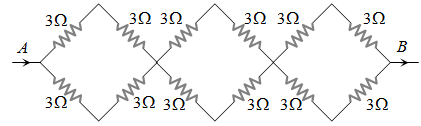
In the network of resistors shown in the adjoining figure, the equivalent resistance between $A$ and $B$ is
Let V and E be the gravitational potential and gravitational field at a distance r from the centre of a uniform spherical shell. Consider the following two statements:
  1. The plot of V against r is discontinuous.
  2. The plot of E against r is discontinuous.
  1. Both A and B are correct.
  2. A is correct but B is wrong.
  3. B is correct but A is wrong.
  4. Both A and B are wrong.
The resistance of the series combination of two resistance is S. When they are joined in parallel the total resistance is P. If S = nP, then the minimum possible value of n is(a) 4(b) 3(c) 2(d) 1
       
Curie temperature is the temperature above which:
PN-junction diode works as a insulator, if connected(a) To A.C.(b) In forward bias(c) In reverse bias(d) None of these
       
An electron with velocity $\vec{v}=\left(v_x \hat{i}+v_y \hat{j}\right)$ moves through a magnetic field $\vec{B}=\left(B_x \hat{i}-B_y \hat{j}\right)$. The force $\overrightarrow{ F }$ on the electron is: ( e is the magnitude of its charge)