MCQ
Below conversion can be brought about by ?
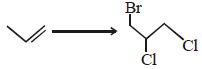
- A$(i)$ $HBr$ ; $(ii)$ $Cl_2$
- B$(i)$ $Cl_2 $ ; $(ii)$ $NBS$
- ✓$(i)$ $NBS$ ; $(ii)$ $Cl_2$
- D$(i)$ $Cl_2$ ; $(ii)$ $BrCl / CCl_4$

Generate a complete, print-ready paper with questions like this in minutes — across 16+ boards, with answer keys.
${C{H_3} - C{H_2} - CH = C{H_2} + HBr\,\to \,CH _{3}- CH _{2}- CH _{2}- C^{+}H _{2}+ Br ^{-}} _{"A"}$
${C{H_3} - C{H_2} - CH = C{H_2} + HBr\, \to \,CH _{3}- CH _{2}- C^{+}H - CH _{3}+ Br ^{-}}_{"B"}$
Reason : The third ionization energy of $Mn$ is larger than that of $Cr$.
$Sn ^{2+}+2 e ^{-} \rightarrow Sn$
$Sn ^{4+}+4 e ^{-} \rightarrow Sn$
The electrode potentials are; $E _{ Sn ^{2+} / Sn }^{\circ}=-0.140\, V$ and $E _{ Sn ^{4+} / Sn }^{\circ}=0.010\, V$. The magnitude of standard electrode potential for $Sn ^{4+} / Sn ^{2+}$ i.e. $E _{ Sn ^{4+} / Sn ^{2+}}^{\circ}$ is $.....\times 10^{-2}\, V$. (Nearest integer)