MCQ
Below conversion can be brought about by ?
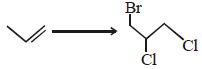
- A$(i)$ $HBr$ ; $(ii)$ $Cl_2$
- B$(i)$ $Cl_2 $ ; $(ii)$ $NBS$
- ✓$(i)$ $NBS$ ; $(ii)$ $Cl_2$
- D$(i)$ $Cl_2$ ; $(ii)$ $BrCl / CCl_4$

Generate a complete, print-ready paper with questions like this in minutes — across 16+ boards, with answer keys.
$0.48 + \log \left\{ { - \frac{{d[A]}}{{dt}}} \right\} = \log \left\{ { + \frac{{d[B]}}{{dt}}} \right\} + 0.7$
Then, $x : y$ is
$\begin{array}{*{20}{c}}
H\\
|\\
{ClHC = HC - C - CH = CHCl}\\
|\\
{Cl}
\end{array}$
Assertion $(A)$: There is a considerable increase in covalent radius from $\mathrm{N}$ to $\mathrm{P}$. However from $As$ to $Bi$ only a small increase in covalent radius is observed.
Reason $(R)$: covalent and ionic radii in a particular oxidation state increases down the group.
In the light of the above statement, choose the most appropriate answer from the options given below:
