MCQ
Benzamide and benzyl amine can be distinguished by
- Acold dil. $NaOH$
- ✓cold dil. $HCl$
- Cboth $a$ and $b$
- D$NaNO_2$, $HCl$, $0\,^oC$, then $\beta - $ naphthol
Generate a complete, print-ready paper with questions like this in minutes — across 16+ boards, with answer keys.
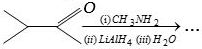
then rate determining step will be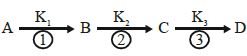
$Cl_2(aq) + H_2S(aq) \to S(s) + 2H^+(aq) + 2Cl^-(aq)$
The rate equation for this reaction is rate $= k[Cl_2][H_2S]$ Which of these mechanisms is/are consistent with this rate equation ?
$A.\,C{l_2} + {H_2}S \to {H^ + } + C{l^ - } + C{l^ + } + H{S^- }$ (slow)
$C{l^ + } + H{S^ - } \to {H^ + } + C{l^ - } + {S}$ (fast)
$B.\, H_2S \Leftrightarrow H^+ + HS^-$ (fast equilibrium)
$Cl_2 + HS^-\to 2Cl^-+ H^+ + S$ (slow)
$[Figure]$ $\longrightarrow \,\,A\,\xrightarrow{{{C_6}{H_5}N{H_2}}}B$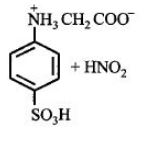
$\left[\right.$ Given : $K _{ sp }( AgBr )=4.9 \times 10^{-13}$ at $298 K$
$\lambda_{ Ag ^{+}}^0=6 \times 10^{-3} Sm ^2\,mol ^{-1}$
$\lambda_{ Br ^{-}}^0=8 \times 10^{-3} Sm ^2\,mol ^{-1}$
$\left.\lambda_{ NO _3^{-}}^0=7 \times 10^{-3} Sm ^2\,mol ^{-1}\right]$