MCQ
Which one is highest melting halide
  • A
    $NaCl$
  • B
    $NaBr$
  • $NaF$
  • D
    $NaI$

Answer

Correct option: C.
$NaF$
c
(c) $NaF$ is highest melting halide because it is most ionic in nature.

Need a full question paper?

Generate a complete, print-ready paper with questions like this in minutes — across 16+ boards, with answer keys.

Start Generating Free

Similar questions

Oxidation of toluene to Benzaldehyde can be easily carried out with which of the following reagents?
For the sequence of reactions, $A\xrightarrow[{ether}]{{{C_2}{H_5}MgI}}B\xrightarrow{{{H_2}O/{H^ + }}}$ tert-Pentyl alcohol. The compound $A$ in-the  sequence is
For increase in difference between  $P_A^ o$  and  $P_A$
Chlorine water on standing loses its colour and forms
Which of the following does not show haloform reaction
Which of the following outer orbital complex has maximum number of unpaired electron
$p$-Amino- $N, N$-dimethylaniline is added to a strongly acidic solution of ${X}$. The resulting solution is treated with a few drops of aqueous solution of ${Y}$ to yield blue coloration due to the formation of methylene blue. Treatment of the aqueous solution of ${Y}$ with the reagent potassium hexacyanoferrate$(II)$ leads to the formation of an intense blue precipitate. The precipitate dissolves on excess addition of the reagent. Similarly, treatment of the solution of ${Y}$ with the solution of potassium hexacyanoferrate$(III)$ leads to a brown coloration due to the formation of ${Z}$.

$1.$ The compound ${X}$ is

$(A)$ $\mathrm{NaNO}_3$ $(B)$ $\mathrm{NaCl}$ $(C)$ $\mathrm{Na}_2 \mathrm{SO}_4$ $(D)$ $\mathrm{Na}_2 \mathrm{~S}$

$2.$ The compound ${Y}$ is

$(A)$ $\mathrm{MgCl}_2$ $(B)$ $\mathrm{FeCl}_2$ $(C)$ $\mathrm{FeCl}_3$ $(D)$ $\mathrm{ZnCl}_2$

$3.$ The compound ${Z}$ is

$(A)$ $\left.\mathrm{Mg}_2 \mid \mathrm{Fe}(\mathrm{CN})_6\right]$ $(B)$ $\operatorname{Fe}\left[\mathrm{Fe}(\mathrm{CN})_6\right]$

$(C)$ $\mathrm{Fe}_4\left[\mathrm{Fe}(\mathrm{CN})_6\right]_3$ $(D)$ $\mathrm{K}_2 \mathrm{Zn}_3\left[\mathrm{Fe}(\mathrm{CN})_6\right]_2$

Give the answer question $1,2$ and $3.$
A certain compound gives negative test with ninhydrin and positive test with Benedict's solution. The compound is
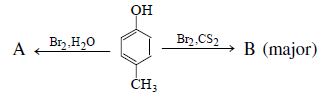
(major) '$A$' and '$B$' are respectively
Aluminium displaces hydrogen from dilute $HCl$ whereas silver does not. The e.m.f. of a cell prepared by combining $Al/A{l^{3 + }}$ and $Ag/A{g^ + }$ is $ 2.46\,V$  The reduction potential of silver electrode is $ + 0.80\;V$. The reduction potential of aluminium electrode is ........... $\mathrm{V}$