MCQ
Bernoulli's principle does not explain
  • A
    curved path of a spinning ball
  • lift by jet flow
  • C
    working of paint sprayer
  • D
    blowing up of tin roofs during storms

Answer

Correct option: B.
lift by jet flow
b

Need a full question paper?

Generate a complete, print-ready paper with questions like this in minutes — across 16+ boards, with answer keys.
Start Generating Free

Similar questions

A coil $10$ turns and a resistance of $20\,\Omega$ is connected in series with B.G of resistance $30\,\Omega$. The coil is placed with its plane perpendicular to the direction of a uniform magnetic field of induction $10^{-2}\,T$. If it is now turned through an angle of $60^{\circ}$ about an axis in its plane. Find the charge induced in the coil $..............\times 10^{-5} C$ (Area of a coil $=10^{-2}\,m ^2$ )
Electrons moving with different speeds enter a uniform magnetic field in a direction perpendicular to the field. They will move along circular paths.
A person can throw a ball upto a maximum range of $100 \,m$. How high above the ground he can throw the same ball?
When a biconves lens of glass having refractive index $1.47$ is dipped in a liqud, it acts as a plane sheet of glass. This implies that the liquid must have refractive index.
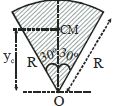
Sector of a circular plate shown in figure has position of centre of mass at $y_{CM} =$
An $n-p-n$ transistor has three leads $A,B$ and $C$ . Connecting $B$ and $C$ by moist fingers, $A$ to the positive lead of an ammeter, and $C$ to the negative lead of the ammeter, one finds large deflection. Then, $A, B$ and $C$ refer respectivily to
Calculate the angle of minimum deviation for an equilateral triangular prism of refractive index $\sqrt 3$........$^o$
The maximum range of a bullet fired from a toy pistol mounted on a car at rest is $R_0= 10\, m$. What will be the acute angle of inclination of the pistol for maximum range when the car is moving in the direction of firing with uniform velocity $v = 20\, m/s$, on a horizontal surface ......... $^o.$ $(g = 10\, m/s^2)$
Which of the following planets have rings around it
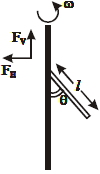
A uniform rod of length $'l'$ is pivoted at one of its ends on a vertical shaft of negligible radius When the shaft rotates at angular speed $\omega$ the rod makes an angle $\theta$ with it (see figure). To find $\theta$ equate the rate of change of angular momentum (direction going into the paper ) $\frac{ m \ell^{2}}{12} \omega^{2} \sin \theta \cos \theta$ about the centre of mass $(CM)$ to the torque provided by the horizontal and vertical forces $F_{H}$ and $F_{V}$ about the CM. The value of $\theta$ is then such that: