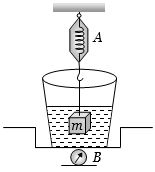
The spring balance $A$ reads $2\, kg$ with a block m suspended from it. $A $ balance $B$ reads $5 \,kg $ when a beaker filled with liquid is put on the pan of the balance. The two balances are now so arranged that the hanging mass is inside the liquid as shown in figure. In this situation
IIT 1985, Medium
Download our app for free and get started
(d) Force of upthrust will be there on mass m shown in figure, so $A$ weighs less than $2 \,kg$. Balance will show sum of load of beaker and reaction of upthrust so it reads more than $5 \,kg$.

Download our appand get started for free
Experience the future of education. Simply download our apps or reach out to us for more information. Let's shape the future of learning together!No signup needed.*
Similar Questions
- 1The terminal velocity of a small sphere of radius $a$ in a viscous liquid is proportional toView Solution
- 2Which of the following is the incorrect graph for a sphere falling in a viscous liquid? (Given at $t = 0$, velocity $v = 0$ and displacement $x = 0$.)View Solution
- 3Spherical balls of radius $ 'r'$ are falling in a viscous fluid of viscosity '$\eta$' with a velocity $ 'v'. $ The retarding viscous force acting on the spherical ball isView Solution
- 4A pump draws water from a tank which is at $2.5\; m$ down from outlet and issues it from the end of a hose which the water is drawn. The cross sectional area is $10\; cm ^{2}$, and the water leaves the end of the hose at a speed of $5\; m / s$. What is the rate at which the pump is working ?View Solution
- 5The reading of spring balance when a block is suspended from it in air, is $60\,N$. This reading is changed to $40\, N$ when the block is immersed in water. The specific density of the block isView Solution
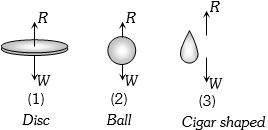
- 6When a body falls in air, the resistance of air depends to a great extent on the shape of the body, $ 3 $ different shapes are given. Identify the combination of air resistances which truly represents the physical situation. (The cross sectional areas are the same).View Solution
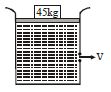
- 7A large cylindrical tank of cross-sectional area $1\ m^2 $ is filled with water. It has a small hole at a height of $1\ m $ from the bottom. $A$ movable piston of mass $5$ $kg$ is fitted on the top of the tank such that it can slide in the tank freely without friction. A load of $45$ $kg$ is applied on the top of water by piston, as shown in figure. The value of $v$ when piston is $7$ $m$ above the bottom is $(g = 10\ m/s^2)$ ....... $m/s$View Solution
- 8If a small orifice is made at a height of $0.25\, m$ from the ground, the horizontal range of water stream will be, (in $cm$)View Solution
- 9View SolutionThe height to which a cylindrical vessel be filled with a homogeneous liquid, to make the average force with which the liquid presses the side of the vessel equal to the force exerted by the liquid on the bottom of the vessel, is equal to
- 10View SolutionThe Working of an atomizer depends upon