Question
Bernoulli's theorem is based on conservation of:
- Momentum.
- Mass.
- Energy.
- Angular momentum.
Explanation:
The principle behind the Bernoulli theorem is the law of conservation of energy. It states that energy can be neither created nor destroyed; it merely changes from One form to another.
Generate a complete, print-ready paper with questions like this in minutes — across 16+ boards, with answer keys.
In a plano-convex lens the radius of curvature of the convex lens is 10 cm. If the plane side is polished, then the focal length will be (Refractive index = 1.5)
|
(a) 10.5 cm |
(b) 10 cm |
(c) 5.5 cm |
(d) 5 cm |
The time constant of an LR circuit represents the time in which the current in the circuit
|
(a) Reaches a value equal to about 37% of its final value |
|
(b) Reaches a value equal to about 63% of its final value |
|
(c) Attains a constant value |
|
(d) Attains 50% of the constant value |
Light wave enters from medium 1 to medium 2. Its velocity in 2nd medium is double from 1st. For total internal reflection the angle of incidence must be greater than
|
(a) 30o |
(b) 60 o |
(c) 45 o |
(d) 90 o |
When we touch the terminals of a high voltage capacitor, even after a high voltage has been cut off, then the capacitor has a tendency to
|
(a) Restore energy |
(b) Discharge energy |
(c) Affect dangerously |
(d) Both (b) and (c) |
In intrinsic semiconductor at room temperature, number of electrons and holes are
|
(a) Equal |
(b) Zero |
(c) Unequal |
(d) Infinite |
The contribution in the total current flowing through a semiconductor due to electrons and holes are  and
and  respectively. If the drift velocity of electrons is
  times that of holes at this temperature, then the ratio of concentration of electrons and holes is
|
(a) 6 : 5 |
(b) 5 : 6 |
(c) 3 : 2 |
(d) 2 : 3 |
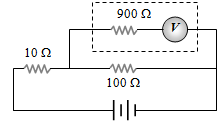
The potential difference across the 100 W resistance in the following circuit is measured by a voltmeter of 900 W resistance. The percentage error made in reading the potential difference is
|
(a) |
(b) 0.1 |
(c) 1.0 |
(d) 10.0 |
