Question
Black Hole is

Answer

Black hole is a super dense planetary material formed due to the continued compression of the core of a star during supernova explosion.

Need a full question paper?

Generate a complete, print-ready paper with questions like this in minutes — across 16+ boards, with answer keys.
Start Generating Free

Similar questions

Which of the following statements is not correct
A cell of e.m.f. $E$ is connected with an external resistance $R$, then p.d. across cell is $V$. The internal resistance of cell will be
Two wires are made of the same material and have the same volume. The first wire has cross-sectional area $A$ and the second wire has cross-sectional area $3A$. If the length of the first wire is increased by $\Delta l$ on applying a force $F$, how much force is needed to stretch the second wire by the same amount?
Let $P\left( r \right) = \frac{Q}{{\pi {R^4}}}r$ be the charge density distribution for a solid sphere of radius $R$ and total charge $Q$. For a point $P$ inside the sphere at distance $r_1$ from the centre of the sphere, the magnitude of electric field is
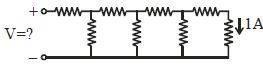
Each element in the finite chain of resistors shown in the figure is $1\,\Omega $. A current of $1\, A$ flows through the final element. Then what is the potential difference $V$ across input terminals of the chain ............... $\mathrm{volt}$
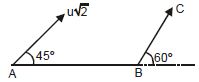
A particle is projected from a point $A$ with velocity $u\sqrt 2$ at an angle of $45^o$ with horizontal as shown in fig. It strikes the plane $BC$ at right angles. The velocity of the particle at the time of collision is
$Assertion :$ At a given temperature the specific heat of a gas at constant pressure. is always greater than its specific heat at constant volume

$Reason :$ When a gas is heated at constant volume some extra heat is needed compared to that at constant pressure for doing work in expansion.

With respect to a rectangular cartesian coordinate system, three vectors are expressed as

$\vec a = 4\hat i - \hat j$, $\vec b = - 3\hat i + 2\hat j$ and $\vec c = - \hat k$ 

where $\hat i,\,\hat j,\,\hat k$ are unit vectors, along the $X, Y $ and $Z-$axis respectively. The unit vectors $\hat r$ along the direction of sum of these vector is
Assume that, the drag force on a football depends only on the density of the air, velocity of the ball and the cross-sectional area of the ball. Balls of different sizes but the same density are dropped in an air column. The terminal velocity reached by balls of masses $250 \,g$ and $125 \,g$ are in the ratio
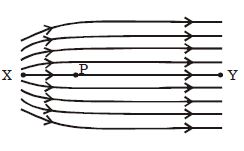
The diagram below shows electric field lines in a region of space. Which of the following diagrams best shows the variation with distance $d$ of the potential $V$ along the line $XY$ as we move from $X$ to $Y$ ?