Assume that, the drag force on a football depends only on the density of the air, velocity of the ball and the cross-sectional area of the ball. Balls of different sizes but the same density are dropped in an air column. The terminal velocity reached by balls of masses $250 \,g$ and $125 \,g$ are in the ratio
KVPY 2018, Advanced
Download our app for free and get started
$(a)$ Given, drag force $F_{d}$ depends on air density $\sigma$, velocity of ball $v$ and area of cross-section of ball $A$.
$\therefore \quad F_{d} \propto \sigma^{\alpha}\propto v^{b} A^{c}$
Substituting dimensions of different physical quantities, we have
$\left[ MLT ^{-2}\right]=\left[ ML ^{-3}\right]^{\alpha}\left[ LT ^{-1}\right]^{b}\left[ L ^{2}\right]^{c}$
Equating dimensions of fundamental quantities, we have
$a=1 \quad \dots(i)$
$-3 a+b+2 c=1\quad \dots(ii)$
$-b=-2 \Rightarrow b=2\quad \dots(iii)$
Putting the values of $a$ and $b$ in Eq $(ii)$, we get
$\Rightarrow \quad-3 \times 1+2+2 c=1 \Rightarrow c=1$
$\because a=1, b=2, c=1$
So, drag force on football is
$F_{d}=k \cdot \sigma \cdot v^{2} \cdot A$
When football reaches terminal speed, its weight is balanced by drag force.
$\Rightarrow m g=F_{d}$
$\Rightarrow m g=k \sigma v_{T}^{2} A$
where, $u_{T}=$ terminal speed of football.
$\Rightarrow \quad m g=k \sigma v_{T}^{2} \pi R^{2}$
$\Rightarrow \quad m g=k \sigma u_{T}^{2} \pi\left(\frac{m}{\frac{4}{3} \pi \rho}\right)^{\frac{2}{3}}$
[from $m=\frac{4}{3} \pi R^{3} \rho$,
where $\rho=$ density of football]
$\Rightarrow \quad u_{T} \propto m^{1 / 6}$
$\Rightarrow \quad \frac{v_{1}}{v_{2}}=\left(\frac{m_{1}}{m_{2}}\right)^{\frac{1}{6}}=\left(\frac{250}{125}\right)^{\frac{1}{6}}=2^{1 / 6}$

Download our appand get started for free
Experience the future of education. Simply download our apps or reach out to us for more information. Let's shape the future of learning together!No signup needed.*
Similar Questions
- 1A liquid is kept in a cylindrical vessel which rotated along its axis. The liquid rises at the sides. If the radius of the vessel is $0.05\,m$ and the speed of rotation is $2\,rev/s$ , The difference in the height of the liquid at the centre of the vessel and its sides will be .............. $\mathrm{cm}$ $(\pi ^2 = 10)$View Solution
- 2A sphere of relative density $\sigma$ and diameter $D$ has concentric cavity of diameter $d$. The ratio of $\frac{D}{d}$, if it just floats on water in a tank is:View Solution
- 3A water tank of height $10\,m$, completely filled with water is placed on a level ground. It has two holes one at $3\, m$ and the other at $7\, m$ from its base. The water ejecting fromView Solution
- 4View SolutionThe weight of an aeroplane flying in the air is balanced by
- 5View SolutionA viscous fluid is flowing through a cylindrical tube. The velocity distribution of the fluid is best represented by the diagram
- 6Two substances of densities ${\rho _1}$ and ${\rho _2}$ are mixed in equal volume and the relative density of mixture is $4$. When they are mixed in equal masses, the relative density of the mixture is $3$. The values of ${\rho _1}$ and ${\rho _2}$ areView Solution
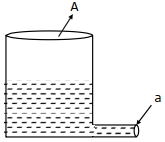
- 7A light cylindrical vessel is kept on a horizontal surface. Area of base is A. A hole of crosssectional area $'a'$ is made just at its bottom side. The minimum coefficient of friction necessary to prevent sliding the vessel due to the impact force of the emerging liquid is $(a\,<\,<\,A)$View Solution
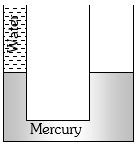
- 8A $U-$ tube in which the cross-sectional area of the limb on the left is one quarter, the limb on the right contains mercury (density $13.6 g/cm^3$). The level of mercury in the narrow limb is at a distance of $36 cm$ from the upper end of the tube. What will be the rise in the level of mercury in the right limb if the left limb is filled to the top with water ........ $cm$View Solution
- 9View SolutionAn application of Bernoulli's equation for fluid flow is found in
- 10Figure shows a siphon. Choose the wrong statement:View Solution
($P_0$ = atmospheric pressure)