MCQ
Bladderwort and Venus fly trap are examples of
- ✓insectivorous plants
- Bparasitic plants
- CN $2$ - rich plants
- Daquatic plants
Generate a complete, print-ready paper with questions like this in minutes — across 16+ boards, with answer keys.
| List $I$ | List $II$ |
| $A$. Mast cells | $I$. Ciliated epithelium |
| $B$. Inner surface of bronchiole | $II$. Areolar connective tissue |
| $C$. Blood | $III$. Cuboidal epithelium |
| $D$. Tubular parts of nephron | $IV$. Specialised connective tissue |
Choose the correct answer from the options give below:
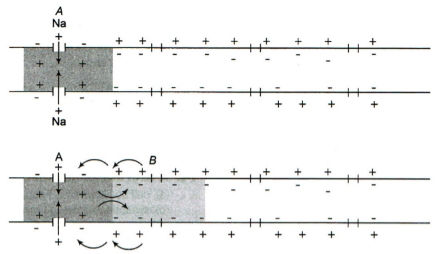
$I.$ The polarity of the membrane at site $A$ is reversed and depolarized, i.e., the outer surface becomes negatively charged and the innerside becomes positively charged, generating nerve impulse
$II$. A stimulus causes disturbance to the membrane at site of $A$ nerve fibre resulting in leakage of $N a^{+i i}$ ions inside the nerve fibre
$III.$ On the outer surface, current flows from site $B$ to site $A$ to complete the circuit of current flow. Hence, the polarity at the site is reversed, and an action potential is generated at site $B.$ The impulse (action potential) generated at site $A$ arrives at site $B .$ The sequence is repeated along the length of the axon and consequently the impulse is conducted
$IV.$ Immediately ahead, the axon $(e \cdot g .$, site $B )$ membrane has a positive charge on the outer surface and a negative charge on its inner surface. As a result, a current flows on the inner surface from site $A$ to site $B$