MCQ 11 Mark
Which one of the following is not a criterion for classification of fungi?
Answera
The morphology of the mycelium, mode of spore formation and fruiting bodies form the basis for the division of the kingdom fungi into various classes.
View full question & answer→MCQ 21 Mark
Match List $I$ with List $II$
| List $I$ |
List $II$ |
| $A$. Rhizopus |
$I$. Mushroom |
| $B$. Ustilago |
$II$. Smut fungus |
| $C$. Puccinia |
$III$. Bread mould |
| $D$. Agaricus |
$IV$. Rust fungus |
Choose the correct answer from the options given below:
- A
$A-I, B-III, C-II, D-IV$
- B
$A-III, B-II, C-I, D-IV$
- C
$A-IV, B-III, C-II, D-I$
- ✓
$A-III, B-II, C-IV, D-I$
AnswerCorrect option: D. $A-III, B-II, C-IV, D-I$
d
Rhizopus is a bread mould fungus. Ustilago is a smut fungi. Puccinia is known as rust fungi. Agaricus is commonly called mushroom.
$A-III, B-II, C-IV, D-I$
View full question & answer→MCQ 31 Mark
Which of the following is a correct statement?
- A
Bacteria are exclusively heterotrophic organisms.
- B
Slime moulds are saprophytic organisms classified under Kingdom Monera.
- C
Mycoplasma have DNA, Ribosome and cell wall
- ✓
Cyanobacteria are a group of autotrophic organisms classified under Kingdom Monera.
AnswerCorrect option: D. Cyanobacteria are a group of autotrophic organisms classified under Kingdom Monera.
View full question & answer→MCQ 41 Mark
Which of the following statements is correct?
- A
Fusion of two cells is called Karyogamy.
- ✓
Fusion of protoplasms between two motile on non-motile gametes is called plasmogamy.
- C
Organisms that depend on living plants are called saprophytes.
- D
Some of the organisms can fix atmospheric nitrogen in specialized cells called sheath cells.
AnswerCorrect option: B. Fusion of protoplasms between two motile on non-motile gametes is called plasmogamy.
View full question & answer→MCQ 51 Mark
Which of the following is correct about viroids$?$
- A
They have free $DNA$ without protein coat.
- B
They have $RNA$ with protein coat.
- ✓
They have free $RNA$ without protein coat.
- D
They have $DNA$ with protein coat.
AnswerCorrect option: C. They have free $RNA$ without protein coat.
c
They have free $RNA$ without protein coat.
View full question & answer→MCQ 61 Mark
Which of the following is incorrect about Cynobacteria?
- A
They have chiorophyll "a' similar to green plants
- B
- ✓
- D
They often form blooms in polluted water bodies
Answerc
Cynobacteria have heterocyst that fixes atmospheric nitrogen to ammenia.
View full question & answer→MCQ 71 Mark
Mad cow disease in catttle is caused by an organism which has
AnswerCorrect option: B. abnormally folded protein
View full question & answer→MCQ 81 Mark
Which of the following statements is correct ?
- ✓
Lichens do not grow in polluted areas.
- B
Algal component of lichens is called mycobiont
- C
Fungal component of lichens is called phycobiont
- D
Lichens are not good pollution indicators
AnswerCorrect option: A. Lichens do not grow in polluted areas.
View full question & answer→MCQ 91 Mark
Which of the following statements is incorrect?
- A
VIrolds lack a protein coat
- B
Viruses are obligate parasites
- ✓
Infective constituent in viruses is the protein coat
- D
Prions consist of abnormally folded proteins
AnswerCorrect option: C. Infective constituent in viruses is the protein coat
View full question & answer→MCQ 101 Mark
Which of the following statements is incorrect?
AnswerCorrect option: D. Yeasts have fllamentous bodies with long threadlike hyphae.
View full question & answer→MCQ 111 Mark
Match the organisms in Column$-I$ with habitats in Column$-II$
| Column$-I$ |
Column$-II$ |
| $(a)$ Halophiles |
$(i)$ Hot springs |
| $(b)$ Thermoacidophiles |
$(ii)$ Aquatic environment |
| $(c)$ Methanogens |
$(iii)$ Guts of ruminants |
| $(d)$ Cyanobacteria |
$(iv)$ Salty area |
Select the correct answer from the options given below
- ✓
$(a)-(iv), (b)-(i), (c)-(iii), (d)-(ii)$
- B
$(a)-(i), (b)-(ii), (c)-(iii), (d)-(iv)$
- C
$(a)-(iii), (b)-(iv), (c)-(ii), (d)-(i)$
- D
$(a)-(ii), (b)-(iv), (c)-(iii), (d)-(i)$
AnswerCorrect option: A. $(a)-(iv), (b)-(i), (c)-(iii), (d)-(ii)$
View full question & answer→MCQ 121 Mark
After karyogamy followed by meiosis, spores are produced exogenously in
MCQ 131 Mark
Which of the following organisms are known as chief producers in the oceans?
MCQ 141 Mark
Ciliates differ from all other protozoans in
- A
Using flagella for locomotion
- ✓
Having two types of nuclei
- C
Using pseudopodia for capturing prey
- D
Having a contractile vacuole for removing excess water
AnswerCorrect option: B. Having two types of nuclei
View full question & answer→MCQ 151 Mark
Which among the following is $not$ a prokaryote?
Answerb
An organism that does not possess a true nucleus (nucleus with nuclear membrane) and double membrane-bounded organelles are called as prokaryotes.
Phylum Monera is the prokaryotes i.e., bacteria (Mycobacterium), cyanobacteria (Nostoc and Oscillatoria).
Whereas, Saccharomyces belong to phylum Fungi which possess a true nucleus and double membrane-bounded organelles i.e., eukaryotic.
View full question & answer→MCQ 161 Mark
Viroids differ from viruses in having
- A
$DNA$ molecules without protein coat
- B
$RNA$ molecules with protein coat
- ✓
$RNA$ molecules without protein coat
- D
$DNA$ molecules with protein coat.
AnswerCorrect option: C. $RNA$ molecules without protein coat
c
(c) : Viroids are free $RNA$ particles that lack protein coat. They are infectious agents smaller than viruses.
View full question & answer→MCQ 171 Mark
Which among the following are the smallest living cells, known without a definite cell wall, pathogenic to plants as well as animals and can survive without oxygen?
Answerb
(b) : Mycoplasmas are the smallest living cells, known without a definite cell wall. They are pathogenic to both plants and animals and can survive without oxygen.
View full question & answer→MCQ 181 Mark
Which of the following are found in extreme saline conditions?
Answerd
(d) : Halophiles, a type of archaebacteria, usually occur in extreme saline conditions like salt pans, salt beds and salt marshes.
View full question & answer→MCQ 191 Mark
Which one of the following statements is wrong?
- ✓
Eubacteria are also called false bacteria.
- B
Phycomycetes are also called algal fungi.
- C
Cyanobacteria are also called bluegreen algae.
- D
Golden algae are also called desmids.
AnswerCorrect option: A. Eubacteria are also called false bacteria.
a
(a) : Eubacteria are also called true bacteria.
View full question & answer→MCQ 201 Mark
Which of the following statements is wrong for viroids?
AnswerCorrect option: B. Their $RNA$ is of high molecular weight.
b
(b) : $RNA$ of viroid has low molecular weight.
View full question & answer→MCQ 211 Mark
One of the major components of cell wall of most fungi is
Answerc
(c) : Fungal cell wall contains chitin or fungal cellulose along with other olysaccharides, proteins, lipids and a number of other substances.
View full question & answer→MCQ 221 Mark
Which one of the following is wrong for fungi?
- A
- ✓
All fungi possess a purely cellulosic cell wall.
- C
- D
They are both unicellular and multicellular.
AnswerCorrect option: B. All fungi possess a purely cellulosic cell wall.
b
(b) : Cell wall in fungi is composed of chitin, a polysaccharide comprising $N$-acetyl$D$- glucosamine (a derivative of glucose).
View full question & answer→MCQ 231 Mark
Chrysophytes, Euglenoids, Dinoflagellates and Slime moulds are included in the Kingdom
Answerd
(d) : Protista is a kingdom of unicellular eukaryotic organisms. It includes hotosynthetic protists (dinoflagellates, chrysophytes and euglenoids), consumerdecomposer protists (slime moulds) and protozoan protists.
View full question & answer→MCQ 241 Mark
The primitive prokaryotes responsible for the production of biogas from the dung of ruminant animals, include the
Answera
(a) : Methanogens belong to archaebacteria. They include methane producing genera such as Methanobacillus and Methanothrix. Methanogens are obligate anaerobes found in oxygendeficient environments, such as marshes, swamps, sludge (formed during sewage treatment), and the digestive systems of ruminants. Mostly they obtain their energy by reducing carbon dioxide and oxidising hydrogen, with the production of methane.
View full question & answer→MCQ 251 Mark
Answerb
(b) : Methanogens belong to archaebacteria. They include methane producing genera such as Methanobacillus and Methanothrix. Methanogens are obligate anaerobes found in oxygendeficient environments, such as marshes, swamps, sludge (formed during sewage treatment), and the digestive systems of ruminants. Mostly they obtain their energy by reducing carbon dioxide and oxidising hydrogen, with the production of methane.
View full question & answer→MCQ 261 Mark
Pick up the wrong statement.
- A
- ✓
Nuclear membrane is present in Monera.
- C
Cell wall is absent in Animalia.
- D
Protistshavephotosyntheticand heterotrophic modes of nutrition.
AnswerCorrect option: B. Nuclear membrane is present in Monera.
b
(b) : Kingdom Monera consists of prokaryotic organisms, characterised by absence of nuclear envelope around nucleus and absence of membrane-bound cell organelles.
View full question & answer→MCQ 271 Mark
Which one is a wrong statement?
AnswerCorrect option: D. Mucor has biflagellate zoospores.
d
(d) : Mucor is a member of Zygomycetes (the conjugation fungi) in which motile cells $e.g.$ zoospores, planogametes, etc. are absent. Asexual reproduction takes place by the formation of non motile mitospores called sporangiospores. Sexual reproduction takes place by the formation of non motile zygospores.
View full question & answer→MCQ 281 Mark
Select the wrong statement.
AnswerCorrect option: C. The viroids were discovered by D.J. Ivanowsky.
c
(c) : Viroids are infectious $RNA$ particles which were discovered by T.O. Diener $(1971)$. These are devoid of protein coat and cause diseases in plants only, e.g., potato spindle tuber, chrysanthemum stunt etc.
View full question & answer→MCQ 291 Mark
Which one of the following matches is correct ?
| Mucor |
Reproduction by Conjugation |
Ascomycetes |
| Agaricus |
Parasitic fungus |
Basidiomycetes |
| Phytophthora |
Aseptate mycelium |
Basidiomycetes |
| Alternaria |
Sexual reproduction absent |
Deuteromycetes |
- A
Mucor Reproduction Ascomycetes by Conjugation
- B
Agaricus Parasitic fungus Basidiomycetes
- C
Phytophthora Aseptate Basidiomycetes mycelium
- ✓
Alternaria Sexual Deuteromycetes reproduction absent
AnswerCorrect option: D. Alternaria Sexual Deuteromycetes reproduction absent
d
(d) : Alternaria is a Deuteromycetes member which are also known as fungi imperfecti. Their perfect stages (sexually reproducing stages) are either absent or not known.
View full question & answer→MCQ 301 Mark
Choose the wrong statement.
- ✓
Morels and truffles are poisonous mushrooms.
- B
Yeast is unicellular and useful in fermenta tion.
- C
Penicillium is multicellular and produces antibiotics.
- D
Neurospora is used in the study of bio chemical genetics.
AnswerCorrect option: A. Morels and truffles are poisonous mushrooms.
a
(a) : Morels are Ascomycetes with edible ascocarps that have fleshy spongelike conical cap or pileus and a stalk like stipe, $e.g.$, Morchella esculenta. Truffles are also edible members of Ascomycetes with tuberlike subterranean ascocarps that are often dug out with the help of trained dogs and pigs, $e.g.$, Tuber aestivum.
View full question & answer→MCQ 311 Mark
The imperfect fungi which are decomposers of litter and help in mineral cycling belong to
Answerc
(c) : Deuteromycetes are the imperfect fungi which include all those fungi in which sexual stage is either absent or not known. Some members are saprophytes or parasites while a large number of them are decomposers of litter and help in mineral cycling. $E.g.$, Colletotrichum, Helminthosporium etc.
View full question & answer→MCQ 321 Mark
AnswerCorrect option: A. $DNA $ enclosed in a protein coat
a
(a) : Viruses are nucleoprotein entities which are able to utilize synthetic machinery of a living cell of the host organism for its multiplication which does not involve growth and division. They have either $RNA$ or $DNA$ as genetic material and a protein coat.
View full question & answer→MCQ 331 Mark
Archaebacteria differ from eubacteria in.
Answera
(a) : The archaebacteria are the ‘ancient’ bacteria that include extremophiles like methanogens, halophiles and thermophiles. They represent some of the most ancient of life forms that persist today.They have both eubacterial and eukaryotic characters besides the features unique to them. Their mode of reproduction, nutrition and cell shape and size resembles a typical eubacteria. Their cell walls are made of a variety of polymers, but do not contain peptidoglycan unlike eubacteria. Lipids of their cytoplasmic membranes are ether linked unlike eubacteria which contain glycerol ester lipids in their cell membrane.
View full question & answer→MCQ 341 Mark
Five kingdom system of classification suggested by R.H. Whittaker is not based on
- A
presence or absence of a well defined nucleus
- ✓
- C
- D
complexity of body organisation.
Answerb
(b) : R.H. Whittaker considered complexity of cell structure and structural (body) organisation, mode of nutrition, ecological life style and phylogenetic relationships for the five kingdom system of classification.
View full question & answer→MCQ 351 Mark
Which one of the following is true for fungi?
- A
They lack a rigid cell wall.
- ✓
- C
They lack nuclear membrane.
- D
Answerb
(b) : Fungi are achlorophyllous, heterotrophic, spore forming, nonvascular, eukaryotic organisms which often contain chitin or fungal cellulose in their walls. Hence, their cell wall is rigid.
View full question & answer→MCQ 361 Mark
Which of the following are likely to be present in deep sea water?
Answerc
(c) : Archaebacteria belong to a group of prokaryotic organisms called Monera. These include the methanogens, which produce methane? the thermoacidophilic bacteria, which live in extremely hot and acidic environments (such as hot springs)? and the halophilic bacteria, which can only function at high salt concentrations and are abundant in the world’s oceans.
View full question & answer→MCQ 371 Mark
Select the incorrect statement.
- A
Cuscuta is a parasitic plant
- B
Bladderwort and Venus fly trap are examples of insectivorous plants.
- C
Plantae includes algae, bryophytes, pteridophytes, gymnosperms and angiosperms
- ✓
The mode of nutrition in plants is holozoic
AnswerCorrect option: D. The mode of nutrition in plants is holozoic
d
Cuscuta (Amarbael) is parasitic plant
Bladderwort and Venus fly trap are insectivorous plants
Mode of nutrition in plants is autotrophic.
View full question & answer→MCQ 381 Mark
Consider the following statements with respect to characteristic features of the kingdom.
$(i)$ In animalia, the mode of nutrition is autotrophic.
$(ii)$ In monera, the nuclear membrane is present.
$(iii)$ In protista, the cell type is prokaryotic.
$(iv)$ In plantae, all organisms have cell wall. Of the above statements, which one is correct?
- A
$(i)$ only
- B
$(ii)$ only
- C
$(iii)$ only
- ✓
$(iv)$ only
AnswerCorrect option: D. $(iv)$ only
d
Kingdom animalia includes all heterotrophic, multicellular complex eukaryotes.Kingdom monera includes prokaryotic organisms lacking membrane bound nucleus.Protista organism cell type is eukaryotic.
View full question & answer→MCQ 391 Mark
Which of the following pairs is not correctly matched?
- A
- B
- C
Gonyaulax - Dinoflagellates
- ✓
Answerd
Albugo is the parasitic fungi which is found on mustard. It is the member of phycomycetes that are found in aquatic habitats and on decaying wood in moist and damp places.
View full question & answer→MCQ 401 Mark
Match column-$I$ (Characters/feature) with column-$II$ (examples) and choose the correct option.
|
Column-$I$ (Characters/features)
|
Column-$II$ (Examples) |
| $A$. Red dinoflagellates |
$I$. Rhizopus |
| $B$. Unicellular fungi |
$II$. Gonyaulax |
| $C$. Source of antibiotics |
$III$. Yeast
|
| $D$. Bread mould |
$IV$. Penicillium |
- A
$A - III , B - II , C - I , D - IV$
- B
$A - II , B - III , C - I , D - IV$
- ✓
$A - II , B - III , C - IV , D -I$
- D
$A - II , B - IV , C - III , D -I$
AnswerCorrect option: C. $A - II , B - III , C - IV , D -I$
c
Rhizopus is a genus of common saprophytic fungi on plants and specialized parasites on animals. They are found on a wide variety of organic substrates, including "mature fruits and vegetables", jellies, syrups, leather, bread, peanuts and tobacco. Rhizopus stolonifer is more commonly known as black bread mold. Gonyaulax is one of the dinoflagellates responsible for the advent of red tides. Yeast is a unicellular fungus, used to make bread and beer. Penicillium is a genus of ascomycetous fungi of major importance in the natural environment as well as food and drug production. Some members of the genus produce penicillin, a molecule that is used as an antibiotic.
View full question & answer→MCQ 411 Mark
Match column $I$ (containing fungus name) with column $II$ (common name) and choose the correct options.
| Column-$I$ (Fungus name) |
Column-$II$ (Commonly called) |
| $A$. Puccinia |
$I$. Yeast |
| $B$. Ustilago |
$II$. Mushroom |
| $C$. Agaricus |
$III$. Smut fungus |
| $D$. Saccharomyces |
$IV$. Rust fungus |
- A
$A-I, B-II, C-III, D-I V$
- B
$A-I I, B-I I I, C-I V, D-I$
- C
$A-I I I, B-I V, C-I, D-II$
- ✓
$A-I V, B-I I I, C-I I, D-I$
AnswerCorrect option: D. $A-I V, B-I I I, C-I I, D-I$
d
Puccinia, Ustilago, Agaricus and Saccharomyces are commonly called as rust fungi, smut fungi, mushroom and yeast respectively.
View full question & answer→MCQ 421 Mark
Match the scientists given in column $I$ with their discovery given in column $II$ and choose the correct option.
| Column-$I$ (Scientists) |
Column-$II$ (Discovery) |
|
$A$. Ernst Mayr
|
$I$. Discovered Viroids
|
| $B$. Whittaker |
$II$. Gave the name virus |
| $C$. Ivanowsky |
$III$. Proposed five kingdom classification |
| $D$. Diener |
$IV$. Evolutionary biology |
- ✓
$A -IV ,B - III , C - II , D - I$
- B
$A -III , B - IV , C -II, D -I$
- C
$A - II , B - III , C - IV , D -I$
- D
$A - I , B - II , C - III , D - IV$
AnswerCorrect option: A. $A -IV ,B - III , C - II , D - I$
View full question & answer→MCQ 431 Mark
Match column $I$ (Kingdom) with column $II$ (Class) and select the correct options
| Column-$I$ (Kingdom) |
Column-$II$ (Class) |
| $A.$ Plantae |
$I$. Archaebacteria |
| $B$. Fungi |
$II$. Euglenoids |
| $C$. Protista |
$III$. Phycomycetes |
| $D$. Monera |
$IV$. Algae |
- ✓
$A - IV , B - III , C - II , D - I$
- B
$A - I , B - II , C - III , D - IV$
- C
$A - III , B - IV , C - II , D -I$
- D
$A - IV , B - II , C - III , D - I$
AnswerCorrect option: A. $A - IV , B - III , C - II , D - I$
a
Archaebacteria, euglenoids, phycomycetes and algae are classes of monera, protista, fungi and plantae respectively.
View full question & answer→MCQ 441 Mark
| Column-$I$ (Terms) |
Column-$ll$ (Examples) |
| $A$. Ascus |
$I$. Spirulina |
| $B$. Basidium |
$II$. Penicillium |
| $C$. Protista |
$III$. Agaricus |
| $D$. Cyanobacteria |
$IV$. Euglena |
| $E$. Animalia |
$V$. Sponges |
Match the terms given in column-$I$ with their examples given in column-$II$ and choose the correct option
- A
$A-I I, B-III, C-I V, D-V, E-I$
- B
$A-I, B-II, C-I I I, D-V, E-I V$
- C
$A-II, B-V, C-I I I, D-I, E-I V$
- ✓
$A-II, B-I I I, C-I V, D-I, E-V$
AnswerCorrect option: D. $A-II, B-I I I, C-I V, D-I, E-V$
d
Ascus is a sac, typically cylindrical in shape, in which the spores of ascomycetes fungi develop.eg Penicillinium,Aspergillus
Basidium is a microscopic club-shaped spore-bearing structure produced by club fungi.egAgaricus( Mushroom)
Euglena, Spirulina and sponges are the examples of protista, cyanobacteria and animalia respectively.
View full question & answer→MCQ 451 Mark
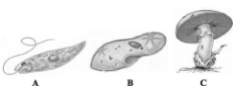
Identify the figures $A$, $B$ and $C$ given below.
- ✓
$A$- Euglena, $B$ - Paramecium, $C$ - Agaricus
- B
$A$ - Trypanosoma, $B$ - Planaria, $C$ - Agaricus
- C
$A$ - Leishmania, $B$ - Vorticella, $C$ - Agaricus
- D
$A$ - Euglena, $B$ - Leishmania, $C$ - Aspergillus
AnswerCorrect option: A. $A$- Euglena, $B$ - Paramecium, $C$ - Agaricus
a
Euglenoids include flagellates like Euglana which have plant like characteristics (chlorophyll) in addition to some animal characteristics. Paramoecium is a ciliated protozoan, aquatic and actively moving organisms because of the presence of thousands of cilia. Agaricus (mushroom) belongs to class basidiomycetes of kingdom Fungi.
View full question & answer→MCQ 461 Mark
Bacteria and yeast are similar in all the following features except that
- A
- ✓
- C
both are capable of causing fermentation.
- D
Answerb
Bacteria and Yeast are unicellular organism that show anaerobic respiration /fermentation and reproduce by forming spores. But, yeast is not prokaryotic;Bacteria are prokaryotes .Yeast belongs to the kingdom Fungi, they are multicellular eukaryotes.
View full question & answer→MCQ 471 Mark
Which of the following organisms is lare correctly assigned its/their taxonomic group
- A
Paramecium and Plasmodium belong to the same kingdom as that of Penicillium.
- B
Lichen is a composite organism formed from the symbiotic association of an alga and a protozoan.
- ✓
Yeast is a fungus that is used in making bread and beer
- D
Nostoc and Anabaena are examples of protista.
AnswerCorrect option: C. Yeast is a fungus that is used in making bread and beer
c
Saccharomyces cervisiae is a yeast used in making bread (Baker's yeast) and commercial production of ethanol.
Paramecium and Plasmodium are both Protozoan Protists while Penicillium is a fungi.
Lichen is composite organism formed from the symbiotic association of an alga and a fungus.
Nostoc and Anabaena are nitrogen fixing cyanobateria (kingdom monera).
View full question & answer→MCQ 481 Mark
Select the $wrong$ statement:
- A
Mitochondria are the powerhouse of the cell in all kingdoms except Monera
- B
Cell wall is present in members of Fungi and Plantae
- C
Mushrooms belong to Basidiomycetes
- ✓
Pseudopodia are locomotory and feeding structures in Sporozoans.
AnswerCorrect option: D. Pseudopodia are locomotory and feeding structures in Sporozoans.
View full question & answer→MCQ 491 Mark
True nucleus is absent in
MCQ 501 Mark
How many organisms in the list given below show autrophic nutrition method? Lactobacillus, Nostoc, Chara, wolffia, Nistrosomonas, Nitrobacter, porphyra Streptococus, Saccharomyces, Trypanosoma,
Answerc
Autotrophic bacteria synthesize their cell constituents using carbon dioxide as the carbon
source.
From the list, autotrophic bacteria include a total of six as Chara, Nostoc, Porphyra, Wolfia, Nitrosomonas, Nitrobacter. Of these Chara, Nostoc, Porphyra, Wolfia is photoautotrophs while Nitrosomonas, Nitrobacter are chemoautotrophs. The other four (Lactobacillus, Streptomyces, Saccharomyces, Trypanosoma) are heterotrophs meaning they utilize organic compounds as a source of food.
Thus, the correct answer is option C.
View full question & answer→MCQ 511 Mark
Arrange the following microbes/organism in ascending order according to their complexity of body. (Simple to complex)
$a$ - animal, $b$- viroids, $c$-bacteria $d$ - virus, $e$ - algae.
- A
$a-c-b-d-e$
- ✓
$b-d-c-e-a$
- C
$c-a-d-b-e$
- D
$e-d-c-a-b$
AnswerCorrect option: B. $b-d-c-e-a$
View full question & answer→MCQ 521 Mark
Saprobiotic and parasitic modes of nutrition are found in
AnswerCorrect option: D. Both $(a)$ and $(c)$
d
(d) Both are heterotrophic in their mode of nutrition, so they are saprophytic or parasitic.
View full question & answer→MCQ 531 Mark
Cephaloridine may not act upon
MCQ 541 Mark
Bovine spongiform encephalopathy disease is equal to:
- A
- B
- ✓
Creutzfeldt-Jacob disease
- D
AnswerCorrect option: C. Creutzfeldt-Jacob disease
View full question & answer→MCQ 551 Mark
$A $: Viruses which infect animals generally possess $ssRNA$ or $dsRNA$ or $dsDNA$.
$R$ : Phytophagineae generally contain $dsDNA$
- A
Assertion and Reason both are correct and also correct explanation.
- B
Assertion and Reason both are correct but not explanation of assertion.
- ✓
Assertion is correct, but Reason is incorrect.
- D
Both Assertion and Reason are incorrect.
AnswerCorrect option: C. Assertion is correct, but Reason is incorrect.
c
Phytophginae generally contain $ssRNA$
View full question & answer→MCQ 561 Mark
$A$ : Viroids are not included in five kingdom system.
$R$ : They are non-cellular.
- ✓
Assertion and Reason both are correct and also correct explanation.
- B
Assertion and Reason both are correct but not explanation of assertion.
- C
Assertion is correct, but Reason is incorrect.
- D
Both Assertion and Reason are incorrect.
AnswerCorrect option: A. Assertion and Reason both are correct and also correct explanation.
View full question & answer→MCQ 571 Mark
$A$ : Phycobiont is dominant parent in lichens.
$R$ : Algal component in the dual organisms can be eukaryotic only.
- A
Assertion and Reason both are correct and also correct explanation.
- B
Assertion and Reason both are correct but not explanation of assertion.
- C
Assertion is correct, but Reason is incorrect.
- ✓
Both Assertion and Reason are incorrect.
AnswerCorrect option: D. Both Assertion and Reason are incorrect.
d
Mycobiont is dominant parent in lichens.
Fungi is eukaryote but algae can be prokaryote or eukaryote.
View full question & answer→MCQ 581 Mark
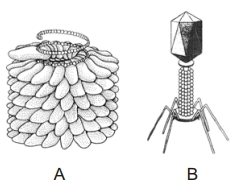
dentify $A$ and $B$ given below:
- A
$A$ - $DNA$ vius - Cauliflower mosaic virus
$B$ - $RNA$ virus - Pox virus
- ✓
$A$ - $RNA$ virus - $T.M.V$
$B$ - $DNA$ virus - $T_{4}$ bacteriophage
- C
$A $- $RNA$ virus - Hepatitis $B$ virus
$B $- Reterovinus - $T.M.V$
- D
$A$ - Reterovirus - Hepatitis $B$ virus
$B$ - $RNA$ virus - $T_{4}$ bacterophage
AnswerCorrect option: B. $A$ - $RNA$ virus - $T.M.V$
$B$ - $DNA$ virus - $T_{4}$ bacteriophage
b
$TMV$ - $RNA$ Virus
$T_{4}$ bacteriaphage - $DNA$ virus
View full question & answer→MCQ 591 Mark
Viruses possess all the following properties, except
AnswerCorrect option: B. Possess both $DNA$ and $RNA$
b
Viruses posses either $DNA$ or $RNA.$
View full question & answer→MCQ 601 Mark
Symptom not seen in plants due to viruses is
Answerd
Viral symptoms in plants
- Mosaic formation
- Leaf rolling and curling
- Yellowing, vein clearing
View full question & answer→MCQ 611 Mark
Lichens show symbiotic relationship between
Answera
Lichen (Algae and fungi)
View full question & answer→MCQ 621 Mark
Select the correct statement.
AnswerCorrect option: C. Mumps and Herpes are viral diseases
c
$(i)$ Viroids-infectious $RNA$ particles
$(ii)$ $RNA$ of viroids have low molecular weight.
$(iii)$ Name virus was given by Pasteur
View full question & answer→MCQ 631 Mark
Viruses that infect the bacteria are termed as
Answerb
Bacteriphages - Viruses that infect the bacteria
View full question & answer→MCQ 641 Mark
Which of the following statement is incorrect about viruses?
- A
Viruses contain either $RNA$ or $DNA.$
- B
Viruses do not have their own metabolic system
- C
Bacteriophages are usually double stranded $DNA$ viruses
- ✓
$TMV$ contains both $RNA$ and $DNA$ as its genetic material
AnswerCorrect option: D. $TMV$ contains both $RNA$ and $DNA$ as its genetic material
d
$TMV$ contains $RNA$ as its genetic material
View full question & answer→MCQ 651 Mark
$T. O.$ Diener discovered a new infectious agent that was smaller than viruses and have the following characteristics.
$(i)$ It causes potato spindle tuber disease.
$(ii)$ It has free $RNA.$
$(iii)$ Molecular weight of $RNA$ is low. Identify the infections agent.
Answerb
Viroids cause potato spindle tuber disease $(PSTV)$, chrysanthemum stunt, citrus exocortis, cucumber pale fruit etc. They cause persistent infections, i.e., never recovered.
View full question & answer→MCQ 661 Mark
Which of the following statements is incorrect?
- ✓
$TMV$ has a double-stranded $RNA$ molecule.
- B
Most plant viruses are $RNA$ viruses.
- C
The bacteriophages are usually double stranded $DNA$ viruses
- D
Animal viruses are either single or double stranded $RNA$ or double stranded $DNA$ viruses.
AnswerCorrect option: A. $TMV$ has a double-stranded $RNA$ molecule.
a
Tobacco mosaic virus ($TMV$) is a single stranded $RNA$ virus that infects a wide range of plants, especially tobacco and other members of the family Solanacea.
View full question & answer→MCQ 671 Mark
Which of the following statements is not correct for viruses?
- A
Viruses are obligate parasites.
- B
Viruses can multiply only when they are inside the living cells.
- ✓
Viruses cannot pass through bacterial filters.
- D
Viruses are nucleoprotein particles
AnswerCorrect option: C. Viruses cannot pass through bacterial filters.
c
Virus is a small infectious agent that replicates only inside the living cells of other organisms. Viruses can infect all types of life forms, from animals and plants to microorganisms, including bacteria and archaea. Viruses can pass through bacterial proof filters as they are smaller than bacteria.
View full question & answer→MCQ 681 Mark
The genetic material of virus includes
AnswerCorrect option: D. $RNA$ or $DNA$, i.e., one nucleic acid in a virus.
d
Viruses are obligate intracellular parasite which can reproduce only by invading and taking over other cells as they lack the cellular machinary for self reproduction. Viruses have either $DNA$ or $RNA$ as the genetic material. Viruses having $RNA$ as the genetic material are known as Retroviruses.
View full question & answer→MCQ 691 Mark
The subunit of capsid is called
Answerd
The capsomere is a subunit of the capsid, an outer covering of protein that protects the genetic material of a virus. Capsomeres self-assemble to form the capsid.
View full question & answer→MCQ 701 Mark
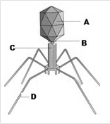
The given figure shows some structures labelled as $A, B, C$ and $D$. Which structure has the protein coat that encloses the nucleic acid?
Answera
The structure marked as $A , B , C$ and $D$ are respectively head, collar, sheath and tail fibres. In head (structure marked as A), the protein coat (called the capsid) made of small subunits called capsomeres, protect the nucleic acid.
View full question & answer→MCQ 711 Mark
A scientist "$X$" demonstrated that extract of infected plants of " $Y$ " could cause infection in healthy plants and called the fluid as "Contagium vivum fluidum". Identify $X$ and $Y$.
- A
- ✓
M. W. Beijerinek , Tobacco
- C
D. J. Ivanowsky, Cauliflower
- D
AnswerCorrect option: B. M. W. Beijerinek , Tobacco
b
M. W. Beijerinek demonstrated that extract of infected plants of tobacco could cause infection in healthy plants and called the fluid as "Contagium vivum fluidum".
View full question & answer→MCQ 721 Mark
In some viruses, $RNA$ is present instead of $DNA$ indicating that
AnswerCorrect option: D. $RNA$ can transfer heredity material.
d
Viruses are defined as infectious nucleoproteins. A complete virus particle is called virion whose main function is to deliver its $DNA$ or $RNA$ gesnome into the host cell, so that genome can be expressed by the host cell. In a particular virus either $DNA$ or $RNA $is genetic material, never both are present in a virus. Hence, viruses are: $(i)$ Double stranded $DNA$ or ds $DNA$ - Hepatitis B $(ii)$ Single stranded $DNA$ or ss $DNA$ - coliphage $(iii)$ Double stranded $RNA$ or ds $RNA $- Reo virus, wound Tumor virus $(iv)$ Single stranded $RNA$ or ss $RNA$ - Tobacco mosaic virus $(TMV)$
View full question & answer→MCQ 731 Mark
A virus can be considered a living organism because it
- A
- B
- ✓
reproduces (inside the host)
- D
AnswerCorrect option: C. reproduces (inside the host)
c
A virus is an infective agent that typically consists of a nucleic acid molecule in a protein coat. It is too small to be seen by light microscopy, and is able to multiply only within the living cells of a host. It can be considered living organisms because it reproduces inside the host cell.
View full question & answer→MCQ 741 Mark
They are pollution indicatar and never grow on poouted area
MCQ 751 Mark
Select the wrong statements
- A
W.M. Stanley showed that viruses could be crystallized
- B
The term 'contagium vivum fluidum' was coined by M.W. Bejerinek
- C
Mosaic disease in tobacco and AIDS inhuman being are caused by virus
- ✓
The viroids were dicovered by D.J.lavanowski
AnswerCorrect option: D. The viroids were dicovered by D.J.lavanowski
View full question & answer→MCQ 761 Mark
Which of the following statements is wrong for viroids?
AnswerCorrect option: B. Their $RNA$ is of high molecular weight
View full question & answer→MCQ 771 Mark
AnswerCorrect option: A. $DNA$ enclosed in a protein coat
View full question & answer→MCQ 781 Mark
Which of the following shows coiled $RNA$ strand and cashmeres ?
View full question & answer→MCQ 791 Mark
Which statement is wrong for viruses ?
- A
- ✓
All of them have helical symmetry
- C
They have ability to synthesize nucleic acids and proteins
- D
Antibiotic have no effect on them
AnswerCorrect option: B. All of them have helical symmetry
View full question & answer→MCQ 801 Mark
- ✓
$RNA$ with lack of protein layer
- B
A protein chain without $DNA$ layering
- C
Double strands of $DNA$ with protein layer
- D
$DNA$ with lipid layer
AnswerCorrect option: A. $RNA$ with lack of protein layer
View full question & answer→MCQ 811 Mark
Who stated that virus are crystelline ?
MCQ 821 Mark
The genome of transducing phages is
- A
Single stranded $RNA$
- B
Double stranded $RNA$
- C
Single stranded $DNA$
- ✓
Double stranded $DNA$
AnswerCorrect option: D. Double stranded $DNA$
View full question & answer→MCQ 831 Mark
Which one of the following statements is correct
- ✓
Viruses are obligate parasites
- B
- C
- D
Bacteria are always harmful to mankind
AnswerCorrect option: A. Viruses are obligate parasites
a
(a) Viruses are obligate parasites because they cannot multiply or grow outside the host cells.
View full question & answer→MCQ 841 Mark
'Viroids' differ from 'viruses' in being
- ✓
Naked $RNA$ molecules only
- B
Naked $DNA $ molecules only
- C
Naked $DNA$ packaged with viral genome
- D
Satellite $ RNA$ packaged with viral genome
AnswerCorrect option: A. Naked $RNA$ molecules only
a
(a) Viruses are made up of proteins and nucleic acids while viroids are naked $RNA $ molecules.
View full question & answer→MCQ 851 Mark
$DNA$ is not present in one of the following
Answerd
(d) Because plant viruses have $RNA$ as genetic material.
View full question & answer→MCQ 861 Mark
Lichens are ecologically important as they
- A
- ✓
Are pioneers of barren rocks
- C
Are symbionts of algae and fungi
- D
Are associated with mycorrhizal roots
AnswerCorrect option: B. Are pioneers of barren rocks
b
(b)Lichens are considered as pioneers in initiating a plant succession on rocks.
View full question & answer→MCQ 871 Mark
Cause of ‘Mad Cow’ disease of England
MCQ 881 Mark
Which of the following is not concerned with viruses
- A
Viruses are made up of nucleic acid and proteins
- B
Viruses multiply only in living host cell
- C
Viruses can not use oxygen for respiration
- ✓
Viruses can be grown in sugary liquid
AnswerCorrect option: D. Viruses can be grown in sugary liquid
View full question & answer→MCQ 891 Mark
The best supporting fact that "Viruses are living'' is that viruses
MCQ 901 Mark
View full question & answer→MCQ 911 Mark
Answerb
(b)Influenza is caused by virus. It is a $RNA$ virus with a helical capsid surrounded by an envelope with spike.
View full question & answer→MCQ 921 Mark
Virus that infects bacteria is called
MCQ 931 Mark
- ✓
A virus attacking a bacterium
- B
A bacterium attacking a virus
- C
A stage in the life-cycle of bacterium
- D
A virus attacking another virus
AnswerCorrect option: A. A virus attacking a bacterium
View full question & answer→MCQ 941 Mark
The protein coat of virus is called
Answera
(a) The outermost covering of virus, called capsid which is made up of protein.
View full question & answer→MCQ 951 Mark
The Tobacco mosaic virus was crystallized for first time by
MCQ 961 Mark
Virus with icosahedral head and helical tail is termed as
MCQ 971 Mark
Bacteriophage is made up of
AnswerCorrect option: C. Nucleoprotein $(Nucleic\, acid + protein)$
c
(c) Bacteriophage is a virus which infect bacteria. In its tadpole like structure,$ DNA$ is found inside the proteinous head.
View full question & answer→MCQ 981 Mark
View full question & answer→MCQ 991 Mark
View full question & answer→MCQ 1001 Mark
Which of the following is a viral disease
MCQ 1011 Mark
Potato tuber spindle disease is caused by
MCQ 1021 Mark
The structure present in nature which is living and non-living both is
MCQ 1031 Mark
Which of the following is true for viruses
AnswerCorrect option: B. They multiply only in host cell
View full question & answer→MCQ 1041 Mark
View full question & answer→MCQ 1051 Mark
The part of the virus which gives to it the hereditary feature, is
Answerc
Be it virus or any other system heredity information is always carried by nucleic acids. The sequence of nucleotide bases in a molecule of nucleic acid is the genetic or heredity information
View full question & answer→MCQ 1061 Mark
One of the living symbols of virus is
MCQ 1071 Mark
Which is not true for viruses
- A
Double stranded $DNA$
- B
Double stranded $ RNA$
- ✓
Both $DNA$ and $ RNA$
- D
Single stranded $ DNA$
AnswerCorrect option: C. Both $DNA$ and $ RNA$
View full question & answer→MCQ 1081 Mark
Genetic material in $TMV $ is
- A
$DNA$
- ✓
$RNA$
- C
- D
Both $DNA$ and $ RNA$
Answerb
(b) Genetic material of $ TMV $ is single stranded $RNA.$
View full question & answer→MCQ 1091 Mark
Viruses were called Contagium vivum fluidum by
MCQ 1101 Mark
The filterable property of tobacco mosaic virus $(TMV)$ was shown by
View full question & answer→MCQ 1111 Mark
Virus was assigned its name by
MCQ 1121 Mark
Most of the plant viruses are characterized in having
- A
$DNA$
- ✓
$RNA$
- C
$DNA$ and $ RNA$
- D
View full question & answer→MCQ 1131 Mark
Protein of capsomeres is made up of
MCQ 1141 Mark
Which of the following is called "filterable agent''
MCQ 1151 Mark
Absence of respiration is what type of character of a virus
MCQ 1161 Mark
Which of the following is absent in virus
MCQ 1171 Mark
AnswerCorrect option: C. Both $(a)$ and $(b)$
c
(c) The outer coat of virus is made up of protein inside which $DNA$ or $ RNA$ is found as nucleic acid.
View full question & answer→MCQ 1181 Mark
Which have great importance in genetics?
Answerc
Neurospora complete their sexual life cycle in a few days and thus, make ideal organism for the study of laws of heredity. Penicillin, a potent antibiotic is obtained from Penicillium notatum and $LSD$ is obtained from Claviceps purpurea.
View full question & answer→MCQ 1191 Mark
$A$ : Secondary mycelium of Agaricus is binucleated.
$R$ : Secondary mycelium is formed by somatogamy of primary mycelium.
- ✓
Assertion and Reason both are correct and also correct explanation.
- B
Assertion and Reason both are correct but not explanation of assertion.
- C
Assertion is correct, but Reason is incorrect.
- D
Both Assertion and Reason are incorrect.
AnswerCorrect option: A. Assertion and Reason both are correct and also correct explanation.
View full question & answer→MCQ 1201 Mark
Select incorrectly matched pair
- A
Mucor mucedo - Coprophilous
- ✓
Albugo candida - Facultative parasite
- C
Agaricus bisporus - Edible basidiocarp
- D
Puccinia graminis - Black rust fungi
AnswerCorrect option: B. Albugo candida - Facultative parasite
b
Albugo candida -Obligate parasite
View full question & answer→MCQ 1211 Mark
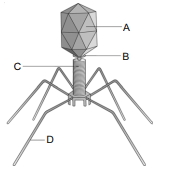
Identify $A, B, C$ and $D$ parts in this diagram of bacteriophage.
- A
$A$ - Head, $B$ - Sheath, $C$ - Collar, $D$ - Tail fibres
- ✓
$A$ - Head, $B$ - Collar, $C$ - Sheath $D$ - Tail fibres
- C
$A$ - Head ,$B$ - Collar ,$C$ - Tail fibres, $D$ - Sheath
- D
$A$ -Head, $B$ -Sheath, $C$ - Tail fibres, $D$ - Collar
AnswerCorrect option: B. $A$ - Head, $B$ - Collar, $C$ - Sheath $D$ - Tail fibres
b
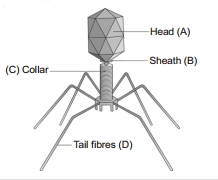
View full question & answer→MCQ 1221 Mark
Which one is correctly matched?
- A
- B
- C
Puccinia - Insectivorous plant
- ✓
Deuteromycetes - Imperfect fungi
AnswerCorrect option: D. Deuteromycetes - Imperfect fungi
d
Agaricus - Mushroom
Ustilago - Smut
Puccinia - Rust
Deuteromycetes - Imperfect fungi
View full question & answer→MCQ 1231 Mark
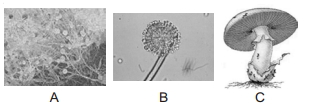
Identify $A, B$ and $C$ in given diagram.
- ✓
$A =$ Mucor, $B =$ Aspergilus, $C =$ Agaricus
- B
$A =$ Mucor, $B =$ Agaricus, $C =$ Aspergillus
- C
$A =$ Agaricus, $B =$ Mucor, $C =$ Aspergillus
- D
$A =$ Agaricus, $B =$ Aspergillus, $C =$ Mucor
AnswerCorrect option: A. $A =$ Mucor, $B =$ Aspergilus, $C =$ Agaricus
a
Mucor - Zygomycetes
AspergiNus - Ascomycetes
Agaricus - Basidiomycetes
View full question & answer→MCQ 1241 Mark
The members of which group are commonly known as sac fungi?
Answerd
Sac fungi - Ascomycetes
Club fungi - Basidiomycetes
Imperfect fungi - Deuteromycetes
OR
Dustbin fungi
Algal fungi - Oomycetes
Conjugated fungi - Zygomycetes
View full question & answer→MCQ 1251 Mark
Coenocytic mycelium is found in
Answerb
Coenocytic mycelium - Oomycetes and Zygomycetes
Septate mycelium - Deuteromycetes, Ascomycetes and Basidiomycetes
View full question & answer→MCQ 1261 Mark
Haploid sexual spore produced exogenously is
Answerb
Exogenous haploid sexual spore - Basidiospore
Endogenous haploid sexual spore - Ascospores
View full question & answer→MCQ 1271 Mark
Vegetative reproduction by fragmentation is common in
Answera
Vegetative reproduction by fragmentation is common in fungi.
View full question & answer→MCQ 1281 Mark
The fungi form fruiting bodies in which _________ division occurs, leading to formation of _________ spores.
Answerb
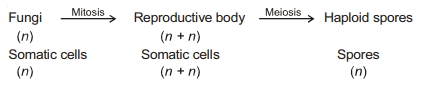
View full question & answer→MCQ 1291 Mark
The sex organs are absent, but plasmogamy is brought about by fusion of two vegetative or somatic cells of different genotypes. It is the feature of
Answerb
Basidiomycetes
$\bullet$ Sex organs absent
$\bullet$ Fusion of two vegetative/somatic cells of different genotypes
View full question & answer→MCQ 1301 Mark
Mark the correct statement.
- A
Phycomycetes include mushrooms, bracket fungi or puff balls
- ✓
The mycelium of basidiomycetes is branched and septate
- C
Neurospora is used extensively in biochemical and genetic work, it belongs to group basidiomycetes
- D
Morels and truffles are non-edible
AnswerCorrect option: B. The mycelium of basidiomycetes is branched and septate
b
Basidiomycetes include mushrooms, bracket fungi or puff balls.
Neurospora belongs to group ascomycetes.
Morels and Truffles are edible.
View full question & answer→MCQ 1311 Mark
$Statement-1$ : Yeast is a multicellular fungus.
$Statement-2$ : Penicillium is an unicellular fungus.
$Statement-3$ : Albugo is a parasitic fungus on mustard.
- A
Only $statement-1$ and $statement-2$ are correct
- B
All the above statements are incorrect
- ✓
Only $statement-3$ is correct
- D
Both $statement-1$ and $statement-3$ are correct
AnswerCorrect option: C. Only $statement-3$ is correct
c
Yeast is a unicellular fungus.
Penicillium is a multicellular fungus.
Albugo is a parasitic fungus, causes white rust in crucifers.
View full question & answer→MCQ 1321 Mark
Which is the incorrect statement regarding fungi?
- A
Wheat rust causing agent is Puccinia
- B
Penicillium is a source of antibiotic
- ✓
The cell wall of fungi are composed of peptidoglycan
- D
Fungi prefer to grow in warm and humid places
AnswerCorrect option: C. The cell wall of fungi are composed of peptidoglycan
c
Cell wall of fungi are composed of Chitin and Polysaccharide
View full question & answer→MCQ 1331 Mark
Which of the following statement(s) is/are correct?
$(i)$ Reproduction in fungi can take place by vegetative means - fragmentation and budding.
$(ii)$ Fusion of two nuclei is called plasmogamy.
$(iii)$ Fusion of protoplasms between two motile or nonmotile gametes is called karyogamy.
$(iv)$ Meiosis in zygote results in diploid spores.
- ✓
Only $(i)$
- B
Both $(ii)$ and $(iii)$
- C
$(ii), (iii)$ and $(iv)$
- D
AnswerCorrect option: A. Only $(i)$
a
Fusion of two nuclei is called karyogamy.
Fusion of protoplasms between two motile or non-motile gametes called plasmogamy.
Meiosis in zygote results in haploid spores.
View full question & answer→MCQ 1341 Mark
Read the following statements and answer the question.
$(i)$ Some members are saprophytes or parasites while a large number of them are decomposers of litter and help in mineral cycling.
$(ii)$ They reproduce only by asexual spores known as conidia.
$(iii)$ Mycelium is septate and branched.
$(iv)$ Alternaria, Colletotrichum and Trichoderma are examples of this class. Which of the following class of fungi is being described by the above statements?
Answerb
Deuteromycetes is an artificial group without any common relationship. They are commonly known as fungi imperfecti due to absence of perfect sexual stage. They have septate hyphae and reproduce asexually by means of conidia.
View full question & answer→MCQ 1351 Mark
Which of the following statement(s) is/are correct about class basidiomycetes?
$(i)$ They are commonly known as imperfect fungi because only the asexual or vegetative phases of these fungi are known.
$(ii)$ They grow in soil, on logs and tree stumps and
$(iii)$ Live inside plant bodies as parasites, e.g., rusts and smuts
$(iv)$ Some common members are Agaricus, Ustilago and Puccinia.
- A
Only $(i)$
- B
Both $(i)$ and $(ii)$
- ✓
$(ii), (iii)$ and $(iv)$
- D
AnswerCorrect option: C. $(ii), (iii)$ and $(iv)$
c
Basidiomycetes are commonly known as club fungi. Other commonly known forms of basidiomycetes are mushrooms, bracket fungi or puffballs.
View full question & answer→MCQ 1361 Mark
Which of the following statement(s) is/are correct about ascomycetes?
$(i)$ Neurospora, which is used in biochemical and genetic work is a member of this class.
$(ii)$ They are mostly multicellular, e.g., Yeast, or rarely unicellular, e.g., Penicillium.
$(iii)$ They are saprophytic, decomposers, parasitic or coprophilous.
$(iv)$ Some examples are Aspergillus, Claviceps and Neurospora.
AnswerCorrect option: C. $(i), (iii) \;and \;(iv)$
View full question & answer→MCQ 1371 Mark
Which of the following class of fungi is being described by the given statements ?
$(i)$ They are found in aquatic habitats and on decaying wood in moist and damp places.
$(ii)$ Mycelium is aseptate and coenocytic.
$(iii)$ Asexual reproduction takes place by zoospores (motile) or by aplanospores (non-motile).
$(iv)$ Some common examples are Mucor, Rhizopus and Albugo.
Answerb
Phycomycetes is a large and important class of parasitic or saprophytic fungi, the algal or alga like fungi. The plant body ranges from an undifferentiated mass of protoplasm to a welldeveloped and much-branched mycelium. Mycelium is aseptate and coenocytic. Asexual reproduction takes place by spores and sexual reproduction by the formation of conidia or sporangia.
View full question & answer→MCQ 1381 Mark
Read the given statements and answer the question.
$(i)$ It includes unicellular as well as multicellular fungi.
$(ii)$ In multicellular forms, hyphae are branched and septate.
$(iii)$ Conidiophore produces conidia (spores) exogenously in chain.
$(iv)$ Sexual spores are ascospores produced endogenously in chain.
$(v)$ Fruiting body is called ascocarp. Identify the correct class of fungi which have all the above given characteristics.
Answerb
Sac fungi is a common name of ascomycetes which produce spores in a distinctive type of microscopic sporangium called an ascus. They are characterized by well-developed thallus and production of ascospores. They are the largest class of fungi. Examples of sac fungi are yeasts, morels, truffles, and Penicillium.
View full question & answer→MCQ 1391 Mark
Select the correct match from the given option.
- ✓
Occurrence of dikaryotic stage - ascomycetes and basidiomycetes.
- B
Saprophytes - They are autotrophic and absorb soluble organic matter from dead substrates.
- C
Vegetative mean of reproduction in fungi fragmentation, budding and gemmae cup
- D
Steps involved in asexual cycle of fungi - plasmogamy, karyogamy and meiosis in zygote resulting in haploid spores.
AnswerCorrect option: A. Occurrence of dikaryotic stage - ascomycetes and basidiomycetes.
a
Saprophytes are heterotrophic and absorb soluble organic matter from dead substrates. Vegetative mean of reproduction in fungi are fragmentation, budding and fission. Steps involved in sexual cycle of fungi are plasmogamy, karyogamy and meiosis in zygote resulting in haploid spores.
View full question & answer→MCQ 1401 Mark
Match the class of fungi given in column $I$ with their examples given in column $II$ and choose the correct option
| Column-$I$ (Class of fungi) |
Column-$II$ (Examples) |
| $A$. Ascomycetes |
$I$. Rhizopus |
| $B$. Basidiomycetes |
$II$. Penicillium |
| $C$. Deuteromycetes |
$III$. Ustilago |
| $D$. Phycomycetes |
$IV$. Alternaria |
- A
$A-I V, B-III, C-I, D-II$
- ✓
$A-II, B-I I I, C-I V, D-I$
- C
$A-I V, B-I, C-I I, D-I I I$
- D
$A-I I I, B-I V, C-I I, D-I$
AnswerCorrect option: B. $A-II, B-I I I, C-I V, D-I$
View full question & answer→MCQ 1411 Mark
Match the class of fungi given in column-$I$ with their common name given in column-$II$ and select the correct option.
| Column-$I$ [Class of fungi) |
Column-$II$ (Common name) |
| $A$. Phycomycetes |
$I$. Sac fungi |
| $B$. Ascomycetes |
$II$. Algal fungi |
|
$C$. Basidiomycetes
|
$III$. Fungi imperfecti |
| $D$. Deuteromycetes |
$IV$. Club fungi |
- ✓
$A - II , B - I , C - IV , D - III$
- B
$A - II , B - IV , C -I, D - III$
- C
$A - IV , B - I , C - II , D - III$
- D
$A - IV , B - III , C - II , D -I$
AnswerCorrect option: A. $A - II , B - I , C - IV , D - III$
a
Phycomycetes, ascomycetes, basidiomycetes and deuteromycetes are four classes of fungi which are divided on the basis of the septation of the mycelium and the characteristics features of reproduction. Phycomycetes, ascomycetes, basidiomycetes and deuteromycetes are respectively commonly known as algal like fungi, sac fungi, club fungi and fungi imperfecti.
View full question & answer→MCQ 1421 Mark
Fungi are filamentous with the exception of " $X$ " which is unicellular. Identify $X$. $y$
Answera
Yeast being a unicellular fungus does not show filamentous nature. It is a microscopic fungus consisting of a single oval cell that reproduces by budding.
View full question & answer→MCQ 1431 Mark
Plasmogamy is the fusion of
- A
two haploid somatic cells including their nuclei.
- ✓
two haploid cell cytoplasm without nuclear fusion.
- C
- D
sperm and two polar nuclei.
AnswerCorrect option: B. two haploid cell cytoplasm without nuclear fusion.
b
Plasmogamy is the first stage of sexual reproduction in which the cytoplasm of two sex cells fuse with each other. The nuclei of sex cells come close to each other but do not fuse. Thus, the resulting cell becomes binucleate or dikaryon.
View full question & answer→MCQ 1441 Mark
Dikaryon formation is the characteristic feature of
- ✓
ascomycetes and basidiomycetes.
- B
phycomycetes and basidiomycetes.
- C
ascomycetes and deuteromycetes
- D
phycomycetes and deuteromycetes
AnswerCorrect option: A. ascomycetes and basidiomycetes.
a
In fungi (ascomycetes and basidiomycetes), kayrogamy is delayed and occurs just before meiosis. In the stage intervening between plasmogamy and karyogamy the cells often contain two nuclei or dikaryons $(n+n) .$ Such cells are called dikaryotic cells. The phase is known as dikaryophase.
View full question & answer→MCQ 1451 Mark
Which group of fungi is commonly known as imperfect fungi?
Answerd
Deuteromycetes is commonly known as fungi imperfecti due to absence of perfect sexual stage. They are classed by the colour and structure of the conidia. Since most of the conidia structures look like ascomycetes type, they are believed to be derived from ascos which does not have the ability to reproduce sexually.
View full question & answer→MCQ 1461 Mark
Which of the following is/are example(s) of deuteromycetes?
Answerd
Deuteromycetes is also known as fungi imperfecti because the perfect (sexual) stage is either absent or not reported. Alternaria, Colletotrichum and Trichoderma belong to deuteromycetes.
View full question & answer→MCQ 1471 Mark
Which of the following is used extensively in biochemical and genetic work?
Answerc
Neurospora belongs to class ascomycetes and kingdom Fungi. It is used extensively in biochemical and genetic work.
View full question & answer→MCQ 1481 Mark
Which of the following is a parasitic fungi on the mustard plant?
Answera
Albugo is the parasitic fungi on mustard and belongs to the class phycomycetes and kingdom fungi.
View full question & answer→MCQ 1491 Mark
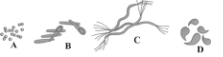
Choose the correct names of the different bacteria given below according to their shapes.
- ✓
$A$- Cocci, $B$ - Bacilli, $C$ - Spirilla, $D$ - Vibrio
- B
$A$ - Bacilli, $B$- Cocci, $C$ - Spirilla, $D$ - Vibrio
- C
$A -$ Spirilla, $B$ - Bacilli, $C$ - Cocci, $D$ - Vibrio
- D
$A-$ Spirilla, $B$ - Vibrio, $C $- Cocci, $D$ - Bacilli
AnswerCorrect option: A. $A$- Cocci, $B$ - Bacilli, $C$ - Spirilla, $D$ - Vibrio
a
$A$ - Cocci (spherical), $B$ - Bacilli (rod shaped), $C$ Spirilla (spiral), $D$ - Vibrio (comma shaped). These are all the shapes of the bacteria.
View full question & answer→MCQ 1501 Mark
Refer to the statement and answer the question. "Once the sexual stage of members of deuteromycetes were discovered, they were of ten moved to $X$ and $Y$ " Identify $X$ and $Y$.
- A
$X -$ Monera; $Y$ - Protista
- B
$X$ - Basidiomycetes; $Y$ Phycomycetes
- ✓
$X$ - Ascomycetes; $Y -$ Basidiomycetes
- D
$X$ - Phycomycetes ; $Y$ - Archaebacteria
AnswerCorrect option: C. $X$ - Ascomycetes; $Y -$ Basidiomycetes
c
Deuteromycetes is commonly known as fungi imperfecti. Once the sexual stage of members of deuteromycetes was discovered they were often moved to ascomycetes and basidiomycetes.
View full question & answer→MCQ 1511 Mark
Which class of fungi lacks sex organs but the process of plasmogamy is brought about by fusion of two vegetative or somatic cells of different strains or genotypes?
Answerb
Club fungi or basidiomycetes is the class of fungi that lacks sex organs but they show sexual reproduction by the process of plasmogamy which is brought about by fusion of two vegetative or somatic cells of different strains or genotypes.
View full question & answer→MCQ 1521 Mark
Identify the basis of classification of fungi into phycomycetes, ascomycetes, basidiomycetes and deuteromycetes.
$i$. Fruiting bodies
$ii$. Nature of habitat
$iii$. Morphology of mycelium
$iv$. Mode of spore formation
- A
$i$ & $ii$ only
- B
$ii$ & $iii$ only
- ✓
$i$, $iii$, & $iv$ only
- D
AnswerCorrect option: C. $i$, $iii$, & $iv$ only
c
Fruiting bodies, morphology of mycelium and mode of spore formation are the basis of classification of fungi into phycomycetes, ascomycetes, basidiomycetes and deuteromycetes. habitat is not the criteria for classification of fungi
View full question & answer→MCQ 1531 Mark
An " $X$ " reproduces in such a great numbers that the water may appear, producing a red tides and kills large marine animals like $"Z"."X"$ belongs to $"Y".$ Identify $"X", "Y"$ and $"Z"$.
- ✓
$X$-Gonyaulax; $Y$-Dinoflagellates; $Z$-Fishes
- B
$X$ - Paramecium ; $Y$ - Protozoa ; $Z$ Crocodiles
- C
$X$ - Trypanosoma; $Y-$ Protozoa $; Z$ - Frogs
- D
$X$ - Plasmodium ; $Y$ - Euglenoids; $Z$ - Oysters
AnswerCorrect option: A. $X$-Gonyaulax; $Y$-Dinoflagellates; $Z$-Fishes
a
A Gonyaulax reproduces in such a great numbers that the water may appear red, producing a red tides and kills large marine animals like fishes. Gonyaulax belongs to dinoflagellates.
View full question & answer→MCQ 1541 Mark
Assume that two normal hyphal cells of different fungal mating types unite to form
- A
- B
- C
- ✓
dikaryotic cell forming secondary mycelium
AnswerCorrect option: D. dikaryotic cell forming secondary mycelium
d
When two hyphal cells of different mating types fuse, they form a dikaryotic cell which is heterokaryotic.
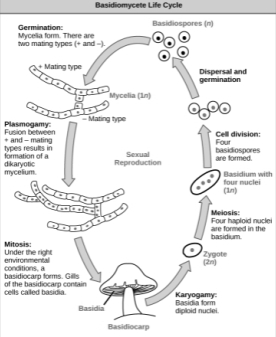
View full question & answer→MCQ 1551 Mark
Fungi show asexual reproduction by all of the following kinds of spores except
Answerb
In fungi, asexual reproduction takes place by spores called conidia or sporangiospores or zoospores, and sexual reproduction is by oospores, ascospores and basidiospores.
View full question & answer→MCQ 1561 Mark
A specimen of fungus is brought by a student for identification. Upon close examination, he discovered that its hyphae are completely septate and it has gills on the underside of the pileus. To which fungal group does it most likely belong?
Answera
The pileus, or cap, is a common characteristic of the club fungi (basidiomycetes). The mycelium is branched and septate.
View full question & answer→MCQ 1571 Mark
A fungus contains cells with two nuclei from different genomes. The nuclei do not fuse but divide independently to from dikaryotic secondary mycelium. The fungus belongs to
Answerd
Basidiomycetes are commonly known as club fungi. They are fungus whose spores develop in basidia. They include the majority of familiar mushrooms and toadstools.
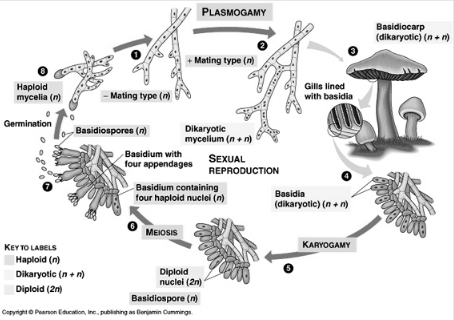
View full question & answer→MCQ 1581 Mark
When a moist bread is kept exposed in air, it becomes mouldy and black because
- A
spores are present in the water.
- B
spores are present in the bread.
- ✓
spores are present in the air.
- D
AnswerCorrect option: C. spores are present in the air.
c
When moist bread is kept exposed in air, it becomes mouldly and black because spores are present in the air whe settle on bread they grow and multiply to form mycelium
View full question & answer→MCQ 1591 Mark
Yeast is not included in protozoans but are placed in fungi because
- A
- ✓
some fungal hyphae grow in such a way that they give the appearance of pseudomycelium.
- C
it has eukaryotic organization.
- D
cell wall is made up of cellulose and reserve food material is starch.
AnswerCorrect option: B. some fungal hyphae grow in such a way that they give the appearance of pseudomycelium.
b
The plant body of fungi typically consists of branched and filamentous hyphae, which form a net like structure, known as mycelium. In yeast, the plant body is unicellular but sometimes cells remain attached in short chains, forming a pseudomycelium.
View full question & answer→MCQ 1601 Mark
View full question & answer→MCQ 1611 Mark
View full question & answer→MCQ 1621 Mark
It is true for animal kingdom but not true for fungi
- A
Asexual reproduction occur through conidia
- ✓
Food storage is in the form of glycogen or fat
- C
Thallus is branched and septate
- D
Germ cells are always isogamous
AnswerCorrect option: B. Food storage is in the form of glycogen or fat
View full question & answer→MCQ 1631 Mark
Which pair of the following belongs to Basidiomycetes
MCQ 1641 Mark
One of the major components of cell wall of most fungi is
MCQ 1651 Mark
- A
- B
- C
Basidiomycetes - Aspergillus
- ✓
Deuteromycetes - Trichoderma
AnswerCorrect option: D. Deuteromycetes - Trichoderma
View full question & answer→MCQ 1661 Mark
The imperfect fungi which are decomposer of litter and help in mineral cycling belong to :
MCQ 1671 Mark
Which of the following matches is correct?
- ✓
Alternaria - Sexual reproduction absent - Deuteromycetes
- B
Mucor - Reproduction by Conjugation - Ascomycetes
- C
Agaricus - Parastic fungus - Ascomycetes
- D
Phytophthora - Parastic fungus - Basidiomycetes
AnswerCorrect option: A. Alternaria - Sexual reproduction absent - Deuteromycetes
View full question & answer→MCQ 1681 Mark
Cell-wall all fungi are couposed of
MCQ 1691 Mark
Choenocytic hyphae means.
- A
Fungi possess cell wall made up of polysaccharide.
- ✓
Contimnuos tubes filled with multinucleated cytoplasm.
- C
Symbiosis in higher plant between root and fungi.
- D
Long and thin body of fungi which contain one nucleus in its cytoplasm.
AnswerCorrect option: B. Contimnuos tubes filled with multinucleated cytoplasm.
View full question & answer→MCQ 1701 Mark
Which is correct group for basidiomycetes?
- A
Aspergillus, Ustilago Rhizopus
- B
- C
Antennaria, choletotrichum, trichoderma
- ✓
View full question & answer→MCQ 1711 Mark
Which of following is incorrect for phycomycetes?
- A
A sexual reproduction takes place by zoospores or by aplanospore.
- ✓
Common examples are Claviceps and Neurospora
- C
Mycelium is acetate and coanocytic
- D
Parasitic fungi on mustard is a example of Phycomycetes.
AnswerCorrect option: B. Common examples are Claviceps and Neurospora
View full question & answer→MCQ 1721 Mark
View full question & answer→MCQ 1731 Mark
View full question & answer→MCQ 1741 Mark
Who is responsible for wheat rust?
MCQ 1751 Mark
It is also parasite on mustard.
MCQ 1761 Mark
Fusion of gametangia in Rhizopus is
MCQ 1771 Mark
Fungi growing on rotten wood are called
Answera
(a)Rotting of wood is caused due to degradation of lignin and cellulose. It is brought about by fungi like Polyporus, Ganoderma, Fusarium etc.
View full question & answer→MCQ 1781 Mark
Which one of the following group of fungi is sometimes known as "fungal waste basket"
Answerd
(d)Duteromycetes is also known as fungal waste basket because its lack perfect sexual stage.
View full question & answer→MCQ 1791 Mark
Answera
(a) The species of genus Lycoperdon are commonly called puff balls.
They have ball-shaped basidiocarps which send out puffs of spores.
Young puff balls are edible.
View full question & answer→MCQ 1801 Mark
Which one of the following is a member of the group fungi imperfecti
MCQ 1811 Mark
'Mycorrhizae' are useful for plants mainly due to their following attribute
- A
Fixing atmospheric nitrogen
- ✓
Enhanced absorption of nutrients from soil
- C
Killing insects and pathogens
- D
Providing resistance against abiotic stresses
AnswerCorrect option: B. Enhanced absorption of nutrients from soil
View full question & answer→MCQ 1821 Mark
Which organism is used to obtain the single cell protein
- A
- ✓
- C
- D
All of the aboveLichen and Mycorrhiza
Answerb
(b) The single cell protein $(SCP)$ obtained from yeasts, Penicillium, Fusarium etc. are used as substitute of protein food.
View full question & answer→MCQ 1831 Mark
Branched, aseptate, coenocytic mycelium present in
MCQ 1841 Mark
Answerb
(b) The mycelium is intercellular branched, aseptate and multinucleate.
The mycelium produces finger like or globular haustoria which enter into the host cells to absorb the food material.
View full question & answer→MCQ 1851 Mark
Which is used for preparing alcohol
MCQ 1861 Mark
Yeast is divided under the class
Answerc
(c)True yeast bear asci which are not organized in to ascocarps. e.g., Schizosaccharomyces, Saccharomyces, Saccharomycodes, , Zygosaccharomyces, Nematospora. Therefore, yeast are classified under ascomycetes.
View full question & answer→MCQ 1871 Mark
Pseudomycelium is formed in
Answera
(a) Yeast reproduces by means of budding.
Sometime the bud starts forming new bud before it saparates from parent cell.
This may result in formation of branched and unbranched chains of bud which is called as pseudomycelium.
View full question & answer→MCQ 1881 Mark
Yeast differs from Rhizopus in being
- A
Multicellular and coenocytic
- ✓
Unicellular and uninucleate
- C
Unicellular and coenocytic
- D
AnswerCorrect option: B. Unicellular and uninucleate
View full question & answer→MCQ 1891 Mark
During budding the primary septum separating the parent cell and the bud is made up of
MCQ 1901 Mark
Yeast are economically important because they
- A
- B
- C
Are used in tea and tobacco industry
- ✓
Are used in wine and baking industry
AnswerCorrect option: D. Are used in wine and baking industry
View full question & answer→MCQ 1911 Mark
View full question & answer→MCQ 1921 Mark
In Yeast the sexual reproduction is by conjugation. After fusion the zygotic nucleus divides meiotically and forms haploid spores. The unicellular structure with haploid spores is
MCQ 1931 Mark
Yeasts cell wall is rich in
Answerc
(c)Cell wall of yeast is rich in carbohydrates like glucan, mannan and chitin.
View full question & answer→MCQ 1941 Mark
- A
Branched, septate and uninucleate
- ✓
Branched, aseptate and multinucleate
- C
Unbranched, aseptate and multinucleate
- D
Unbranched, septate and coenocytic
AnswerCorrect option: B. Branched, aseptate and multinucleate
View full question & answer→MCQ 1951 Mark
The sexual reproduction is initiated in Rhizopus by
MCQ 1961 Mark
- A
- B
- C
Mostly homothallic rarely heterothallic
- ✓
Mostly heterothallic rarely homothallic
AnswerCorrect option: D. Mostly heterothallic rarely homothallic
View full question & answer→MCQ 1971 Mark
The reduction division in the life cycle of Rhizopus occurs
- ✓
At the time of germination of zygospores
- B
During the formation of germ sporangium
- C
During asexual reproduction
- D
During the formation of gametangium
AnswerCorrect option: A. At the time of germination of zygospores
View full question & answer→MCQ 1981 Mark
The wall of Rhizopus hypha is composed of
MCQ 1991 Mark
Mycelium of Mucor/ Rhizopus is
- A
- B
- C
Septate and multicellular
- ✓
View full question & answer→MCQ 2001 Mark
Rhizopus reproduces asexually through
MCQ 2011 Mark
Mode of nutrition in Rhizopus is
MCQ 2021 Mark
In Rhizopus, sexual fusion takes place between
Answera
(a)The two gametangia fuse with each other and lose their identity in the sexual act, resulting in the formation of zygospore.
View full question & answer→MCQ 2031 Mark
The negatively geotrophic and unbranched hyphae in Rhizopus are known as
MCQ 2041 Mark
Sporangiospores of Mucor are
Answera
(a) Sporangiospores are produced in large number inside the sporangia of Mucor,
which are borne over special hyphae known as sporangiophore.
These spore are produced during asexual reproduction.
View full question & answer→MCQ 2051 Mark
Answera
(a) Both $(+)$ and $(-)$ progametangium are similar in structure.
View full question & answer→MCQ 2061 Mark
Multinucleated filament of rihzophus is
Answera
(a) The hyphae are aseptate and multinucleate (i.e., $Coenocytic$).
View full question & answer→MCQ 2071 Mark
Answerd
(d) Fusion of coenogametes $(Rhizopus\, and\, Mucor)$ produced a diploid resting spore called zygospore.
View full question & answer→MCQ 2081 Mark
In Mucor, asexual reproduction takes place by
Answerb
(b)In asexual reproduction of Mucor three type of non-motile mitospores are produced. i.e., sporangiospores, chlamydospores and oidia.
View full question & answer→MCQ 2091 Mark
Warm and humid condition is most favourable for the growth of
MCQ 2101 Mark
Under favourable conditions Mucor reproduces
MCQ 2111 Mark
- A
- ✓
- C
Facultative saprophytic fungus
- D
Answerb
(b)Mucor is an saprophytic fungus, living on dead organic material. It is also called dung mold.
View full question & answer→MCQ 2121 Mark
Answera
(a) Gametangial copulation involves direct conjugation $(fusion)$ of two gametangia of opposite strain to form zygospore e.g., Rhizopus, Yeasts etc.
View full question & answer→MCQ 2131 Mark
Which is not true for fungi
- A
- B
They can be multicellular
- ✓
They can be photosynthetic
- D
AnswerCorrect option: C. They can be photosynthetic
c
(c)Because chlorophyll is absent.
View full question & answer→MCQ 2141 Mark
Black rust of wheat is caused by
Answera
(a)Puccinia graminis tritici causes black rust of wheat.
View full question & answer→MCQ 2151 Mark
Clamp connection is found in
Answera
(a) In many members of basidiomycetes cells division accompained by clamp connection.
These are bridge $(hook)$ like connection.
They function as bypass hyphae through which nuclei migrate to make all of mycellium dikaryotic.
View full question & answer→MCQ 2161 Mark
Which of the following is the characteristic feature of ascomycetes
Answerd
(d) In ascomycetes, diploid nucleus divided by meiosis and then by mitosis to form $8$ (sometimes only $ 4$ ) haploid ascospores.
These sexually produced ascospores remain inside the sac like structure called ascus.
View full question & answer→MCQ 2171 Mark
View full question & answer→MCQ 2181 Mark
- A
Toadstool is an edible fungus
- B
Rust fungi are homoecious
- C
Parathecium is fruiting body
- ✓
In mushroom gills produce basidia
AnswerCorrect option: D. In mushroom gills produce basidia
View full question & answer→MCQ 2191 Mark
Fungi differ from algae in being
- A
- B
- C
Without unicellular forms
- ✓
Without chlorophyll and possessing chitinised wall
AnswerCorrect option: D. Without chlorophyll and possessing chitinised wall
View full question & answer→MCQ 2201 Mark
Which one is not related to perfect stage of fungus
Answerd
(d) Mitospores reproduce asexually by the formation of conidia or conidiospores.
These are non-motile spores produced exogenously from the tips and sides of hyphae.
View full question & answer→MCQ 2211 Mark
Fungus used in genetic experiments is
Answerc
(c) Many species of Neurospora have been used as convenient organisms for genetical (one gene -one enzyme theory by Beadle and Tatum) and biochemical studies.
Neurospora is also known as Drosophila of plant kingdom.
View full question & answer→MCQ 2221 Mark
A fungus contains cells with two nuclei from different genomes. The nuclei do not fuse but divide independently and simultaneously as new cells are formed. It belongs to
Answerd
(d)In basidiomycetes dikaryotisation occurs.
View full question & answer→MCQ 2231 Mark
Algal fungi are placed in
Answerc
(c) Many scientist (Sachs, $1874$ ; Bessey, $1950$ ) believe that fungi, particularly class Phycomycetes, have evolved from siphonaceous green algae.
Both the group have some common features such as presence of coenocytic thalli, flagellated zoospores, streaming movement and mode of sexual reproduction.
Therefore Phycomycetes is called algal fungi.
View full question & answer→MCQ 2241 Mark
- A
- B
- C
- ✓
Two dissimilar haploid nuclei
AnswerCorrect option: D. Two dissimilar haploid nuclei
View full question & answer→MCQ 2251 Mark
First antibiotic isolated was
Answera
(a)A British Bacteriologist, Alexander flemming discovered the first antibiotic penicillin in $1928.$
View full question & answer→MCQ 2261 Mark
Dikaryon formation is characteristic of
- ✓
Ascomycetes and basidiomycetes
- B
Phycomycetes and basidiomycetes
- C
Ascomycetes and phycomycetes
- D
Phycomycetes and zygomycetes
AnswerCorrect option: A. Ascomycetes and basidiomycetes
View full question & answer→MCQ 2271 Mark
Which of the following fungi are edible
Answerd
(d) Agaricus compestris is a common field mushroom, Morchella esculanta having apothecia type of edible ascocarp $(vern.\, gucchi)$ and Podaxon prodaxis is also edible.
View full question & answer→MCQ 2281 Mark
The hyphae of Aspergillus are
- A
Aseptate and multinucleate
- ✓
Septate and multinucleate
- C
- D
AnswerCorrect option: B. Septate and multinucleate
b
(b)The mycelium of Aspergillus consist of branch septate hyphae. Cells of hyphae are multinucleate.
View full question & answer→MCQ 2291 Mark
Which of the following produces spores, but lacks vascular structure
MCQ 2301 Mark
Which of the following divisions of fungi includes ’Club fungi’
Answerd
(d) The members of division basidiomycota $(class\, basidiomycetes)$ are commonly called club fungi because the basidia are club shaped.
View full question & answer→MCQ 2311 Mark
When fungi feed on dead organic matter, they are known as
Answerc
(c)All fungi are heterotrophs in their nutrition. Some are depends upon organic matter known as saprophytes.
View full question & answer→MCQ 2321 Mark
Answera
(a) Claviceps perpurea is a fungus which causes ergotism in rye $(secale\, cereale)$ and other plants.
It also yields a hallucinogenic drug called $ LSD$.
View full question & answer→MCQ 2331 Mark
The cell wall of fungi is made up of
MCQ 2341 Mark
The following is an example of saprophytes
Answera
(a)Mushroom is a basidiomycetes fungus, which is grow on dead and decay matter.
View full question & answer→MCQ 2351 Mark
Which of the following is not a fungal disease
Answerc
(c)Red rust of tea is caused by alga Cephaleuros.
View full question & answer→MCQ 2361 Mark
Genus Penicillium belong to the class
MCQ 2371 Mark
Thread like filaments of fungi are known as
MCQ 2381 Mark
Fungal spores produced asexually at the tips of hyphae are called
Answerc
(c)Conidia are non-motile spores produced exogenously by constrictions at the tip of special hyphae called conidiophores.
View full question & answer→MCQ 2391 Mark
A group of fungi with septate mycelium in which sexual reproduction is either unknown or lacking are classified under
Answerb
(b) Due to the presence of mentioned characters in question,
this group is also called fungi imperfecti.
View full question & answer→MCQ 2401 Mark
Which one is saprophytic in nutrition
MCQ 2411 Mark
$A$ : Holophytic protistans are important phytoplanktons and they contribute $80\%$ of the total photosynthesis.
$R$ : They lack chemosynthetic nutrition and utilize non sulphur organic compound as the source of electron and proton in carbon assimilation.
- A
Assertion and Reason both are correct and also correct explanation.
- B
Assertion and Reason both are correct but not explanation of assertion.
- ✓
Assertion is correct, but Reason is incorrect.
- D
Both Assertion and Reason are incorrect.
AnswerCorrect option: C. Assertion is correct, but Reason is incorrect.
c
Holophytic protistans
-$80\%$ of total photosynthesis
-Source of electron is $H_{2}O$
View full question & answer→MCQ 2421 Mark
$A$ : Slime moulds form fruiting bodies under unfavourable conditions.
$R$ : Naked plasmodium is formed during favourable conditions
- A
Assertion and Reason both are correct and also correct explanation.
- ✓
Assertion and Reason both are correct but not explanation of assertion.
- C
Assertion is correct, but Reason is incorrect.
- D
Both Assertion and Reason are incorrect.
AnswerCorrect option: B. Assertion and Reason both are correct but not explanation of assertion.
b
Both ($A$) & ($R$) are correct
View full question & answer→MCQ 2431 Mark
$A$ : Unicellular eukaryotes are included in Monera.
$R$ : Unicellular eukaryotes have $70\;S$ cytoribosomes.
- A
Assertion and Reason both are correct and also correct explanation.
- B
Assertion and Reason both are correct but not explanation of assertion.
- C
Assertion is correct, but Reason is incorrect.
- ✓
Both Assertion and Reason are incorrect.
AnswerCorrect option: D. Both Assertion and Reason are incorrect.
d
Unicellular eukaryotes are in protist
View full question & answer→MCQ 2441 Mark
$A $: Slime moulds have the characters of both plants and animals.
$R $: Reproductive phase is animal like and vegetative phase is plant-like.
- A
Assertion and Reason both are correct and also correct explanation.
- B
Assertion and Reason both are correct but not explanation of assertion.
- ✓
Assertion is correct, but Reason is incorrect.
- D
Both Assertion and Reason are incorrect.
AnswerCorrect option: C. Assertion is correct, but Reason is incorrect.
c
Slime moulds
-Reproductive phase is plant-like (Cell wall present in spore)
-Vegetative phase is animal-like (Cell wall absent)
View full question & answer→MCQ 2451 Mark
Consider the following statements and select correct set of features w.r.t. the life cycle of acellular slime moulds
$a.$ Haploid vegetative stage as myxamoebae
$b.$ Diploid vegetative stage as plasmodium
$c.$ Capillitium
$d.$ Photosynthetic protists
$e.$ Sporic meiosis
$f.$ Isogamous sexual reproduction
$g.$ Anisogamous sexual reproduction with zygotic meiosis
- A
$a, c, g$
- B
$b, c, g$
- C
$b, d, e, f$
- ✓
$b, c, e, f$
AnswerCorrect option: D. $b, c, e, f$
d
Acellular slime mould $\Rightarrow$
$\bullet$ diploid vegetative stage as plasmodium
$\bullet$ Capillitium $\Rightarrow$ bears spores
$\bullet$ Sporic meiosis = Meiosis leads to spore formation.
$\bullet$ Isogamous sexual reproduction
View full question & answer→MCQ 2461 Mark
Being photosynthetic, which organism in absence of sunlight behave like heterotrophs?
Answerb

View full question & answer→MCQ 2471 Mark
_________ are saprophytic protists, whose body moves along decaying twigs and leaves engulfing organic material.
Answerd
Slime moulds saprophytic protists
View full question & answer→MCQ 2481 Mark
Which is not a feature of dinoflagellates?
- A
- B
Their cell wall has stiff cellulose plates on the outer surface
- C
- ✓
These are mostly fresh water and non-photosynthetic
AnswerCorrect option: D. These are mostly fresh water and non-photosynthetic
d
Features of dinoflagellates.
$\bullet$ Cell wall has stiff cellulose plates on the outer surface
$\bullet$ Release toxins
$\bullet$ Causes red tides
$\bullet$ Mostly marine and photosynthetic
View full question & answer→MCQ 2491 Mark
Read the following statements and answer the question given below
$(i)$ They are saprophytic protists.
$(ii)$ Under suitable conditions, they form an aggregation (called plasmodium) which may grow and spread over several feet.
$(iii)$ During unfavourable conditions, the plasmodium differentiates and forms fruiting bodies bearing spores at their tips.
Which of the following class of protists is being described by the above statements
Answerc
All the described statements are related to slime moulds. Slime moulds are saprophytic protists. They are a simple organism that consists of an acellular mass of creeping jelly-like protoplasm containing nuclei, or a mass of amoeboid cells. When it reaches a certain size it forms a large number of spore cases.
View full question & answer→MCQ 2501 Mark
The given statements are some characters of a particular group of Kingdom protista.
$(i)$ Most of them are fresh water organisms found in standing water.
$(ii)$ They have a protein rich layer (called pellicle) which makes their body flexible.
$(iii)$ They have two flagella, a short and a long one.
$(iv)$ Though they are photosynthetic in the presence of sunlight, but in the absence of sunlight they behave like heterotrophs by predating on other smaller organisms. Identify the correct group on the basis of these characters.
Answerd
Euglenoids is one of the best-known groups of flagellates. They are commonly found in freshwater, especially when it is rich in organic materials, with a few marine, and endosymbiotic members. Most euglenoids are unicellular. Many euglenoids have chloroplasts and produce energy through the process of photosynthesis, but others feed by phagocytosis, or strictly by diffusion. This group is known to contain carbohydrate paramylon.
View full question & answer→MCQ 2511 Mark
Which of the following group of kingdom protista is being described in the statements given below?
$(i)$ This group includes diatoms and golden algae.
$(ii)$ They are microscopic and float passively in water currents (plankton).
$(iii)$ Most of them are photosynthetic.
$(iv)$ They have deposits in their habitat; this accumulation over billion of years is referred to as 'diatomaceous earth'.
Answerb
Chrysophytes are plant-like protists that can be found in marine and freshwater environments which are often low in calcium. There are three main types of chrysophytes:
diatoms (bacillariophyta), goldenbrown algae (chrysophyceae), and yellow-green algae (xanthophyceae).
View full question & answer→MCQ 2521 Mark
Which of the following statements is correct for dinoflagellates flagella?
- A
A single flagellum lies in the transverse groove between the cell plates.
- B
A single flagellum lies in the longitudinal groove between the cell plates.
- ✓
Two flagella, one lies longitudinally and the other transversely in a furrow between the wall plates.
- D
AnswerCorrect option: C. Two flagella, one lies longitudinally and the other transversely in a furrow between the wall plates.
c
Dinoflagellates are mostly marine and photosynthetic organism. They appear yellow, green, brown, blue or red depending on the main pigments present in their cells. Most of them have two flagella; one lies longitudinally and the other transversely in a furrow between the cell plates.
View full question & answer→MCQ 2531 Mark
Which of the following statements is a characteristic feature of chrysophytes?
- A
They are parasitic forms which cause diseases in animals.
- B
They have a protein rich layer called pellicle.
- ✓
They have indestructible cell wall layer deposited with silica.
- D
They are commonly called dinoflagellates.
AnswerCorrect option: C. They have indestructible cell wall layer deposited with silica.
c
Chrysophytes belong to the kingdom protista. Examples are diatoms and golden algae. Their walls are embedded with silica and thus the walls are indestructible.
View full question & answer→MCQ 2541 Mark
Which of the following groups of protozoan is not correctly matched with its feature?
- A
Amoeboid - Marine forms that ingest or capture prey by false feet
- B
Flagellated - Either free living or parasitic.
- C
Ciliated - Actively moving organisms due to presence of cilia.
- ✓
Sporozoans - Move and capture their prey with the help of hooks \& suckers
AnswerCorrect option: D. Sporozoans - Move and capture their prey with the help of hooks \& suckers
d
hook n suckers are present in parasitic helminthes
View full question & answer→MCQ 2551 Mark
Match the type of protozoans given in column-$I$ with their examples given in column-$II$ and choose the correct option.
| Column-$I$ (Type of Protozoans) |
Column-$II$ (Examples) |
| $A$. Amoeboid protozoans |
$I$. Paramecium |
| $B$. Ciliated protozoans |
$II$. Plasmodium |
| $C$. Flagellated protozoa |
$III$. Amoeba |
| $D$. Sporozoans |
$IV$. Trypanosoma |
- A
$A - I , B -III C - IV , D -II$
- B
$A -III , B - I , C - II , D - IV$
- ✓
$A - III , B - I , C - IV , D -II$
- D
$A -III , B - IV , C - I , D -II$
AnswerCorrect option: C. $A - III , B - I , C - IV , D -II$
c
Protozoans are single celled microscopic eukaryotic organisms that are noted for their ability to move independently. Protozoans are classified on the basis of their locomotion amoeboid (Amoeba), ciliated (Paramecium), flagellated (Trypanosoma) and Sporozoans (Plasmodium).
View full question & answer→MCQ 2561 Mark
Which of the following is an example of amoeboid protozoans?
Answerd
Amoeboid protozoans are organisms that live in fresh water, sea water or moist soil. They move and capture their prey by putting out pseudopodia (e.g. Amoeba). Some of them such as Entamoeba are parasites.
View full question & answer→MCQ 2571 Mark
Which of the following pairs come under the group chrysophytes?
Answerc
Chrysophytes are a group of diatoms, golden algae (desmids) and golden brown photosynthetic microscopic protists. Their body is covered by a transparent siliceous shell.
View full question & answer→MCQ 2581 Mark
- ✓
single-celled eukaryotes.
- B
multicellular eukaryotes.
- C
single-celled prokaryotes.
- D
AnswerCorrect option: A. single-celled eukaryotes.
a
Haeckel created the kingdom Protista to include all unicellular eukaryotic micro-organisms. They have a typical eukaryotic structure with membrane bound organelles and nucleus.
View full question & answer→MCQ 2591 Mark
Protozons are not included in kingdom animalia because they are
- A
- ✓
- C
- D
multicellular prokaryotes.
Answerb
Protozoans comes under the kingdom protista (single-celled eukaryotes). They are heterotrophs and live as predators or parasites. They are divisible into four major groups - zooflagellata, sarcodina, sporozoa and ciliata.
View full question & answer→MCQ 2601 Mark
Select the wrong statement.
- ✓
The walls of diatoms are easily destructible
- B
Diatomaceous earth is formed by the cell walls of diatoms
- C
Diatoms are chief producers in the oceans
- D
Diatoms are microscopic and float passively in water
AnswerCorrect option: A. The walls of diatoms are easily destructible
View full question & answer→MCQ 2611 Mark
Which one of the following organism is not an example of eukaryotic cells?
MCQ 2621 Mark
The thalloid body of a slime mould (Myxomycetes) is known as
MCQ 2631 Mark
What is correct for Euglena ?
- A
Show saprophytic nutrient
- ✓
Presence of protenious pellicle
- C
- D
silica shells on their surface
AnswerCorrect option: B. Presence of protenious pellicle
View full question & answer→MCQ 2641 Mark
Which one of the following is a slime mould ?
MCQ 2651 Mark
In which group of organisms the cell walls form two thin overlapping shells which fit together?
MCQ 2661 Mark
Which of the following is a red dinoflagellate ?
MCQ 2671 Mark
View full question & answer→MCQ 2681 Mark
Plant like nutrition is present in
MCQ 2691 Mark
Disease occurs by protozoans
MCQ 2701 Mark
Which of the following is chief 'producers' in the oceans?
MCQ 2711 Mark
What is similarities between antamoeba and plasmodium ?
- A
- B
- C
Both only decomposer organism
- ✓
View full question & answer→MCQ 2721 Mark
Which group includes diverse organisms that have an infectious spore like stage in their life cycle ?
MCQ 2731 Mark
It is not a character of dianoflagelates.
- A
- B
Cell wall has stiff cellulose plates
- C
- ✓
The walls are embadded with silica
AnswerCorrect option: D. The walls are embadded with silica
View full question & answer→MCQ 2741 Mark
They are responsible for sleeping sickness.
MCQ 2751 Mark
View full question & answer→MCQ 2761 Mark
They are consider primary relative of animals
MCQ 2771 Mark
Which of the following does not contain chlorophyll
MCQ 2781 Mark
Which of the following is not true for nutrition in Amoeba
MCQ 2791 Mark
Death of host shall be disastrous to
MCQ 2801 Mark
Trypanosoma brucei produces
MCQ 2811 Mark
View full question & answer→MCQ 2821 Mark
Which one carries malarial parasite to the host
MCQ 2831 Mark
View full question & answer→MCQ 2841 Mark
Alternation of generation is exhibited by
MCQ 2851 Mark
.........is not true for Euglena
AnswerCorrect option: C. Presence of cellulose cell wall
View full question & answer→MCQ 2861 Mark
View full question & answer→MCQ 2871 Mark
Contractile vacuole is generally absent in the
- A
- B
- ✓
Both $(a)$ and $(b)$
- D
Some fresh water protozoans
AnswerCorrect option: C. Both $(a)$ and $(b)$
View full question & answer→MCQ 2881 Mark
Locomotory organ of sporozoa is
MCQ 2891 Mark
Protists are
$1.$ Unicellular and prokaryote
$2.$ Unicellular and eukaryote
$3.$ Multicellular and eukaryote
$4.$ Autotrotroph and heterotroph
- A
$1 + 2 + 3$
- B
$2 + 3 + 4$
- C
$3 + 4$
- ✓
$2 + 4$
AnswerCorrect option: D. $2 + 4$
d
(d) Protists are primitive single celled organism with well organised nucleus,
which shows auto as well as heterotrophic mode of nutrition.
View full question & answer→MCQ 2901 Mark
Kingdom protista includes
- ✓
Amoeba, Euglena, Chlamydomonas
- B
Amoeba, Euglena, Escherichia
- C
Amoeba, Euglena, Pseudomonas
- D
Amoeba, Euglena, Penicillium
AnswerCorrect option: A. Amoeba, Euglena, Chlamydomonas
View full question & answer→MCQ 2911 Mark
Protozoans are also called
Answera
(a)Protozoans discharge all the body functions in one cell, therefore they are called unicellular.
View full question & answer→MCQ 2921 Mark
The protozoan parasite which possesses a food vacuole is
MCQ 2931 Mark
Which is not the locomotory organ of protozoa
Answerd
(d) Parapodia is the locomotory organ of Nereis (Annelida).
View full question & answer→MCQ 2941 Mark
Which is not the characteristic of phylum protozoa
- A
- B
- C
- ✓
Cell membrane as body covering
AnswerCorrect option: D. Cell membrane as body covering
View full question & answer→MCQ 2951 Mark
The main basis of classification of phylum protozoa is
MCQ 2961 Mark
Choose the photosynthetic protozoan from the following
MCQ 2971 Mark
- A
Euglena, Dinoflagellates and Yeast
- B
Amoeba, Paramaecium, Hydra
- C
Euglena, Paramaecium, Mushroom
- ✓
Amoeba, Paramaecium and Dinoflagellates
AnswerCorrect option: D. Amoeba, Paramaecium and Dinoflagellates
d
(d)Amoeba and Paramecium are protozoan protist while dinoflagellates are photosynthetic protist.
View full question & answer→MCQ 2981 Mark
Diatoms stay afloat due to
Answerc
(c)Store lipid drops of diatoms, help in the floating of water surface.
View full question & answer→MCQ 2991 Mark
Diatom frustule/shell is made of
Answera
(a) Frustule of diatoms is made of silica, cellulose and pectic compounds.
View full question & answer→MCQ 3001 Mark
Which one of the following can photosynthesise its food
Answerd
(d)Mixotrophic nutrition found in Euglena, when light is available it is photosynthetic in darkness, it is saprophytic.
View full question & answer→MCQ 3011 Mark
Unlike other algae, diatoms do not readily decay due to
MCQ 3021 Mark
View full question & answer→MCQ 3031 Mark
Answerb
(b)Slime moulds are consumer protist.
View full question & answer→MCQ 3041 Mark
Red oceanic tides can be due to
Answerb
(b)Red tides of oceans are due to excessive growth of dinoflagellates like Gymnodinium and Gonyaulax.
View full question & answer→MCQ 3051 Mark
Answerc
(c)They are unicellular, photosynthetic, eukaryotes.
View full question & answer→MCQ 3061 Mark
- ✓
Protozoa, algae and fungi
- B
Algae, bryophyta, bacteria and fungi
- C
Fungi, slime moulds and vascular plants
- D
Protozoa, bacteria, algae and bryophyta
AnswerCorrect option: A. Protozoa, algae and fungi
a
(a)Protozoans, unicellular algae and unicellular fungi are the members of protista.
View full question & answer→MCQ 3071 Mark
Euglena belongs to kingdom
Answerb
(b)Euglena is a photosynthetic protist.
View full question & answer→MCQ 3081 Mark
Phytoplankton consists of
- A
- ✓
Aquatic algae and photosynthetic bacteria
- C
Micro-organisms functioning as decomposers
- D
Plant consuming animals and their remains
AnswerCorrect option: B. Aquatic algae and photosynthetic bacteria
View full question & answer→MCQ 3091 Mark
If phytoplanktons are destroyed in the sea, then
- A
- B
Primary consumers will grow luxuriently
- ✓
It will effect the food chain
- D
Algae will get more space to grow
AnswerCorrect option: C. It will effect the food chain
c
(c)Because in sea ecosystem, phytoplanktons are primary producers, if they are destroyed, naturally food chain will be disturbed.
View full question & answer→MCQ 3101 Mark
Planktons are organisms which
Answera
(a)Free floating living protist are collectively called plankton, which are float on the water surface.
View full question & answer→MCQ 3111 Mark
Which organism behaves like plants in the presence of light and absence of organic food, but in reverse conditions behaves like animals
Answerb
(b)Euglena having chlorophyll, photosynthesize and produce food while in reverse condition Euglena consume food and behave like animals.
View full question & answer→MCQ 3121 Mark
Which kingdom incorporates phytoplanktons and zooplanktons
MCQ 3131 Mark
Holophytic nutrition occurs in
Answerc
(c) Because Euglena is a photosynthetic organism.
View full question & answer→MCQ 3141 Mark
A unicellular organism often considered connecting link between plants and animals is
MCQ 3151 Mark
$A$ : Majority of bacteria are autotrophs.
$R$ : Chemoheterotrophic nutrition is absent in bacteria.
- A
Assertion and Reason both are correct and also correct explanation.
- B
Assertion and Reason both are correct but not explanation of assertion.
- C
Assertion is correct, but Reason is incorrect.
- ✓
Both Assertion and Reason are incorrect.
AnswerCorrect option: D. Both Assertion and Reason are incorrect.
d
Majority of bacteria are heterotrophs.
View full question & answer→MCQ 3161 Mark
$A$ : Methanogens can show symbiotic association with eukaryotic organisms.
$R$ : They are used for the production of biogas.
- A
Assertion and Reason both are correct and also correct explanation.
- ✓
Assertion and Reason both are correct but not explanation of assertion.
- C
Assertion is correct, but Reason is incorrect.
- D
Both Assertion and Reason are incorrect.
AnswerCorrect option: B. Assertion and Reason both are correct but not explanation of assertion.
b
Both statements are correct but reason is not correct explanation
View full question & answer→MCQ 3171 Mark
$70\; s$ ribosomes, chromatophores and circular $DNA$, are found in
- A
- B
- ✓
- D
Some eukaryotes and some prokaryotes
Answerc
Some prokaryotes
- $70\; S$ ribosomes
- Chromatophores
- Circular $DNA$
View full question & answer→MCQ 3181 Mark
Bacteria are considered primitive organisms because they
- ✓
Possess incipient nucleus
- B
Are small, microscopic plants, which are not seen by the naked eyes
- C
Cause serious diseases to human being, domesticated animals and crop plants
- D
Produce endospores which are very resistant to adverse conditions
AnswerCorrect option: A. Possess incipient nucleus
a
Bacteria
- Primitive organisms
- Posses incipient nucleus
View full question & answer→MCQ 3191 Mark
During favourable conditions bacteria mainly reproduce by
Answerd
Reproduction in bacteria during favourable condition-fission (mainly)
View full question & answer→MCQ 3201 Mark
Match the following
Column$-I$
(Group of bacteria) |
Column$-II$
(Their shape) |
| $a.$ Coccus |
$(i)$ Rod-shaped |
| $b.$ Bacillus |
$(ii)$ Spherical |
| $c.$ Spirillum |
$(iii)$ Spiral |
| $d.$ Vibrium |
$(iv)$ Comma-shaped |
- A
$(a)-(i), (b)-(ii), (c)-(iii), (d)-(iv)$
- ✓
$(a)-(ii), (b)-(i), (c)-(iii), (d)-(iv)$
- C
$(a)-(i), (b)-(ii), (c)-(iv), (d)-(iii)$
- D
$(a)-(ii), (b)-(i), (c)-(iv), (d)-(iii)$
AnswerCorrect option: B. $(a)-(ii), (b)-(i), (c)-(iii), (d)-(iv)$
b
Coccus -Spherical
Bacillus -Rod shaped
Spirillum -Spiral
Vibrium -Comma-shaped
View full question & answer→MCQ 3211 Mark
Which of the following statements regarding cyanobacteria is incorrect?
- A
It is also called blue green algae.
- ✓
They are chemosynthetic autotrophs.
- C
It forms blooms in polluted water bodies.
- D
It is unicellular, colonial or filamentous, marine or terrestrial bacteria.
AnswerCorrect option: B. They are chemosynthetic autotrophs.
b
Cyanobacteria are photosynthetic (containing a blue photosynthetic pigment) autotrophs. They are prokaryotic and represent the earliest known form of life on the Earth. Certain cyanobacteria can fix atmospheric nitrogen and convert them to ammonia with the help of Heterocysts.
View full question & answer→MCQ 3221 Mark
The given characters are seen in which of the following group?
$(i)$ Unicellular, colonial, filamentous, symbiotic or free living.
$(ii)$ The colonies are surrounded by a gelatinous sheath.
$(iii)$ Some can fix atmospheric nitrogen in specialized cells called heterocysts.
$(iv)$ They often form blooms in water bodies.
Answerb
Cyanobacteria are aquatic and photosynthetic, i.e., they live in the water, and can manufacture their own food. They are quite small and usually unicellular, though they often grow in colonies large enough to see. They are the first organisms to make the atmosphere aerobic.
View full question & answer→MCQ 3231 Mark
Choose the correct statements $(i - v)$ regarding mycoplasma
$(i)$ Mycoplasma has no cell wall.
$(ii)$ Mycoplasma is the smallest living organism known.
$(iii)$ Mycoplasma cannot survive without $O_{2}$.
$(iv)$ Mycoplasma are pathogenic in animals and plants.
- A
$(ii),(iii) \;and \;(iv)$
- B
$(i), (iii) \;and \;(iv)$
- C
$(i), (ii), \;and \;(iii)$
- ✓
$(i), (ii) \;and \;(iv)$
AnswerCorrect option: D. $(i), (ii) \;and \;(iv)$
d
Mycoplasma refers to a genus of bacteria that lack cell wall around their cell membrane. Without a cell wall, they are unaffected by many common antibiotics such as penicillin or other beta-lactam antibiotics that target cell wall synthesis. They can be parasitic or saprotrophic.Mycoplasma are the facultative anaerobes, they grow best where there is oxygen but can survive without oxygen also.
View full question & answer→MCQ 3241 Mark
Which of the following statement is/ are correct for bacteria?
- A
They are the members of the kingdom monera.
- B
They live in extreme habitats such as hot springs, deserts, snow and deep oceans.
- C
They show the most extensive metabolic diversity
- ✓
Answerd
Bacteria are microscopic organisms placed under kingdom monera whose single cells have neither a membrane-enclosed nucleus nor other membraneenclosed organelles like mitochondria and chloroplasts.
View full question & answer→MCQ 3251 Mark
Which of the following statements is correct for both blue-green algae and bacteria?
- A
Both show anaerobic respiration.
- B
Both have chlorophyll pigment.
- ✓
Both are devoid of true nucleus.
- D
AnswerCorrect option: C. Both are devoid of true nucleus.
c
Cyanobacterial cells (blue-green algal cells) are larger and more elaborate than bacteria. In both the organisms the cell structure is typically prokaryotic type one envelope organisation with peptidoglycan wall, naked $DNA$, Blue- grenalgal have chlorophyll, bacteria is devold of chlorophyll.
View full question & answer→MCQ 3261 Mark
Which of the following statements is not correct for methanogens?
AnswerCorrect option: C. Methane is their preferred carbon source.
c
Methanogens are archaebacteria that live in marshy area produce methane as a metabolic byproduct in anoxic conditions. Methane is not their preferred carbon source.
View full question & answer→MCQ 3271 Mark
The bacteria which oxidize various inorganic substances and use the released energy for the synthesis of food are called _______.
- A
- B
- C
Photosynthetic autotrophic bacteria
- ✓
Chemosynthetic autotrophic bacteria
AnswerCorrect option: D. Chemosynthetic autotrophic bacteria
d
Chemosynthetic autotrophic bacteria use the energy obtained by the oxidation of chemicals for the synthesis of food. They play a great role in recycling of nutrients like nitrogen, phosphorous, iron and sulphur.
View full question & answer→MCQ 3281 Mark
Which of the following is the smallest living cell and can live without oxygen?
Answera
Mycoplasma are the simplest or smallest known organisms that completely lack a cell wall and can survive without oxygen.
View full question & answer→MCQ 3291 Mark
Organisms of which of the following kingdom do not have nuclear membrane?
Answerc
Monera is the group of prokaryotes. They are basically unicellular, may be mycelial, colonial and filamentous. They do not contain any organized nucleus with distinct membrane.
View full question & answer→MCQ 3301 Mark
The given figure shows the structure of filamentous blue green algae. Nostocwith a structure marked as "$X$". Select the option which shows the correct identification of " $X$ " with its feature.
- A
- ✓
Heterocysts - Nitrogen fixation - Nitrogen
- C
Pellicle - Recycling of nutrition
- D
Mucilaginous sheath - Photosynthesis
AnswerCorrect option: B. Heterocysts - Nitrogen fixation - Nitrogen
b
Heterocysts are pale-yellow, thick-walled cells that are capable of nitrogen fixation and therefore play a major part in the nitrogen cycle.
View full question & answer→MCQ 3311 Mark
The most abundant prokaryotes helpful to humans in making curd from milk and in production of antibiotics are categorised as
- A
- B
- C
chemosynthetic autotrophs
- ✓
View full question & answer→MCQ 3321 Mark
Bacteria are found to be primitive organisms because they
- A
are small, microscopic which are not seen with naked eye.
- B
cause serious diseases to human being, domestic animals and crop plants.
- C
produce endospores which are very resistant to adverse conditions.
- ✓
possess incipient nucleus and show amitotic division.
AnswerCorrect option: D. possess incipient nucleus and show amitotic division.
d
Bacteria are microscopic organisms whose single cells have neither a membrane-enclosed nucleus nor other membrane-enclosed organelles like mitochondria and chloroplasts. Bacteria are found to be primitive organisms because they do not have well-defined nucleus and shows amitotic division.
View full question & answer→MCQ 3331 Mark
What is true for archae bacteria ?
MCQ 3341 Mark
In eubacteria, a cellular component that resembles eukaryotic cell is
MCQ 3351 Mark
Membrane-bound organelles are absent in
MCQ 3361 Mark
During microsporogenesis Organisms called methanogens are most abundant in a
MCQ 3371 Mark
The most abundant prokaryotes helpful to humans in making curd from milk and in production of antibiotics are the ones categorised as :
- A
- B
- C
Chemosynthetic autotrophs
- ✓
View full question & answer→MCQ 3381 Mark
The primitive prokaryotes responsible for the production of biogas from the dung of ruminant animals, include the
MCQ 3391 Mark
Specialized cells for fixing atmospheric nitrogen in Nostoc are
MCQ 3401 Mark
The cyanobacteria are also referred to as
MCQ 3411 Mark
Identify $P$ from figure
View full question & answer→MCQ 3421 Mark
- ✓
Nitrogen fixation - Nostoc
- B
- C
Paramoecium - flagellated
- D
Unicellular fungi - penicillium
AnswerCorrect option: A. Nitrogen fixation - Nostoc
View full question & answer→MCQ 3431 Mark
Which of following is concerned with eubacteria?
$(1)$ Methanogens $(2) $ Anabaena $(3)$ $N_2$, fixation $(4)$ Thermoacido philus $(5)$ eykaryotes $(6)$ Diatoms $(7)$ gelatinous sheath $(8)$ Heterocyst
- A
$1,4,7 $
- ✓
$2,3,7,8 $
- C
$4,5,6,7 $
- D
$1,3,6,7$
AnswerCorrect option: B. $2,3,7,8 $
View full question & answer→MCQ 3441 Mark
In Monera kingdom, which kind of reproduction is seen in adverse condition and which is seen in normal condition respectively ?
- ✓
Spore formation, binary fission.
- B
Budding, multiple fission.
- C
Binary fission, exogenous budding.
- D
AnswerCorrect option: A. Spore formation, binary fission.
View full question & answer→MCQ 3451 Mark
View full question & answer→MCQ 3461 Mark
- ✓
- B
Disease occurs through viroid
- C
Disease occurs through algae
- D
View full question & answer→MCQ 3471 Mark
View full question & answer→MCQ 3481 Mark
They play a great role in recycling nutrients like Nitrogen, Phosphorous, iron and sulphur.
MCQ 3491 Mark
They do not possess eukaryotic cell
MCQ 3501 Mark
View full question & answer→MCQ 3511 Mark
View full question & answer→MCQ 3521 Mark
Archaebacteria found in extremely salty area
MCQ 3531 Mark
View full question & answer→MCQ 3541 Mark
What is incorrect for nostoc and Anabena ?
$(a)$. Possess tissue level organistion
$(b)$. Has heterocyst
$(c)$. Can fix atmospheric Hydrogen
$(d)$. They are eubacteria
- ✓
$a$ and $c$
- B
$b$ and $d$
- C
$b$ and $c$
- D
$a$ and $b$
AnswerCorrect option: A. $a$ and $c$
View full question & answer→MCQ 3551 Mark
View full question & answer→MCQ 3561 Mark
Which one of the following is wrong statement?
- A
Anabaena and Nostoc are capable of fixing nitrogen in freeliving state also.
- B
Root nodule forming nitrogen fixers live as aerobes under freeliving conditions.
- ✓
Phosphorus is a constituent of cell membranes, certain nucleic acids and all proteins.
- D
Nitrosomonas and Nitrobacter are chemo autotrophs.
AnswerCorrect option: C. Phosphorus is a constituent of cell membranes, certain nucleic acids and all proteins.
c
(c) Phosphorus is present in plasma membrane in the form of phospholipid bilayer. It is an essential component of all nucleic acids not 'certain' nucleic acids. Moreover, phosphorus is never found in proteins.
View full question & answer→MCQ 3571 Mark
Which of the following is a nitrogen fixer
MCQ 3581 Mark
Pigment phycocyanin and phycoerythrin are found in
Answerd
(d) Cynobacteria have a water soluble phycobilin pigments. $C-$ phycocyanin $(blue)$ and $C$ -phcoerythrin $(red).$
View full question & answer→MCQ 3591 Mark
The most primitive in the following are
MCQ 3601 Mark
Which of the following statements is right
- A
Fronds are found in bryophytes
- B
Multiciliate sperms are found in angiosperms
- C
Diatoms produce basidiospores
- ✓
Heterocysts are found in Nostoc
AnswerCorrect option: D. Heterocysts are found in Nostoc
View full question & answer→MCQ 3611 Mark
- A
Mosses which attack bacteria
- B
Bacteria which attack cyanophyceae
- ✓
Autotrophic organism with phycocyanin
- D
AnswerCorrect option: C. Autotrophic organism with phycocyanin
c
(c)Cynobacteria contain chlorophyll $a $ and other photosynthetic pigment they synthesis their own carbohydrate food from $CO_2$ and also have water soluble pycobilin pigment $ c-$ phycocyanin.
View full question & answer→MCQ 3621 Mark
Nitrogen fixation by Nostoc takes place in
Answera
(a) Heterocysts are airtight anaerobic bodies in which enzyme nitrogenase fixes atmospheric nitrogen.
View full question & answer→MCQ 3631 Mark
Which of the following may cause water blooms
MCQ 3641 Mark
Which of the following is a Prokaryote
MCQ 3651 Mark
The characteristic of blue green algae is
- A
$DNA $ without histone
- B
- C
$70 S$ ribosomes
- ✓
Answerd
(d)Blue green algae or cyanobacteria is designated as Prokaryotes.
View full question & answer→MCQ 3661 Mark
Nostoc is known to perform
- A
- ✓
Photosynthesis and nitrogen fixation simultaneously
- C
- D
Either photosynthesis or nitrogen fixation at a time
AnswerCorrect option: B. Photosynthesis and nitrogen fixation simultaneously
b
(b)Because they have photosynthetic lamellae for photosynthesis and heterocyst for -fixation.
View full question & answer→MCQ 3671 Mark
- A
Virus which affect bacteria
- B
Bacteria which used cyanide as nutrition
- ✓
Algae which has blue-green pigment
- D
AnswerCorrect option: C. Algae which has blue-green pigment
c
(c)Classification of algae is based on their pigments.
View full question & answer→MCQ 3681 Mark
Heterocysts are found in certain
Answerc
(c)Some cynobacteria possess heterocyst like Nostoc, Scytonema etc. Heterocyst is a site of $N_2$ fixation.
View full question & answer→MCQ 3691 Mark
The following micro-organisms have the property of photosynthesis as well as nitrogen fixation
Answerc
(c)Because they have heterocyst for nitrogen fixation and chlorophyll for photosynthesis.
View full question & answer→MCQ 3701 Mark
Which is not true for the heterocyst of Nostoc
- A
- B
Site of nitrogen fixation
- C
Presence of polar nodules
- ✓
$CO_2$ fixation ability
AnswerCorrect option: D. $CO_2$ fixation ability
View full question & answer→MCQ 3711 Mark
Blue-green algae belong to
- A
- B
- ✓
- D
Neither the eukaryota nor the prokaryota
View full question & answer→MCQ 3721 Mark
- A
- B
Is the new name of all bacteria
- ✓
New name of myxophyceae or blue-green algae
- D
AnswerCorrect option: C. New name of myxophyceae or blue-green algae
View full question & answer→MCQ 3731 Mark
The name cyanobacteria refers to
MCQ 3741 Mark
The cells of cyanobacteria and bacteria exhibit similarity in having
MCQ 3751 Mark
Blue-green algae and bacteria show similarity in
- A
Both show anaerobic respiration
- B
Both show the presence of chlorophyll
- ✓
Both are devoid of true nucleus
- D
AnswerCorrect option: C. Both are devoid of true nucleus
View full question & answer→MCQ 3761 Mark
Which of the following important features are found in blue-green algae
MCQ 3771 Mark
- A
- B
- C
- ✓
Mycoplasma and blue-green algae
AnswerCorrect option: D. Mycoplasma and blue-green algae
View full question & answer→MCQ 3781 Mark
Cell of mycoplasma contains
- A
$RNA$
- B
$DNA$
- ✓
Both $ RNA$ and $DNA$
- D
AnswerCorrect option: C. Both $ RNA$ and $DNA$
View full question & answer→MCQ 3791 Mark
- A
Eukaryotic and multicellular
- B
Prokaryotic and multicellular
- ✓
Prokaryotic and unicellular
- D
Eukaryotic and unicellular
AnswerCorrect option: C. Prokaryotic and unicellular
View full question & answer→MCQ 3801 Mark
Which of the following are called bacteria without cell wall
Answerc
(c)Mycoplasma are cell wall less cells but show multiplication like bacteria, so that they are termed as cell wall less bacteria.
View full question & answer→MCQ 3811 Mark
View full question & answer→MCQ 3821 Mark
'Citrus canker' is caused by a
MCQ 3831 Mark
Which of the following decompose the remanents of the plants into $ CO_2$ and water
View full question & answer→MCQ 3841 Mark
Bacteria which convert the nitrogen of the air to nitrogenous compounds are called
MCQ 3851 Mark
The Streptococcus lactis is responsible for
- ✓
Conversion of milk into curd
- B
Conversion of molasses into alcohol
- C
- D
Flavouring the leaves of tea and tobacco
AnswerCorrect option: A. Conversion of milk into curd
a
(a)This bacteria converts lactose sugar of milk into lactic acid and condenses casein protein and milk converts into curd.
View full question & answer→MCQ 3861 Mark
Which one of the following is also called haplophiles
Answerc
(c) Halophiles Archaebacteria : These are facultative anaerobes, chemoorganotrophs gram negative archaebacteria found in salt lakes, salt pans, dead sea.
That produce salt by solar evaporation of sea.
View full question & answer→MCQ 3871 Mark
Bacteria are included in which of the following kingdoms
MCQ 3881 Mark
View full question & answer→MCQ 3891 Mark
Which of the following does not evolve oxygen
Answera
(a) Because they used $H_2S$ at the place of $H_2O$
View full question & answer→MCQ 3901 Mark
Bacteria obtaining energy from oxidation of inorganic substances are called
MCQ 3911 Mark
Which of the following are extreme halophiles and thermophiles
MCQ 3921 Mark
Organisms which have cells but no distinct nucleus
AnswerCorrect option: C. Both $(a)$ and $(b)$
c
(c) Both bacteria and cyanobacteria are prokaryotes.
View full question & answer→MCQ 3931 Mark
The nitrifying bacteria are
Answerd
(d) Nitrifying bacteria such as Nitrosomonas and Nitrobacter manufacturing their organic food utilizing chemical energy in oxidation of some inorganic compound known is called chemosynthesis
View full question & answer→MCQ 3941 Mark
Purple sulphur bacteria are
MCQ 3951 Mark
Bacterial ribosomes are present
MCQ 3961 Mark
Which of the following can be called as genophore
- A
- B
- ✓
Bacterial $ DNA$
- D
Eukaryotic $DNA$
AnswerCorrect option: C. Bacterial $ DNA$
View full question & answer→MCQ 3971 Mark
Answera
(a)The nuclear material of bacteria, consisting of naked $ DNA$ molecule, it is identified as nucleoid.
View full question & answer→MCQ 3981 Mark
Bacterial photosynthesis is very peculiar because it takes place
- A
Without $CO_2$
- B
Without photosynthetic pigments
- C
- ✓
View full question & answer→MCQ 3991 Mark
What is the nuclear material of a bacterium
- A
Nucleic acid and histone protein
- B
Nucleic acid and cytoplasm
- ✓
- D
View full question & answer→MCQ 4001 Mark
- A
- B
- ✓
Extra-chromosomal genetic material
- D
AnswerCorrect option: C. Extra-chromosomal genetic material
View full question & answer→MCQ 4011 Mark
Chemosynthetic bacteria are those bacteria
- A
Which carry out photosynthesis
- ✓
Which synthesize food without light
- C
Which are unable to carry out chemical process
- D
Which carry out photosynthesis in absence of light
AnswerCorrect option: B. Which synthesize food without light
b
(b)Chemosynthetic bacteria synthesize the food by oxidizing the inorganic compound.
View full question & answer→MCQ 4021 Mark
Bacteria whose cell has only a curve/comma is
MCQ 4031 Mark
The chief component of bacterial cell wall is
- A
- B
- ✓
Amino acids and polysaccharides
- D
Cellulose and carbohydrates
AnswerCorrect option: C. Amino acids and polysaccharides
View full question & answer→MCQ 4041 Mark
AnswerCorrect option: C. $DNA$ is double stranded and ringed
View full question & answer→MCQ 4051 Mark
Gram $-ve$ and $+ve$ bacteria have cell membrane made up of
View full question & answer→MCQ 4061 Mark
Which of the following is not found in bacteria
Answera
(a) Bacteria devoid of all cell organells except $70 S$ ribosome.
View full question & answer→MCQ 4071 Mark
An organism lacking chlorophyll but able to carry on photosynthesis of organic matter has been found among which one of the following
MCQ 4081 Mark
Biochemical resemblance is generally used for the identification of which group of individuals
MCQ 4091 Mark
Which kingdom incorporates photoautotrophs, chemoautotrophs and heterotrophs
Answera
(a) Because monera includes bacteria in which a few are photoautotrophs e.g., green sulphur bacteria, a few are chemoautotrophs e.g., Nitrosomonas and rest are heterotrophs e.g., Bacillus sp.
View full question & answer→MCQ 4101 Mark
The structure formed in the life cycle of cellular slime-mould due to chemotactic movement is
Answera

View full question & answer→MCQ 4111 Mark
Select correct match $w.r.t$. Whittaker' system of classification
- A
Monera : Unicellular, osmotrophs, producers and decomposers, true cellulosic cell wall
- B
Protista : Unicellular, eukaryotic, photoauto-trophs and chemoautotrophs
- ✓
Fungi : Multicellular/loose tissue, eukaryotic, osmotrophs, chitinous wall
- D
Animalia : Multicellular, eukaryotic, organ or organ system, holozoic, no saprobic
AnswerCorrect option: C. Fungi : Multicellular/loose tissue, eukaryotic, osmotrophs, chitinous wall
c
Whittaker's system of classification
Fungi - Multicellular / loose tissue
Eukaryotic
Osmotrophs $\rightarrow$ Saprotrophs
Chitinous wall
View full question & answer→MCQ 4121 Mark
Who for the first time classified organisms on the basis of scientific approach?
Answera
Aristotle first time classified organisms on the basis of scientific approach.
View full question & answer→MCQ 4131 Mark
According to five kingdom system, gymnosperms and angiosperms are grouped under the kingdom
Answerd
Gymnosperm and Angiosperm -Kingdom-Plantae
View full question & answer→MCQ 4141 Mark
Position of bacteria in the kingdom system of classification proposed by Linnaeus is
Answerc
Two kingdom classification, proposed by Linnaeus kept bacteria in Plantae.
View full question & answer→MCQ 4151 Mark
In five kingdom classification, the kingdom that includes the blue-green algae, nitrogen-fixing bacteria and methanogenic archaebacteria, is
Answera
Bacteria Kingdom
Blue-green algae -Prokaryotes
Nitrogen-fixing bacteria -Prokaryotes
Methanogenic bacteria -Prokary
View full question & answer→MCQ 4161 Mark
$Statement-1 : $ Linnaeus classified plants into trees, shrubs and herbs, on the basis of morphological characters.
$Statement-2 :$ Aristotle divided animals into group - Anaima and Enaima.
- A
Only statement$-1$ is correct
- ✓
Only statement$-2$ is correct
- C
Both statement$-1$ and statement$-2$ are correct
- D
Both statement$-1$ and statement$-2$ are correct
AnswerCorrect option: B. Only statement$-2$ is correct
b
Aristotle classified plants into tree, shrubs and herbs
View full question & answer→MCQ 4171 Mark
Which scientist classified plants into trees, shrubs and herbs and animals into two groups based on absence or presence red blood cells?
- ✓
- B
$R. H.$ Whittaker
- C
$D. J.$ Ivanowsky
- D
$W. M.$ Stanley
Answera
Aristotle was the earliest scientist to attempt a more scientific basis of classification. He classified plants into trees, shrubs and herbs on the basis of simple morphological characters and animals into two groups based on absence of presence of red blood cells.
View full question & answer→MCQ 4181 Mark
Bladderwort and Venus fly trap are examples of
Answera
Bladderwort and venus fly trap are partially antotrophs. They trap insects for obtaining mtrogen and are called insectivorous plants e.g. itcher plant.
View full question & answer→MCQ 4191 Mark
Which of the following characteristic(s) is/are used by Whittaker for the classification of organisms?
- A
- B
- C
Phylogenetic relationships
- ✓
Answerd
R.H. Whittaker $(1969)$ proposed a five kingdom classification. The main criteria for classification used by him include cell structure, thallus organisation, mode of nutrition, reproduction and phylogenetic relationships.
View full question & answer→MCQ 4201 Mark
Five kingdom system of classification suggested by R.H. Whittaker is not based on
- ✓
Presence or absence of a well-defined nucleus
- B
- C
- D
Complexity of body organization
AnswerCorrect option: A. Presence or absence of a well-defined nucleus
View full question & answer→MCQ 4211 Mark
The scientist who coined the term 'protista' to include both plant and animal like unicellular organism was
Answerb
(b) Ernst Haeckel coined the term protista. In which include protozoans $(animals)$, bacteria and algae $(plants)$.
View full question & answer→MCQ 4221 Mark
In Whittaker's five kingdom classification, unicellular eukaryotes primarily aquatic and having various cell organelles constitute
MCQ 4231 Mark
Bacteria are considered as plants, because
- ✓
These have a rigid cell wall
- B
- C
- D
They are present everywhere
AnswerCorrect option: A. These have a rigid cell wall
View full question & answer→MCQ 4241 Mark
Modern system of classification classified organisms in ……. Kingdom
MCQ 4251 Mark
Aristotle is associated with
MCQ 4261 Mark
Latest classification of biological kingdoms has been proposed by
MCQ 4271 Mark
A system of classification that is based on evolution, order and ancestry is known as
MCQ 4281 Mark
In five kingdom classification which kingdom incorporates prokaryotes
Answerb
(b) Monera includes only prokaryotic creatures.
View full question & answer→MCQ 4291 Mark
Distinction of prokaryota and eukaryota is mainly based on
MCQ 4301 Mark
An attribute found in plants but not animals is
Answerc
(c) Autotrophy is a characteristics of plants.
View full question & answer→MCQ 4311 Mark
Aristotle classified the animals into two groups. Mark the correct one
- A
Vertebrata and invertebrata
- B
Chordata and non-chordata
- C
- ✓
View full question & answer→MCQ 4321 Mark
The replacement of two kingdoms grouping by five kingdom classification was proposed in the year
- A
$1859$
- B
$1758$
- C
$1919$
- ✓
$1969$
AnswerCorrect option: D. $1969$
d
(d) R.H. Whittaker ($1969$), an American ecologist, divide all the organisms into five kingdoms.
View full question & answer→MCQ 4331 Mark
The non-nucleated, unicellular organisms of Whittaker’s $(1969)$ classification are included in the kingdom
Answerb
(b) Monera contains the most primitive living forms which are basically unicellular prokaryotes.
View full question & answer→MCQ 4341 Mark
Which of the two kingdoms have equal rank in the five kingdom classification
Answerd
Plantae and animalia have equal ranks in five kingdom classification.In this classification,animal and plant kingdom are more homogeneous . Basically the whole organisms are divided to plant kingdom and animal kingdom earlier in two kingdom classification. That is Kingdom animalia become more homogenous with the separation of protozoa. Kingdom plantae also become more homogeneous with the exclusion of bacteria, fungi and some unicellular algal forms.
View full question & answer→MCQ 4351 Mark
Most of the unicellular organisms are kept under
Answera
(a) According to five kingdom classification, single cellular eukaryotes come under protista and single cellular prokaryotes come under monera.
Thus all single unicellular organisms belong to these two groups.
View full question & answer→MCQ 4361 Mark
In Whittaker's 'Five Kingdom Classification', eukaryotes were assigned to
- A
Only two of the five kingdoms
- B
Only three of the five kingdoms
- ✓
Only four of the five kingdoms
- D
AnswerCorrect option: C. Only four of the five kingdoms
c
(c) In five kingdom classification of Whittaker eukaryotes were assigned to only four of the five kingdom. Prokaryotes are includes in kingdom -monera.
View full question & answer→MCQ 4371 Mark
Five kingdom classification was proposed by
MCQ 4381 Mark
View full question & answer→MCQ 4391 Mark
Which one of the following statements about mycoplasma is wrong?
AnswerCorrect option: B. They are sensitive to penicillin
View full question & answer→MCQ 4401 Mark
Total number of $RNA$ in animal virus is.
View full question & answer→MCQ 4411 Mark
Match the correct class for given example.
$(1)$ pucinia, $(2)$ choletotrichum, $(3)$ albugo, $(4)$ claviceps, $(5)$ agaricus
- A
$1$ - Ascomycetes, $2$- Basidomycetes $,3$ - Deuteromycetes, $4$ - Basidiomycetes $5$ - Phycomycetes
- ✓
$1$- Basidiomycetes, $2$ - Deuteromycetes,$3$ - Physcomycetes, $4$ - Ascomycetes, $5$ - Basidiomycetes
- C
$1$- Ascomycetes, $2$ - basidiomycetes, $3$ - Phycomycetes, $4$ - Deuteromycetes $5$ - Basidiomycetes.
- D
$1$ - Deuteromycetes, $2$ - Phycomycetes $3$ - Ascomycetes, $4$ - Basidiomycetes, $5$ - Basidiomycetes
AnswerCorrect option: B. $1$- Basidiomycetes, $2$ - Deuteromycetes,$3$ - Physcomycetes, $4$ - Ascomycetes, $5$ - Basidiomycetes
View full question & answer→MCQ 4421 Mark
Which one single organism or the pair of organisms is correctly assigned to its or their named taxonomic group?
- A
Paramecium and Plasmodium belong to the same kingdom as that of Penicillium.
- B
Lichen is a composite organism formed from the symbiotic association of an algae and a protozoan.
- ✓
Yeast used in making bread and beer is a fungus.
- D
Nostoc and Anabaena are examples of protista.
AnswerCorrect option: C. Yeast used in making bread and beer is a fungus.
c
(c) : Yeast is a group of unicellular fungi of the class ascomycetes. They occur as single cell or as a group or chain of cells. Yeast of the genus Saccharo myces ferments sugar and are used to make bread and beer.
View full question & answer→MCQ 4431 Mark
The most abundant prokaryotes helpful to humans in making curd from milk and in production of antibiotics are the ones categorised as
- A
- B
- C
chemosynthetic autotrophs
- ✓
Answerd
(d) : Maximum number of antibiotics are produced by mycelial bacteria known as actinomycetes and most of the actinomycetes are saprotrophic (heterotrophic). Lactic acid bacteria that are used in preparation of curd are also heterotrophic ones.
View full question & answer→MCQ 4441 Mark
Maximum nutritional diversity is found in the group
Answerc
(c) : Though the bacterial structure is very simple, they are very complex in behaviour. Compared to many other organisms, bacteria as a group show the most extensive metabolic diversity. Some of the bacteria are autotrophic, $i.e.$, they synthesize their own food from inorganic substrates. They may be photosynthetic autotrophic or chemosynthetic autotrophic. The vast majority of bacteria are heterotrophs, $i.e.$, they do not synthesize their own food but depend on other organisms or on dead organic matter for food.
View full question & answer→MCQ 4451 Mark
The pathogen Microsporum responsible for ringworm disease in humans belongs to the same kingdom of organisms as that of
- A
- B
Wuchereria, a filarial worm
- ✓
- D
Answerc
(c) : The pathogen Microsporum is genus of Kingdom Fungi that causes diseases of skin and hair in humans and animals like dog, cat, monkey. Ringworm is caused by the dermatophyte fungi species of Microsporum, Trichophyton and pidermophyton.
Rhizopus, a black bread mould belongs to group zygomycetes of Kingdom Fungi.
View full question & answer→MCQ 4461 Mark
Select the correct combination of the statements $(i-iv)$ regarding the characteristics of certain organisms.
$(i)$ Methanogens are archaebacteria which produce methane in marshy areas.
$(ii)$ Nostoc is a filamentous bluegreen alga which fixes atmospheric nitrogen.
$(iii)$ Chemosynthetic autotrophic bacteria synthesize cellulose from glucose.
$(iv)$ Mycoplasma lack a cell wall and can survive without oxygen.The correct statements are
- A
$(ii)$ and $(iii)$
- B
$(i),(ii)$ and $(iii)$
- C
$(ii), (iii)$ and $(iv)$
- ✓
$(i), (ii)$ and $(iv)$
AnswerCorrect option: D. $(i), (ii)$ and $(iv)$
d
(d) : Chemosynthetic autotrophic bacteria oxidise various inorganic substances such as nitrates, nitrites and ammonia and use the released energy for their $ATP$ production. They play a great role in recycling nutrients like nitrogen, phosphorous, iron and sulphur.
View full question & answer→MCQ 4471 Mark
Give below is the diagram of a bacteriophage. In which one of the options all the four parts $A, B, C$ and $D$ are correct ?
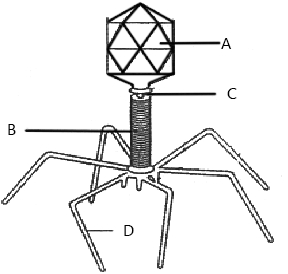
- A
$(a)$-Tail fibres, $(b)$-Head, $(c)$-Sheath, $(d)$-Collar
- B
$(a)$-Sheath, $(b)$-Collar, $(c)$-Head, $(d)$-Tail fibres
- ✓
$(a)$-Head, $(b)$-Sheath, $(c)$-Collar, $(d)$-Tail fibres
- D
$(a)$-Collar, $(b)$-Tail fibres, $(c)$-Head, $(d)$-Sheath
AnswerCorrect option: C. $(a)$-Head, $(b)$-Sheath, $(c)$-Collar, $(d)$-Tail fibres
c
(c) : $(a)$-Head, $(b)$-Sheath, $(c)$-Collar, $(d)$-Tail fibres
View full question & answer→MCQ 4481 Mark
Black (stem) rust of wheat is caused by
Answerc
(c) : Black stem rust is caused by Puccinia graminis tritici. The genus Puccinia includes $700$ species, which cause rust diseases of many economic plants such as wheat, barley, oats, etc.It is called a rust because of the reddish brown color of the spores that are found chiefly upon the surface of the host leaves and stems. P. graminis is heteroecious $i.e.$, requiring two hosts, wheat and barberry for the completion of normal life cycle.According to the nature of the spores, the life cycle of the P. graminis is divided into five stages. It is during, teleuto stage, the teliospore (or teleutospores) produce dark brown to black pustules on the surface of stems and leaves of the wheat that results into ‘black stem rust of wheat’.
View full question & answer→MCQ 4491 Mark
Single-celled eukaryotes are included in
Answera
(a) : Protista include all unicellular and colonial eukaryotes except those of green and red algae. The protistan cells are typically eukaryotic having membrane bound organelles like mitochondria, chloroplasts, Golgi bodies, endoplasmic reticulum, nucleus etc. Protista is commonly known as kingdom of unicellular eukaryotes. Kingdom fungi contains achlorophyllous, spore producing, heterotrophic, multicellular or multinucleate eukaryotic organisms (unicellular yeasts are also included amongst fungi because their sexual reproduction is similar to that of some fungi). Monerans are basically unicellular prokaryotes. Archaea (ancient bacteria) are also a type of monerans which live in primitive environment like high temperature, high salt content, acidic $pH$, etc.
View full question & answer→MCQ 4501 Mark
- A
free infectious $DNA$
- B
- C
- ✓
free infectious $RNA.$
AnswerCorrect option: D. free infectious $RNA.$
d
(d) : Viroids are infectious $RNA$ particles which were discovered by T.O. Diener $(1971)$. These are devoid of protein coat and cause diseases in plants only, $e.g.$, potato spindle tuber, chrysanthemum stunt etc.
View full question & answer→MCQ 4511 Mark
There exists a close association between the algae and the fungus within a lichen. The fungus
- A
Fixes the atmospheric nitrogen for the alga
- ✓
Provides protection, anchorage and absorption for the alga
- C
Provides food for the alga
- D
Releases oxygen for the alga
AnswerCorrect option: B. Provides protection, anchorage and absorption for the alga
View full question & answer→MCQ 4521 Mark
Which of the following is false
- A
Most plant viruses are $ RNA$ viruses
- B
Most animal viruses are $ DNA $ viruses
- ✓
$TMV $ has double stranded $RNA$ molecule
- D
$T_4 $ bacteriophage has double stranded $DNA $ molecule
AnswerCorrect option: C. $TMV $ has double stranded $RNA$ molecule
View full question & answer→MCQ 4531 Mark
Lichens are well known combination of an alga and a fungus where fungus has
- A
A parasitic relationship with the alga
- ✓
A symbiotic relationship with the alga
- C
A saprophytic relationship with the alga
- D
An epiphytic relationship with the alga
AnswerCorrect option: B. A symbiotic relationship with the alga
View full question & answer→MCQ 4541 Mark
Phenetic classification of organisms is based on
AnswerCorrect option: C. Observable characteristics of existing organisms
View full question & answer→MCQ 4551 Mark
- A
Identification and arrangement of organisms on the basis of their cytological characteristics
- B
The classification of organisms based on broad morphological characters
- C
Delimiting various taxa of organisms and establishing their relationships
- ✓
The classification of organisms based on their evolutionary history and establishing their phylogeny on the totality of various parameters from all fields of studies
AnswerCorrect option: D. The classification of organisms based on their evolutionary history and establishing their phylogeny on the totality of various parameters from all fields of studies
View full question & answer→MCQ 4561 Mark
In manufacture of bread, it becomes porous due to release of $CO_2$ by the action of
View full question & answer→MCQ 4571 Mark
In five kingdom system, the main basis of classification is
MCQ 4581 Mark
Answerb
(b) Rhizopus $(pin\, mould \,or\, black \,mould)$ grows on bread and hence also called bread mould.
View full question & answer→MCQ 4591 Mark
Which protozoan is unlikely to have a contractile vacuole
MCQ 4601 Mark
Assertion : $TMV$ is a virus which causes mosaic disease.
Reason : $TMV$ has $RNA$ as genetic material
- A
If both Assertion and Reason are correct and the Reason is a correct explanation of the Assertion.
- ✓
If both Assertion and Reason are correct but Reason is not a correct explanation of the Assertion.
- C
If the Assertion is correct but Reason is incorrect.
- D
If both the Assertion and Reason are incorrect.
AnswerCorrect option: B. If both Assertion and Reason are correct but Reason is not a correct explanation of the Assertion.
b
In $TMV$, the chromosome consists of single stranded, linear $RNA$ molecule coiled into a regular spiral. $TMV$ causes mosaic disease in tobacco and some other plants.
View full question & answer→MCQ 4611 Mark
The symbiotic association of fungi and algae is called
MCQ 4621 Mark
According to their modes of nutrition, the fungi are classified into
Answerb
(b) Modes of nutrition is three types :
$(a)$ Saprophytic $(b)$ Parasitic $(c)$ Symbiotic $(Mycorrhiza)$.
View full question & answer→MCQ 4631 Mark
In the five kingdom system of classification, which single kingdom out of the following can include blue-green algae, nitrogen fixing bacteria and methanogenic archaebacteria
MCQ 4641 Mark
The genetic material in viruses is
AnswerCorrect option: D. $RNA$ or $DNA$ i.e. one nucleic acid in a virus
View full question & answer→MCQ 4651 Mark
Blue-green algae are included in
MCQ 4661 Mark
Which one possess characters of both plants and animals
MCQ 4671 Mark
Mycorrhiza exhibits the phenomenon of
Answerd
(d)Mycorrhiza is a symbiotic association of a saprophytic fungus with the roots of higher.
View full question & answer→MCQ 4681 Mark
The disease produced by fungus Ustilago are known as smuts because
- A
- B
The affected host becomes completely black
- C
- ✓
They produced sooty mass of spores
AnswerCorrect option: D. They produced sooty mass of spores
View full question & answer→MCQ 4691 Mark
- ✓
Photosynthesisers, symbionts and holotrophs
- B
- C
- D
AnswerCorrect option: A. Photosynthesisers, symbionts and holotrophs
View full question & answer→MCQ 4701 Mark
Evolutionary classification is called
Answerc
(c) In phylogenetic systems of classification. Organisms are arranged according to their evolutionary relations.
View full question & answer→MCQ 4711 Mark
The first to isolate plant virus was
- ✓
W.M. $ $Stanley
- B
E. C. $ $Stackmann
- C
A. K$ . $ Smith
- D
AnswerCorrect option: A. W.M. $ $Stanley
View full question & answer→MCQ 4721 Mark
All fungi can be called as
Answera
(a) Heterotrophs : Fungi $(lack\, chlorophyll)$ obtain their nutrition from the extracellular digestion and absorption of the digested material such mode of nutrition is called heterotrophic and the organism celled heterotrophs.
View full question & answer→MCQ 4731 Mark
Most important criteria used for the present day classification of living organisms is based on
- A
Presence and absence of notochord
- B
Resemblances in external features
- C
- ✓
Anatomical and physiological characteristics
AnswerCorrect option: D. Anatomical and physiological characteristics
View full question & answer→MCQ 4741 Mark
Plasmodium, the malarial parasite, belongs to class
MCQ 4751 Mark
Match list $A$ and List $B$ and choose correct option
| List - $A$ |
List - $B$ |
| $(a)$ Citrus canker |
$(i)$ Fungi |
| $(b)$ Spongiform encephalopathy |
$(ii)$ Prion |
| $(c)$ Herpes |
$(iii)$ Virus |
| $(d)$ Red rot |
$(iv)$ Bacteria |
- A
$a-i, b-ii, c-iii, d-iv$
- B
$a-ii, b -iii, c-i v, d-i$
- ✓
$a-iv, b-ii, c-iii, d-i$
- D
$a - i , b - iii , c - ii , d - iv$
AnswerCorrect option: C. $a-iv, b-ii, c-iii, d-i$
c
The correct option is $(C)$ as citrus canker is caused by bacteria, Spongiform encephalopathy is caused by a prion, herpes is caused by viruses named herpes simplex virus and the fungi cause the red rot.
View full question & answer→MCQ 4761 Mark
Match the following
| Column $I$ |
Column $II$ |
| $(a)$ Potato spindle |
$(i)$ Virus |
| $(b)$ Cr-Jacob disease $(CJD)$ |
$(ii)$ Viroid |
| $(c)$ Cholera |
$(iii)$ Prion |
| $(d)$ Leaf rolling and curling |
$(iv)$ Bacteria |
- A
$a - i , b - ii , c - iii , d - iv$
- B
$a - iv , b - iii , c - ii , d - i$
- ✓
$a - ii , b - iii , c - iv , d - i$
- D
$a - iv , b - i , c - iii , d - ii$
AnswerCorrect option: C. $a - ii , b - iii , c - iv , d - i$
c
The correct option is $(C).$
View full question & answer→MCQ 4771 Mark
Match the following:
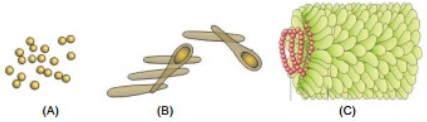
- A
$A$ - Tobacco mosaic virus, $B$ - Coccus, $C$ - Bacillus
- ✓
$A$ - Coccus, $B$ - Bacillus, $C$ - Tobacco mosaic virus
- C
$A$ - Bacillus, $B$ - Coccus, $C$ - Tobacco mosaic virus
- D
$A$ - Coccus, $B$ - Tobacco mosaic virus, $C$ - Bacillus
AnswerCorrect option: B. $A$ - Coccus, $B$ - Bacillus, $C$ - Tobacco mosaic virus
b
The correct option is $(B).$
View full question & answer→MCQ 4781 Mark
Match the column - $I$ and column - $II$
| Column - $I$ |
Column - $II$ |
|
$(i)$ Chrysophyta
|
$(a)$ Fungi |
|
$(ii)$ Gonyaulax
|
$(b)$ Diatom |
| $(iii)$ Penicillium |
$(c)$ Plasmodium |
|
$(iv)$ Slime mould
|
$(d)$ Dinoflagellate |
- A
$(i) - a ,( ii )- b ,( iii )- c ,( iv )- d $
- B
$(i) - b ,( ii )- c ,( iii )- a ,( iv )- d$
- C
$(i) - b ,( ii )- c ,( iii )- d ,( iv )- a$
- ✓
$(i) - b ,( ii )- d ,( iii )- a ,( iv )- c$
AnswerCorrect option: D. $(i) - b ,( ii )- d ,( iii )- a ,( iv )- c$
d
Diatom is one of the members of Chrysophyta phylum. Gonyaulax is the genus of dinoflagellates. Penicillium is a genus of fungi.
View full question & answer→MCQ 4791 Mark
Match the column - $I$ and column - $II$
| Column - $I$ |
Column - $II$ |
| $(i)$ Agaricus |
$(a)$ Ascomycetes |
| $(ii)$ Collectotichum |
$(b)$ Deuteromycetes |
| $(iii)$ Albugo |
$(c)$ Phycomycetes |
| $(iv)$ Neurospora |
$(d)$ Basidiomycetes |
- A
$i - b , ii - a , iii - c , iv - d$
- B
$i - a , ii - b , iii - d , iv - c$
- C
$i - c , ii - b , iii - d , iv - a$
- ✓
$i - d , ii - b , iii - c , iv - a$
AnswerCorrect option: D. $i - d , ii - b , iii - c , iv - a$
d
Neurospora belongs to phylum Ascomycota. Agaricus fungus belongs to Basidiomycota. Colletotrichum belongs to Deuteromycota.
View full question & answer→MCQ 4801 Mark
Match the column:
| Column $I$ |
Column $II$ |
| $(i)$ Tricoderma |
$(a)$ Deuteromycetes |
| $(ii)$ Yeast |
$(b)$ Basidiomycetes |
| $(iii)$ Bread mould |
$(c)$ phycomycetes |
| $(iv)$ Smut |
$(d)$ Ascomycetes |
- A
$i - d , ii - a , iii - c , iv - b$
- B
$i - a , ii - d , iii - b , iv - c$
- ✓
$i - a , ii - d , iii - c , iv - b$
- D
$i - a , ii - c , iii - b , iv - d$
AnswerCorrect option: C. $i - a , ii - d , iii - c , iv - b$
c
The correct option is $(C).$
View full question & answer→MCQ 4811 Mark
Match the column $I$ and $II$
| Column $I$ |
Column $II$ |
| $(i)$ Chrysophyte |
$(a)$ Gonyaulax |
| $(ii)$ Dinoflagellate |
$(b)$ Euglena |
| $(iii)$ Euglenoids |
$(c)$ Diatom |
| $(iv)$ Slime moulds |
$(d)$ Plasmodium |
- A
$i-a, ii-c, iii-b, iv-d$
- B
$i-a, ii-d, iii-b, iv-c$
- C
$i-c, ii-b, iii-d, iv-a$
- ✓
$i-c, ii-a, iii-b, iv-d$
AnswerCorrect option: D. $i-c, ii-a, iii-b, iv-d$
d
The correct option is $(D).$
View full question & answer→MCQ 4821 Mark
Which one of the following organisms do not evolve oxygen during photosynthesis?
Answerc
The photosynthetic bacteria like purple non-sulphur bacteria photosynthesise using bacteriochlorophyll$a$ and $b$ in anoxic environments, such as stagnant water. The reducing agent involved is hydrogen rather than oxygen hence, oxygen is not produced.
View full question & answer→MCQ 4831 Mark
Which of the following statements is not correct for viruses?
AnswerCorrect option: C. Viruses cannot pass through bacterial filters
c
Virus is a small infectious agent that replicates only inside the living cells of other organisms. Viruses can infect all types of life forms, from animals and plants to microorganisms, including bacteria and archaea. Viruses can pass through bacterial proof filters as they are smaller than bacteria
View full question & answer→MCQ 4841 Mark
Which of the following statements regarding cyanobacteria is incorrect?
- A
It is also called blue green algae.
- ✓
They are chemosynthetic heterotrophs
- C
It forms blooms in polluted water bodies
- D
It is unicellular, colonial or filamentous, marine or terrestrial bacteria.
AnswerCorrect option: B. They are chemosynthetic heterotrophs
b
Cyanobacteria are photosynthetic (containing a blue photosynthetic and chemosynthetic pigment) autotrophs. They are prokaryotic and represent the earliest known form of life on the Earth.
View full question & answer→MCQ 4851 Mark
Which of the following is correct about the slime mould ?
$(i)$ Its thalloid body, Plasmodium has pseudopodia for locomotion and engulfing organic matter.
$(ii)$ During unfavourable conditions Plasmodium differentiates and produces fruiting bodies, sporangium.
$(iii)$ Spores posses no true cell wall.
$(iv)$ They are dispersed by air current.
$(v)$ Being extremely resistant, spores survive for many years.
$(vi)$ Plasmodium can grow upto several feet. Choose the answer from the following options
- ✓
$(i),(ii), (iv), (v)$ and $(vi)$
- B
$(i),(ii)$ and $(iii)$
- C
$(i),(ii), (iii)$ and $(vi)$
- D
$(ii),(iii)$ and $(vi)$
AnswerCorrect option: A. $(i),(ii), (iv), (v)$ and $(vi)$
View full question & answer→MCQ 4861 Mark
Match column $-I$ with column $-II$ and select the option
| Column $-I$ |
Column $-II$ |
| (Classes of fungi) |
(Common name) |
| $(A)$ Phycomycetes |
$(I)$ Sac fungi |
| $(B)$ Ascomycetes |
$(II)$ Algal fungi |
| $(C)$ Basidiomycetes |
$(III)$ Fungi imperfecti |
| $(D)$ Deuteromycetes |
$(IV)$ Club fungi |
The correct combination is
- ✓
$A -II; B -I; C -IV; D -III$
- B
$A -II; B -IV; C -I; D -III$
- C
$A -IV; B -I; C -II; D -III$
- D
$A -IV; B -III; C -II; D -I$
AnswerCorrect option: A. $A -II; B -I; C -IV; D -III$
a
$A -II; B -I; C -IV; D -III$
View full question & answer→MCQ 4871 Mark
Which pair of the following belongs to Basidiomycetes?
- A
- B
- C
- ✓
Birds nest fungi and puffballs
AnswerCorrect option: D. Birds nest fungi and puffballs
View full question & answer→MCQ 4881 Mark
Choose the correct names of the different bacteria according to their shapes.
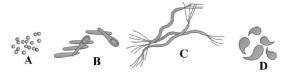
- ✓
$A -$ Cocci, $B -$ Bacilli, $C -$ Spirilla, $D -$ Vibrio
- B
$A -$ Bacilli, $B -$ Cocci, $C -$ Spirilla, $D -$ Vibrio
- C
$A -$ Spirilla, $B -$ Bacilli, $C -$ Cocci, $D -$ Vibrio
- D
$A -$ Spirilla, $B -$ Vibrio, $C -$ Cocci, $D -$ Bacilli
AnswerCorrect option: A. $A -$ Cocci, $B -$ Bacilli, $C -$ Spirilla, $D -$ Vibrio
View full question & answer→MCQ 4891 Mark
Which one of the following statements is correct?
AnswerCorrect option: C. Viroids consist of single-stranded $RNA$ molecule.
c
Viroid is a small infective segment of nucleic acid, usually $RNA$. Prion is an infectious pathogenic agent devoid of nucleic acid and composed mainly of proteins. Mycoplasmas lack a cell wall while Rickettsiae possess a cell wall.
View full question & answer→MCQ 4901 Mark
"Fairy rings" in lawns result from outward,spreading circles of mycelia of mushrooms producing, at their periphery, fruiting bodies called
Answerb
Some basidiomycetes or club fungi (e.g., Agaricus campestris) produce basidiocarps. These aerial structures also called mushrooms. They occur in rings called 'fairy rings'. Basidiocarps of some fungi are edible
View full question & answer→MCQ 4911 Mark
Assertion : Chemosynthesis is an autotrophic nutrition.
Reason : Chemoautotrophs contain chlorophyll pigments
- A
If both Assertion and Reason are correct and the Reason is a correct explanation of the Assertion.
- ✓
If both Assertion and Reason are correct but Reason is not a correct explanation of the Assertion.
- C
If the Assertion is correct but Reason is incorrect.
- D
If both the Assertion and Reason are incorrect.
AnswerCorrect option: B. If both Assertion and Reason are correct but Reason is not a correct explanation of the Assertion.
b
Chemoautotrophs developed the ability to synthesize organic molecules from inorganic raw materials. Chlorophyll pigments are present in photoautotrophs. The photo-autotrophs utilize the solar energy absorbed by them in synthesizing organic compounds. Certain chemoautotrophs include green sulphur bacteria
View full question & answer→MCQ 4921 Mark
Which of the following is found in algal zone of Cycas coralloid roots?
Answera
The algal zone consists of blue green algae in the coralloid roots. The relationship is a mutual relationship. The algae get the dwelling place, while cycas can use the food produced by the algae
View full question & answer→MCQ 4931 Mark
Among rust, smut and mushroom all the three
Answerd
Rust, smut and mushroom bear short lived reproductive bodies called basidiocarps.
View full question & answer→MCQ 4941 Mark
Assertion : Bacteria have three basic shapes, i.e., round , rod, spiral.
Reason : Cocci and Bacilli may form clusters or chain of a definite length.
- A
If both Assertion and Reason are correct and the Reason is a correct explanation of the Assertion.
- B
If both Assertion and Reason are correct but Reason is not a correct explanation of the Assertion.
- C
If the Assertion is correct but Reason is incorrect.
- ✓
If the Assertion is incorrect but the Reason is correct
AnswerCorrect option: D. If the Assertion is incorrect but the Reason is correct
d
Bacteria are microscopic organisms whose single cells have neither a membrane enclosed nucleus nor other membrane enclosed orgnelles like mitochondria and chloroplast. Bacteria possess various forms and shapes like coccus (round), bacillus (rod shaped), vibrio (comma shaped) and spirullum (spiral like cork screw).
View full question & answer→MCQ 4951 Mark
Assertion: Viruses are not considered organism.
Reason: Viruses are nucleoproteins and lack cell organelle, etc.
- ✓
If both Assertion and Reason are correct and the Reason is a correct explanation of the Assertion.
- B
If both Assertion and Reason are correct but Reason is not a correct explanation of the Assertion.
- C
If the Assertion is correct but Reason is incorrect.
- D
If both the Assertion and Reason are incorrect.
AnswerCorrect option: A. If both Assertion and Reason are correct and the Reason is a correct explanation of the Assertion.
a
Virus is a small infectious agent that can only replicate inside the cells of another organism. Viruses are not considered as organisms as they have no independent machinery
View full question & answer→MCQ 4961 Mark
The scientist who created the group Protista for both unicellular plants and animals is
Answera
(a) A German biologist Ernst Haeckel created a third kingdom protista in $1866 $ for unicellular organism such as bacteria, protozoans Algae and fungi.
View full question & answer→MCQ 4971 Mark
- A
Two haploid cells including their nuclei
- ✓
Two haploid cells without nuclear fusion
- C
- D
Sperm and two polar nuclei
AnswerCorrect option: B. Two haploid cells without nuclear fusion
b
(b) It is the first stage of sexual reproduction in which the cytoplasm of two sex cells fuse with each other.
The nuclei of sex cells come close to each other but do not fuse.
Thus the resulting cell becomes binucleate or dikaryon.
View full question & answer→MCQ 4981 Mark
Tobacco mosaic Virus $(TMV)$ has
- ✓
A single stranded $ RNA$ molecule
- B
A double stranded $ RNA$ molecule
- C
A single stranded $DNA$ molecule
- D
A double stranded $DNA$ molecule
AnswerCorrect option: A. A single stranded $ RNA$ molecule
a
(a)In $ TMV$ $(Tobacco\,\, mosaic\,\, virus)$ the genetic materials is $ ssRNA$.
View full question & answer→