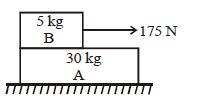
Block $A$ of mass $30\, kg$ . is resting on a frictionless floor. Another block $B$ of mass $5\, kg$ is resting on it as shown in the figure. The coefficient of static friction between the blocks is $0.4$ while kinetic friction is $0.3$. If a horizontal force of $175\, N$ is applied to block $B$ , then the acceleration of the block $A$ will be ........ $m/s^2$ $(g = 10\, m/s^2 )$
Medium


Download our appand get started for free
Experience the future of education. Simply download our apps or reach out to us for more information. Let's shape the future of learning together!No signup needed.*
Similar Questions
- 1View SolutionThe limiting friction is
- 2$STATEMENT-1$ It is easier to pull a heavy object than to push it on a level ground. andView Solution
$STATEMENT-2$ The magnitude of frictional force depends on the nature of the two surfaces in contact.
- 3A motor car has a width $1.1$ m between wheels. Its centre of gravity is $0.62$ m above the ground and the coefficient of friction between the wheels and the road is $0.8$. ...... $m/s$ is the maximum possible speed, if the centre of gravity inscribes a circle of radius $15$ m ? (Road surface is horizontal)View Solution
- 4View SolutionA man balances himself in a horizontal position by pushing his hands and feet against two parallel walls. His centre of mass lies midway between the walls. The coefficients of friction at the walls are equal. Which of the following is not correct?

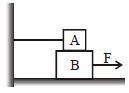
- 5A block $A$ of mass $100\, kg$ rests on another block $B$ of mass $200\, kg$ and is tied to a wall as shown in the figure. The coefficient of friction between $A$ and $B$ is $0.2$ and that between $B$ and the ground is $0.3$. The minimum force $F$ required to move the block $B$ is........ $N$ . $(g = 10\, m/s^2)$View Solution
- 6A body of mass $5\, kg$ is moving in a circle of radius $1\,m$ with an angular velocity of $2$ radian/sec. The centripetal force is ......... $N$View Solution
- 7A coin placed on a rotating table just slips when it is placed at a distance of $1\,cm$ from the center. If the angular velocity of the table in halved, it will just slip when placed at a distance of from the centre $............\,cm$View Solution
- 8$A$ block of mass $M$ is placed on $a$ horizontal surface and it is tied with an inextensible string to $a$ block of mass, as shown in figure. A block of mass $m_0$ is also placed on $M$ The minimum value of $\mu$ between the block $M$ and $m_0$ (taking horizontal surface frictionless) for which all the three blocks move together, isView Solution

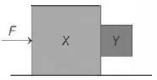
- 9Consider the system shown below. A horizontal force $F$ is applied to a block $X$ of mass $8 \,kg$, such that the block $Y$ of mass $2 \,kg$ adjacent to it does not slip downwards under gravity. There is no friction between the horizontal plane and the base of the block $X$. The coefficient of friction between the surfaces of blocks $X$ and $Y$ is $0.5$. The minimum value of $F$ is ............ $N$ (take, acceleration due to gravity to be $10 \,ms ^{-2}$ )View Solution
- 10A piece of ice slides down a rough inclined plane at $\theta=45^{\circ}$ inclination in twice the time that it takes to slide down an identical but frictionless inclined plane. What is the coefficient of friction between ice and incline ?View Solution