Bohr magneton is given by (symbols have their usual meanings)
Easy
Download our app for free and get started
(d)
$B_m=\frac{e h}{4 \pi m}$

Download our appand get started for free
Experience the future of education. Simply download our apps or reach out to us for more information. Let's shape the future of learning together!No signup needed.*
Similar Questions
- 1An $\alpha - $ particle travels in a circular path of radius $0.45\, m$ in a magnetic field $B = 1.2\,Wb/{m^2}$ with a speed of $2.6 \times {10^7}\,m/\sec $. The period of revolution of the $\alpha - $ particle isView Solution
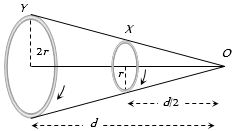
- 2Two circular coils $X$ and $Y$, having equal number of turns, carry equal currents in the same sense and subtend same solid angle at point $O$. If the smaller coil, $X$ is midway between $O$ and $Y$, then if we represent the magnetic induction due to bigger coil $Y$ at $O$ as $BY$ and that due to smaller coil $X$ at $O$ as $BX$ , thenView Solution
- 3Consider the two idealised systems $(i)$ a parallel plate capacitor with large plates and small separation and $(ii)$ a long solenoid of length $L >> R$, radius of cross-section. In $(i)\, E$ ideally treated as a constant between plates and zero outside. In $(ii)$ magnetic field is constant inside the solenoid and zero outside. These idealised assumptions, however, contradict fundamental laws as belowView Solution
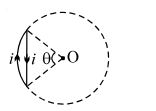
- 4Net magnetic field at the centre of the circle $O$ due to a current carrying loop as shown in figure is $(\theta < 180^o)$View Solution
- 5Two particles $\mathrm{X}$ and $\mathrm{Y}$ having equal charges are being accelerated through the same potential difference. Thereafter they enter normally in a region of uniform magnetic field and describes circular paths of radii $R_1$ and $R_2$ respectively. The mass ratio of $\mathrm{X}$ and $\mathrm{Y}$ is :View Solution
- 6A charged particle with specific charge $S$ moves undeflected through a region of space containing mutually perpendicular uniform electric and magnetic fields $E$ and $B$ . When electric field is switched off, the particle will move in a circular path of radiusView Solution
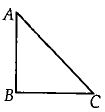
- 7A current carrying closed loop in the form of a right angle isosceles triangle $ABC$ is placed in a uniform magnetic field acting along $AB.$ If the magnetic force on the arm $BC$ is $\vec F,$ the force on the arm $AC$ isView Solution
- 8A galvanometer has a resistance of $20\,\Omega$ and reads full-scale when $0.2\, V$ is applied across it. To convert it into a $10\, A$ ammeter, the galvanometer coil should have aView Solution
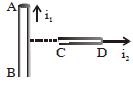
- 9An infinitely long straight conductor $AB$ is fixed and a current is passed through it. Another movable straight wire $CD$ of finite length and carrying current is held perpendicular to it and released. Neglect weight of the wireView Solution
- 10View SolutionMagnetic effect of current was discovered by