MCQ
Borax bead test is not used to identify cation in:
  • A
    Cobalt salt
  • B
    Nickel salt
  • Aluminium salt
  • D
    Copper salt

Answer

Correct option: C.
Aluminium salt
Aluminium forms colourless metaborate and thus gives an indecisive test.

Need a full question paper?

Generate a complete, print-ready paper with questions like this in minutes — across 16+ boards, with answer keys.

Start Generating Free

Similar questions

In the main group elements $(i)$ as we proceed down the same group in the periodic table and $(ii)$ as we proceed from left to right in the same period, the atomic radius
The mixing of one s and one $\ce{p}-$ orbital resulting in the formation of two equivalent $\ce{sp}-$ hybrid orbitals. Which of the following orbitals are $-$ used for $\ce{sp}-$ hybridisation by convention.
The $pH$ of ${10^{ - 5}}\,M$ aqueous solution of $NaOH$ is
For ${N_2} + 3{H_2}$ $\rightleftharpoons$ $2N{H_3}$ equilibrium constant is $k$ then equilibrium constant for $2N_2 + 6H_2 $ $\rightleftharpoons$ $ 4NH_3$ is
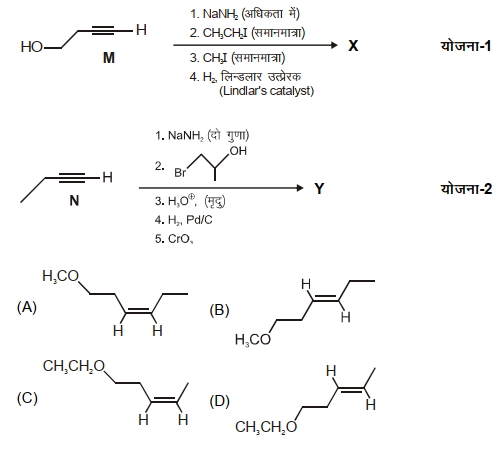
Schemes $1$ and $2$ describe sequential transformation of alkynes $M$ and $N$. Consider only the major products formed in each step for both the schemes. $Image$

$1.$ The product $X$ is

mcq $Image$

$2.$ The correct statement with respect to product $Y$ is :

$(A)$ It gives a positive Tollens test and is a functional isomer of $X$.

$(B)$ It gives a positive Tollens test and is a geometrical isomer of $X$.

$(C)$ It gives a positive iodoform test and is a functional isomer of $X$.

$(D)$ It gives a positive iodoform test and is a geometrical isomer of $X$.

Give the answer question $1$ and $2.$
Chlorine undergoes disproportionation in alkaline medium as shown below :

$ \text { a } \mathrm{Cl}_2(\mathrm{~g})+\mathrm{b} \mathrm{OH}^{-}(\mathrm{aq}) \rightarrow \mathrm{c} \mathrm{ClO}^{-}(\mathrm{aq})+\mathrm{d} \mathrm{Cl}^{-}(\mathrm{aq})  +\mathrm{e} \mathrm{H}_2 \mathrm{O}(l)$

The values of $a, \ b,\  c$ and $d$ in a balanced redox reaction are respectively :

Quartz is the form ?
Which one of the following is responsible for causing skin cancer and mutation?
Which electronic level would allow the hydrogen atom to absorb a photon but not to emit a photon
The strength of an aqueous solution of $I_2$ can be determined by titrating the solution with standard solution of: