Question
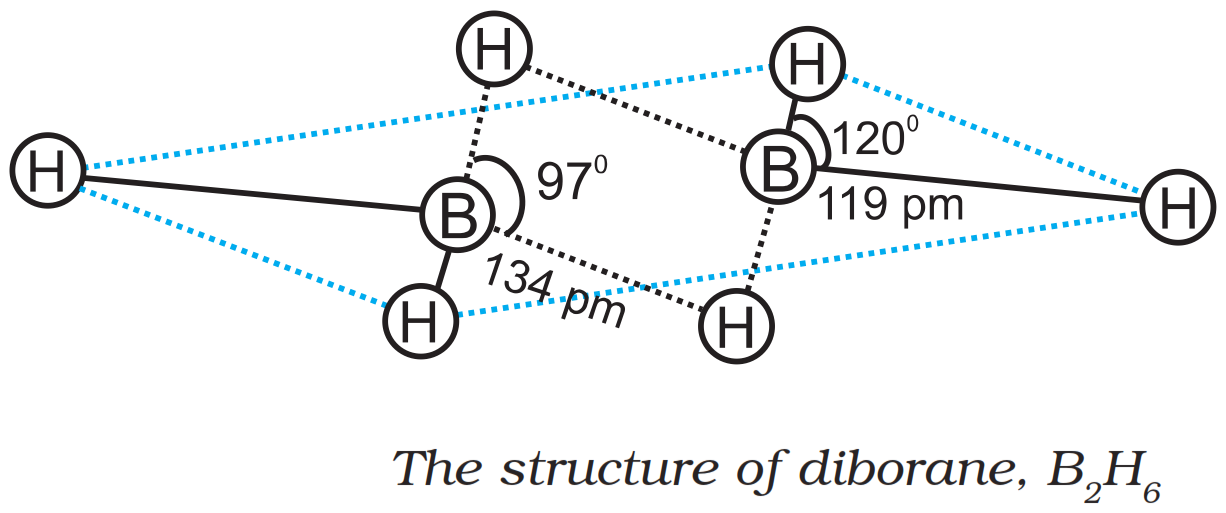
Boron fluoride exists as $\mathrm{BF}_3$ but boron hydride doesn't exist as $\mathrm{BH}_3$. Give reason. In which form does it exist? Explain its structure.
Answer

$\mathrm{BF}_3$ exists as a monomer due to $\mathrm{p} \pi$-prtback bonding. Fluorine transfers two electrons to vacant 2 p -orbital of boron. The delocalisation reduces the deficiency of electrons on boron thereby increasing the stability of $\mathrm{BF}_3$ molecule. Due to absenceof lone pair of electrons on H , the back bonding does not occur in $\mathrm{BH}_3$. In other words, electron deficiency of boron remains and $\mathrm{BH}_3$ does not exist. To reduce electron deficiency $\mathrm{BH}_3$ dimerises to form $\mathrm{B}_2 \mathrm{H}_6$. Hence, boron hydride exists in dimeric form and known as diborane.

Need a full question paper?

Generate a complete, print-ready paper with questions like this in minutes — across 16+ boards, with answer keys.

Start Generating Free

Similar questions

What do you understand by the term “non-stoichiometric hydrides”? Do you expect this type of the hydrides to be formed by alkali metals? Justify your answer.
Explain the following in contrast to alkynes: (i) Polymerisation (ii) Isomerisation (iii) Oxidation (iv) Ozonolysis
Explain standard combustion enthalpy and atomisation enthalpy.
1. During estimation of nitrogen present in an organic compound by Kjeldahl's method, the ammonia evolved from 0.5 g of the compound in Kjeldahl's estimation of nitrogen, neutralized 10 mL of $1 M H _2 SO _4$. Find out the percentage of nitrogen in the compound.
2. Explain why $\left( CH _3\right)_3 \stackrel{+}{ C }$ is more stable than $CH _3 \stackrel{+}{ C } H _2$ and $\stackrel{+}{ C } H _3$ is the least stable cation.
What is the energy in joules, required to shift the electron of the hydrogen atom from the first Bohr orbit to the fifth Bohr orbit and what is the wavelength of the light emitted when the electron returns to the ground state? The ground state electron energy is $-2.18 \times 10^{-11}$ ergs.
Explain the Liebig's combustion process for analysis of carbon and hydrogen.
Reaction between $N_2$ and $O_{2–}$ takes place as follows:
$\text{2N}_2\text{(g) + O}_2\text{(g)}\rightleftharpoons2\text{N}_2\text{O(g)}$
If a mixture of 0.482mol $N_2$ and 0.933mol of $O_2$ is placed in a 10L reaction vessel and allowed to form $N_2O$ at a temperature for which $\text{K}_{\text{c}}=2.0\times10^{-37},$ determine the composition of equilibrium mixture.
Write a relation between $\Delta\text{G}$ and Q and define the meaning of each term and answer the following:
  1. Why a reaction proceeds forward when Q < K and no net reaction occurs when Q = K?
  2. Explain the effect of increase in pressure in terms of reaction quotient Q.
For the reaction,
What is the pH of $0.001M$ aniline solution? The ionization constant of aniline can be taken from Table $7.7$. Calculate the degree of ionization of aniline in the solution. Also calculate the ionization constant of the conjugate acid of aniline.
  1. Write the conjugate acid for Bronsted base of $HCOO^-$.
  2. Calculate the pH of a $1.0 \times 10^{-8}$ M solution of HCl.
  3. Calculate the solubility of $A_2X_3$ in pure water, assuming that neither kind of ion reacts with water. [The solubility product of $A_2X_3, K_{sp} = 1.1 \times 10^{-23}$]