Question
Boron has two stable isotopes, $^{10}_5\text{B }\text{ and }\ ^{11}_5\text{B}.$ Their respective masses are 10.01294 u and 11.00931 u, and the atomic mass of boron is 10.811 u. Find the abundances of $^{10}_5\text{B }\text{ and }\ ^{11}_5\text{B}.$
Answer

Mass of boron isotope $^{10}_5\text{B },\ \text{m}_1=10.01294\text{ u}$
Mass of boron isotope $^{11}_5\text{B },\ \text{m}_2=11.00931\text{ u}$
Abundance of $^{10}_5\text{B },\ \text{n}_1=\text{x}\%$
Abundance of $^{11}_5\text{B },\ \text{n}_2=(100-\text{x})\%$
Atomic mass of boron, m = 10.811 u
The atomic mass of boron atom is given as:
$\text{m}=\frac{\text{m}_1\text{n}_1+\text{m}_2\text{n}_2}{\text{n}_1+\text{n}_2}$
$10.811=\frac{10.01294\times\text{ x }+11.00931\times(100-\text{ x})}{\text{ x }+100-\text{ x}}$
1081.11 = 10.01294x + 1100.9312 - 11.00931x
$\therefore\ \text{x}=\frac{19.821}{0.99637}=19.89\%$
And 100 - X = 80.11%
Hence, the abundance of $^{10}_5\text{B is }19.89\%\text{ and that of }^{11}_5\text{B is }80.11\%.$

Need a full question paper?

Generate a complete, print-ready paper with questions like this in minutes — across 16+ boards, with answer keys.

Start Generating Free

Similar questions

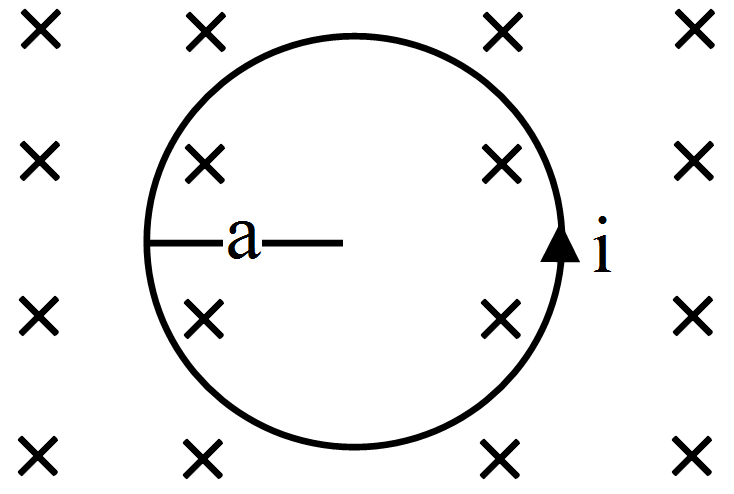
The shows a circular wire loop of radius a and carrying a current i, which is placed in a perpendicular magnetic field B.
  1. Consider a small part dl of the wire. Find the force on this part of the wire exerted by the magnetic field.
  2. Find the force of compression in the wire.
Calculate the height of the potential barrier for a head on collision of two deuterons. (Hint: The height of the potential barrier is given by the Coulomb repulsion between the two deuterons when they just touch each other. Assume that they can be taken as hard spheres of radius 2.0 fm.)
Does focal length of a lens depend on the colour of the light used? Does focal length of a mirror depend on the colour?
Consider the situation of the previous question from a frame moving with a speed v0 parallel to the initial velocity of the block.
  1. What are the initial and final kinetic energies?
  2. What is the work done by the kinetic friction?
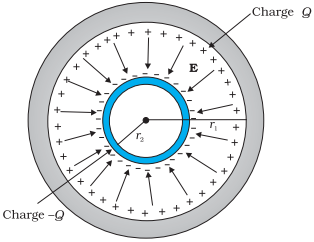
A spherical capacitor consists of two concentric spherical conductors, held in position by suitable insulating supports (2.36). Show
that the capacitance of a spherical capacitor is given by $\text{C}=\frac{{4}\pi\in_{0}\text{r}_1\text{r}_2}{\text{r}_1-\text{r}_2}$ where $r_1$ and $r_2$ are the radii of outer and inner spheres, respectively.
Write any two factors on which internal resistance of a cell depends. The reading on a high resistance voltmeter, when a cell is connected across it, is 2.2 V. When the terminals of the cell are also connected to a resistance of 5 Ω as shown in the circuit, the voltmeter reading drops to 1.8 V. Find the internal resistance of the cell.
Draw the circuit diagram of a full wave rectifier using two p-n junction
diodes. Explain its working and show input and output voltage variations.
A charged particle having a charge of $-2.0 \times 10^{-6}C$ is placed close to a nonconducting plate having a surface charge density $4.0 \times 10^{-5}Cm^{-2}$. Find the force of attraction between the particle and the plate.
Assume that the mass of a nucleus is approximately given by $M = Am_p$ where A is the mass number. Estimate the density of matter in $kg/m^3$ inside a nucleus. What is the specific gravity of nuclear matter?
Suppose the rod in the previous problem has a mass of 1kg distributed uniformly over its length:
  1. Find the initial angular acceleration of the rod.
  2. Find the tension in the supports to the blocks of mass 2kg and 5kg.