Question
Boron rods in nuclear reactor are used as a(a) Moderator(b) Control rods(c) Coolants(d) Protective shield
       

Answer

(b) Control rods

Need a full question paper?

Generate a complete, print-ready paper with questions like this in minutes — across 16+ boards, with answer keys.

Start Generating Free

Similar questions

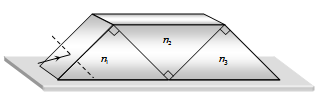
Three right angled prisms of refractive indices $\mathrm{n}_1, \mathrm{n}_2$ and $\mathrm{n}_3$ are fixed together using an optical glue as shown in figure. If a ray passes through the prisms without suffering any deviation, then
A compass needle is placed in the gap of a parallel plate capacitor. The capacitor is connected to a battery through a resistance. The compass needle:
X-rays are :
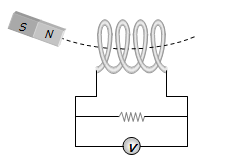
A magnet is made to oscillate with a particular frequency, passing through a coil as shown in figure. The time variation of the magnitude of $e.m.f.$ generated across the coil during one cycle is
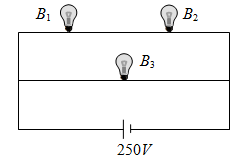
A $100 W$ bulb $B_1,$ and two $60-W$ bulbs $B_2$ and $B_3,$ are connected to a $250 V$ source, as shown in the figure. Now $W_1, W_2$ and $W_3$ are the output powers of the bulbs $B_1, B_2$ and $B_3,$ respectively. Then

 
A parallel beam of light is incident on a converging lens parallel to its principal axis. As one moves away from the lens on the other side on its principal axis, the intensity of light:
  1. Remains, constant.
  2. Continuously increases.
  3. Continuously decreases.
  4. First increases then decreases.
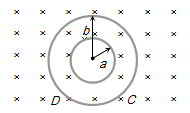
Plane figures made of thin wires of resistance $R = 50$ milli ohm/metre are located in a uniform magnetic field perpendicular into the plane of the figures and which decrease at the rate $dB/dt = 0.1\ m T/s$. Then currents in the inner and outer boundary are. $($The inner radius $a = 10 \ cm$ and outer radius $b = 20 \ cm)$
A double star is a system of two stars rotating about their centre of mass only under their mutual gravitational attraction. Let the star have mass $m$ and $2m$ and their separation be $l.$ Their time period of rotation about their centre of mass will be proportional to
When an ammeter is shunted, its measuring range :
A conductor has $14.4 \times 10^{-19}$ coulombs positive charge. The conductor has $($Charge on electron $=1.6 \times 10^{-19}$ coulombs$)$