Question
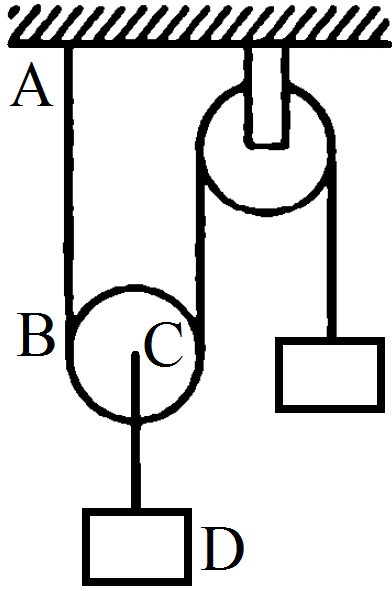
Both the strings, shown in figure are made of same material and have same cross-section. The pulleys are light. The wave speed of a transverse wave in the string AB is $\nu_1$ and in CD it is $\nu_2.$ Then $\frac{\nu_1}{\nu_2}$ is:

  1. $1$

  2. $2$

  3. $\sqrt{2}$

  4. $\frac{1}{\sqrt{2}}.$

Answer

  1. $\frac{1}{\sqrt{2}}$

Explanation:

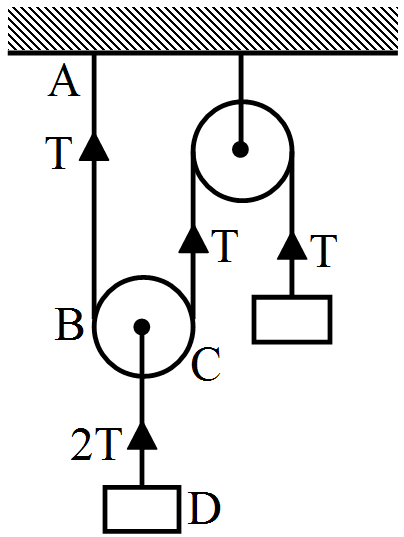
TAB = T

TCD = 2T

where

TAB is the tension in the string AB

TCD is the tension in the stnng CD

The eelatlon between tension and the wave speed is given by

$\text{v}=\sqrt{\frac{\text{T}}{\mu}}$

$\text{v}\propto\sqrt{\text{T}}$

where

v is the wave speed of the transverse wave

$\mu$ is the mass per unit length of the string

$\frac{\text{v}_1}{\text{v}_2}=\sqrt{\frac{\text{T}}{2\text{T}}}$

$=\frac{1}{\sqrt{2}}$

Need a full question paper?

Generate a complete, print-ready paper with questions like this in minutes — across 16+ boards, with answer keys.

Start Generating Free

Similar questions

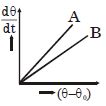
Two circular discs $A$ and $B$ with equal radii and equal mass are blackened. They are heated to same temperature and are cooled under identical conditions.What inference do you draw from their cooling curves ?
If $50$ Vernier divisions are equal to $49$ main scale divisions of a travelling microscope and one smallest reading of main scale is $0.5 \mathrm{~mm}$, the Vernier constant of travelling microscope is:
A small disc is on the top of a hemisphere of radius $R$. What is the smallest horizontal velocity v that should be given to the disc for it to leave the hemisphere and not slide down it ? [There is no friction]
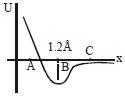
The potential energy $U$ between two molecules as a function of distance $x$ between them is shown $A, B, $ $\&$ $C$ are points for which $x$ $=$ $0.6Å, 1.2 Å $ $\&$ $1.8 Å$ respectively. At  $A, B $ $\&$ $C$ force between two molecules is :-
A bullet fired into a fixed target loses half of its velocity after penetrating $1\,cm.$ How much further it will penetrate before coming to rest, assuming that it faces constant resistance to motion
A body of mass $200\,gram$ is moving along $XY$ plane. Work performed by the force given by $\vec F = (2x\hat i + y\hat j)$ acting on it when the body gets displaced from $(0, 0)$ to $(1, 2)$ will be equal to ............... $\mathrm{unit}$
A compass needle is placed in the gap of a parallel plate capacitor. The capacitor is connected to a battery through a resistance. The compass needle:
  1. Does not deflect.
  2. Deflects for a very short time and then comes back to the original position.
  3. Deflects and remains deflected as long as the battery is connected.
  4. Deflects and gradually comes to the original position in a time that is large compared to the time constant.
The time of flight of an object projected with speed $20 \,ms ^{-1}$ at an angle $30^{\circ}$ with the horizontal, is .... $s$
$y = a\cos (kx + \omega t)$ superimposes on another wave giving a stationary wave having node at $x = 0.$ What is the equation of the other wave
Many exoplanets have been discovered by the transit method, where in one monitors, a dip in the intensity of the parent star as the exoplanet moves in front of it. The exoplanet has a radius $R$ and the parent star has radius $100 \,R$. If $I_0$ is the intensity observed on earth due to the parent star, then as the exoplanet transits