- Must be longitudinal
- May be longitudinal
- Must be transverse
- May be transverse
- Must be longitudinal.
Explanation:
Because particles in a gas are far apart, only longitudinal wave can travel through it.
32 questions · self-marked practice — reveal the answer and mark yourself.
Explanation:
Because particles in a gas are far apart, only longitudinal wave can travel through it.
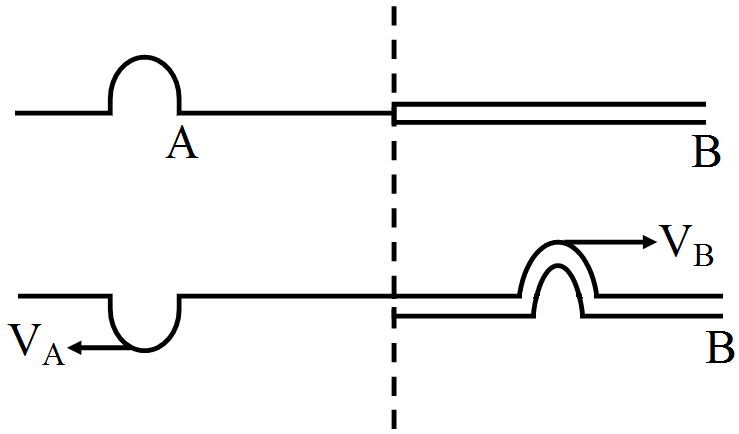
$\lambda'>\lambda$
$\lambda'=\lambda$
$\lambda'<\lambda$
$\lambda'<\lambda$
Explanation:

As $\text{v}=\sqrt{\frac{\text{f}}{\mu}}$
A wave pulse travels faster in a thinner string. The wavelength of the transmitted wave is equal to the wavelength of the Incident wave because the frequency remains constant.
Meaningless.
Explanation:
Sound wave is a mechanical wave; this means that it needs a medium to travel. Thus, its velocity in vacuum is meaningless.
The velocity but not for the kinetic energy.
Explanation:
The principle of superposition Is valid only for vector quantities. Velocity is a vector quantity, but kinetic energy is a scalar quantity.
$\text{y}=(0.001\text{mm})\sin\Big[(50\text{s}^{-1})\text{t}+(2.0\text{m}^{-1})\text{x}\Big]$
Explanation:
$\text{y}=(0.001\text{mm})\sin\Big[(50\text{s}^{-1})\text{t}+(2.0\text{m}^{-1})\text{x}\Big]$
Equating the above equation with the general equation, we get:
$\text{y}=\text{A}\sin(\omega\text{t}-\text{kx})$
$\omega=\frac{2\pi}{\text{T}}=2\pi\nu$
$\text{k}=\frac{2\pi}{\lambda}$
Here. A is the amplitude, $\omega$ is the angular frequency, k is the wave number and $\lambda$ is the wavelength.
$\text{A}=0.001\text{mm}$
Now,
$50=2\pi\nu$
$\Rightarrow\nu=\frac{25}{\pi}\text{Hz}$
$\frac{\lambda}{4}$
$\frac{\lambda}{3}$
$\frac{\lambda}{2}$
$\lambda.$
$\frac{\lambda}{2}$
Explanation:
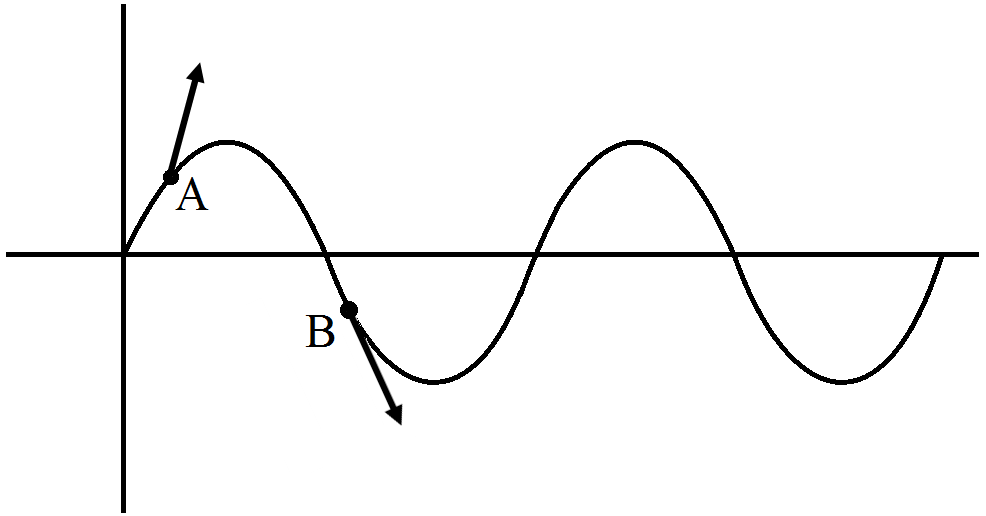
A sine wave has a maxima and a minima and the particle displacement has phase difference of $\pi$ radians. Therefore, applying similar argument we can say that if a particular particle has zero displacement at a certain instant. then the particle closest to it having zero displacement is at a distance is equal to $\frac{\lambda}{2}.$
$1$
$2$
$\sqrt{2}$
$\frac{1}{\sqrt{2}}.$

$\frac{1}{\sqrt{2}}$
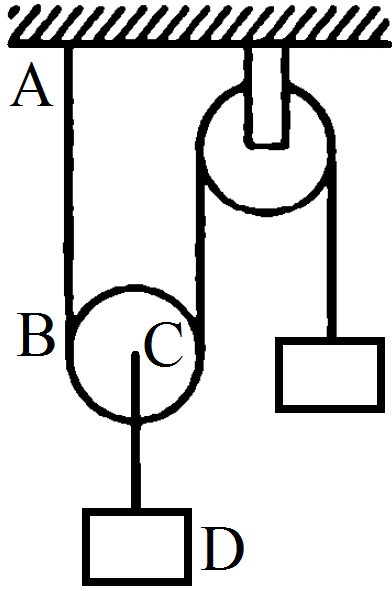
Explanation:

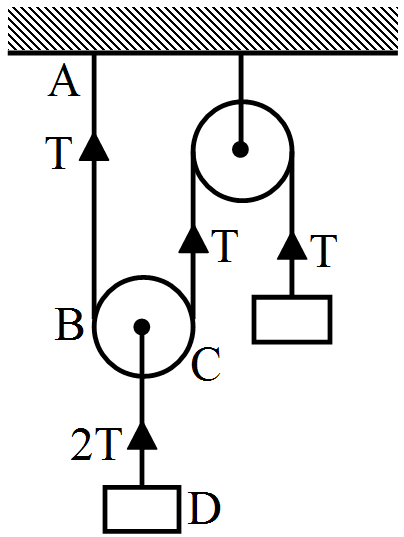
TAB = T
TCD = 2T
where
TAB is the tension in the string AB
TCD is the tension in the stnng CD
The eelatlon between tension and the wave speed is given by
$\text{v}=\sqrt{\frac{\text{T}}{\mu}}$
$\text{v}\propto\sqrt{\text{T}}$
where
v is the wave speed of the transverse wave
$\mu$ is the mass per unit length of the string
$\frac{\text{v}_1}{\text{v}_2}=\sqrt{\frac{\text{T}}{2\text{T}}}$
$=\frac{1}{\sqrt{2}}$
Explanation:
A mechanical wave is of two types: longitudinal and transverse. So, a particle of a mechanical wave may move perpendicular or along the direction of motion of the wave.
Explanation:
Particles in a solid are very close to each other; thus. both longitudinal and transverse waves can travel through it.
In the X-Y plane.
Explanation:
In a transverse wave. particles move perpendicular to the direction of motion of the wave. In other words, if a wave moves along the Z-axis, the particles will move in the X-Y plane.
The energy of any small part of a string remains constant in a standing wave.
Explanation:
A standing wave is formed when the energy of any small part of a string remains constant. If it does not, then there is transfer of energy. In that case. the wave is not stationary.
480Hz
Explanation:
The frequency of vibration of a sonometer wire Is the same as that of a fork. If this happens to be the natural frequency of the wire, standing waves with large amplitude are set In It.
$\text{x}=\text{A}\sin(\text{ky}-\omega\text{t})$
$\text{y}=\text{A}\sin(\text{kx}-\omega\text{t})$
$\text{y}=\text{A}\sin\text{ky}\cos\ \omega\text{t}$
$\text{y}=\text{A}\cos\text{ky}\sin\ \omega\text{t}.$
$\text{x}=\text{A}\sin(\text{ky}-\omega\text{t})$
Explanation:
Here x is the particle displacement of the wave and the wave is travelling along the Y-axis because the particle displacement is perpendicular to the direction of wave motion.
The pulses will pass through each other without any change in their shapes.
Explanation:
The pulses continue to retain their Identity after they meet, but the moment they meet their wave profile differs from the individual pulse.
Explanation:
The frequency of vibration of a sonometer wire is the same as that of a fork. If this happens to be natural frequency of the wire, then standing waves with large amplitude are set up in it.
Explanation:
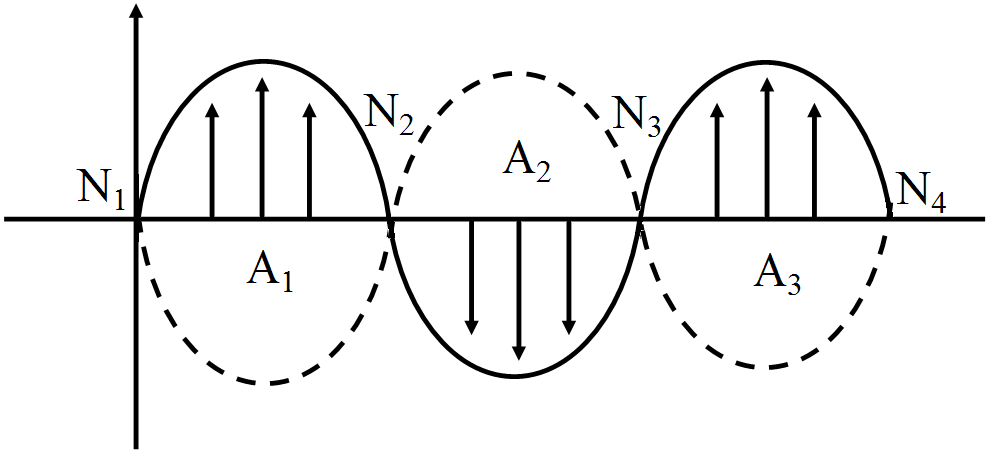
All particles in a particular segment between two nodes vibrate in the same phase, but the particles in the neighbouring segments vibrate in opposite phases, as shown below.

Thus, particles in alternate antinodes vibrate in the same phase.
Sound waves.
Explanation:
There are mainly two types of waves: first is electromagnetic wave, which does not require any medium to travel, and the second is the mechanical wave, which requires a medium to travel. sound requires medium to travel. hence it is a mechanical wave.
Be polarized.
Explanation:
A longitudinal wave has particle displacement along its direction of motion; thus, it cannot be polarised.
$\text{v}$
$\frac{\text{v}}{2}$
$2\text{v}$
$\sqrt{2}\text{v}.$
Explanation:
The boat transmits the same wave without any change of frequency to cause the cork to execute SHM with same frequency though amplitude may differ.
Explanation:

A and Bhave a phase difference of fl. So, when a sine wave passes through the region, they move in opposite directions and have equal displacement. They may be separated by any odd multiple of their wavelength.
$\overrightarrow{\text{yA}}=\text{A}\sin(\omega\text{t})$
$\overrightarrow{\text{yB}}=\text{B}\sin(\omega\text{t}+\pi)$
$\frac{\lambda}{4}$
$\frac{\lambda}{3}$
$\frac{\lambda}{2}$
$\lambda.$
$\frac{\lambda}{2}$
Explanation:
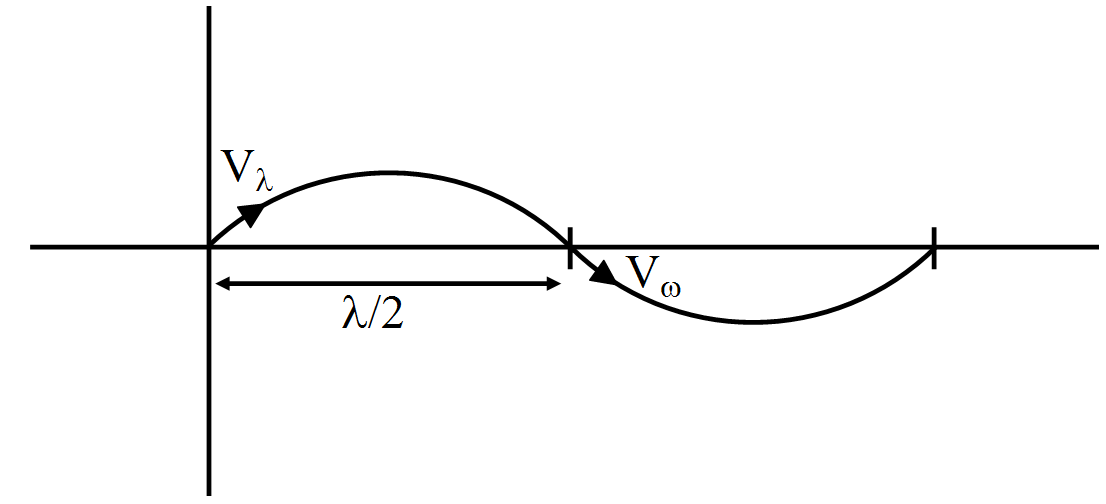
A sme wave has a maxima and a minimum and the particle displacement has phase difference of n radians. The speeds at the maximum point and at the minimum point are same although the direction of motion are different. The difference between the posiuons of maxima and minima Is equal to $\frac{\lambda}{2}.$
$\frac{1}{2}$
$2$
$\frac{1}{4}$
$4.$
$\frac{1}{2}$
Explanation:
wave speed is given by
$\nu=\sqrt{\frac{\text{T}}{\mu}}$Where
T is the tension in the string
v is the speed of the wave
$\mu$ Is the mass per unit length of the stnng
$\mu=\frac{\text{M}}{\text{L}}=\rho\frac{\text{V}}{\text{L}}=\rho\frac{(\text{AL})}{\text{L}}$
Where
Mis the mass of the stnng. which can be written as pV
L Is the length of the string
$=\rho(\pi\text{r}^2)=\rho\Big(\pi\frac{\text{D}^2}{4}\Big)$
$\therefore\nu=\sqrt{\frac{\text{T}}{\rho\pi\frac{\text{D}^2}{4}}}=\frac{2}{\text{D}}\sqrt{\frac{\text{T}}{\rho\pi}}$
Where Dis the diameter of the string.
Thus,
$\text{V}\propto\frac{1}{\text{D}}$Since,
$\text{r}_\text{A}=2\text{r}_\text{B}$$\text{v}_\text{A}\propto\frac{1}{2\text{r}_\text{A}}\propto\frac{1}{2\times2\text{r}_\text{B}}\ \dots(1)$
$\text{v}_\text{B}\propto\frac{1}{2\text{r}_\text{B}}\ \dots(2)$
From Equations (1) and (2) we get
$\frac{\text{v}_\text{A}}{\text{v}_\text{B}}=\frac{1}{2}$
A
Explanation:
We know the resultant amplitude Is given by
$\text{R}_\text{net}=\sqrt{\text{A}^2+\text{A}^2+2\text{A}^2\cos120^\circ}$ $(\phi=120^\circ)$
$=\sqrt{2\text{A}^2-\text{A}^2}$ $\Big[\because\cos120^\circ=\frac{-1}{2}\Big]$
$=\text{A}$
Must be an integral multiple of $\frac{\lambda}{4}$
Explanation:
A standing wave is produced on a string clamped at one end and free at the other. Its fundamental frequency is given by
$\nu=\Big(\text{n}+\frac{1}{2}\Big)\frac{\nu}{2\text{L}}$
$\Rightarrow\text{v}=\nu\lambda$
$\Rightarrow\nu=\Big(\text{n}+\frac{1}{2}\Big)\frac{\nu\lambda}{2\text{L}}$
$\Rightarrow\text{L}=\Big(\frac{2\text{n}+1}{4}\Big)\lambda$
$\Rightarrow\text{L}=\frac{\lambda}{4},\frac{3\lambda}{4},\ \dots$
$\sqrt{2}\text{a}$
Explanation:
We know that the resultant of the amplitude is given by
$\text{R}_\text{net}=\sqrt{\text{A}_1^2+\text{A}_2^2+2\text{A}_1\text{A}_2\cos\phi}$
For the particular case, we can write
$=\sqrt{\text{a}^2+\text{a}^2+2\text{a}^2\cos\frac{\pi}{2}}$
$=\sqrt{2}\text{a}$
The information is insufficient to find the relation betwee t1 and t2.
Explanation:
$\text{v}=\sqrt{\frac{\eta}{\rho}}$
But because the length of wires A and B is not known, the relation between A and B cannot be determined.
Amplitude $\frac{\text{A}}{2},$ frequency $\frac{\omega}{\pi}$
Explanation:
$\text{y}=\text{A}\sin^2(\text{kx}-\omega\text{t})$
$\Big[\cos^2\theta=1-2\sin^2\theta,\ \sin^2\theta=\frac{1-\cos^2\theta}{2}\Big]$
$\text{y}=\text{A}\Big[\frac{1-\cos^2(\text{kx}-\omega\text{t})}{2}\Big]$
$\text{y}=\frac{\text{A}}{2}\Big[1-\cos^2(\text{kx}-\omega\text{t})\Big]$
Thus, we have:
Amplitude $=\frac{\text{A}}{2}$
Frequency $=2\Big(\frac{\omega}{2\pi}\Big)$
$=\frac{\omega}{\pi}$
Inverse of its length.
Explanation:
The relation between wave speed and the length of the string is given by
$\text{v}=\frac{1}{2\text{l}}\sqrt{\frac{\text{F}}{\mu}}$
where
l is the length of the string
F is the tension
$\mu$ linear mass density
From the above relation, we can say that the fundamental frequency of a string is proportional to the inverse of the length of the string.
$\text{v}\propto\frac{1}{\text{l}}.$
Vibrate with a frequency of 208Hz.
Explanation:
According to the relation of the fundamental frequency of a string
$\nu=\frac{1}{2\text{l}}\sqrt{\frac{\text{F}}{\mu}}$
Where
l Is the length of the string
F Is the tension
$\mu$ Is the linear mass density
We know that v1 = 416Hz, l1 = l and l2 = 2l.
$\text{v}_1\propto\frac{1}{\text{l}_1}$
$\text{v}_1\text{l}_1=\text{v}_2\text{l}_2$
$(416)\text{l}=\text{v}_2(2\text{l})$
$\text{v}_2=208\text{Hz}$
Explanation:
The amplitude of the resultant wave depends on the way two waves superimpose, i.e., the phase angle $\phi.$ So, the resultant amplitude lies between the maximum resultant amplitude (Amax) and the minimum resultant amplitude (Amin).
Amax = A + A = 2A
Amin = A - A = 0
16kg.
Explanation:
According to the relation of the fundamental frequency of a string
$\nu=\frac{1}{2\text{l}}\sqrt{\frac{\text{F}}{\mu}}$
Where l is the length of the string
F is the tension
$\mu$ is the linear mass density of the string
We know that v1 = 416Hz, l1 = l and l2 = 2l
Also, m1 = 4kg and m2 = ?
$\nu_1=\frac{1}{2\text{l}_1}\sqrt{\frac{\text{m}_1\text{g}}{\mu}}\ \dots(1)$
$\nu_2=\frac{1}{2\text{l}_2}\sqrt{\frac{\text{m}_2\text{g}}{\mu}}\ \dots(2)$
So, in order to maintain the same fundamental mode
$\nu_1=\nu_2$
squaring both sides of equations (1) and (2) and then equating
$\frac{1}{4\text{l}^2}\frac{4\text{g}}{\mu}=\frac{1}{16\text{l}^2}\frac{\text{m}_2\text{g}}{\mu}$
$\Rightarrow\text{m}_2=16\text{kg}$
2A2
Explanation:
we know resultant amplitude is given by
$\text{A}_\text{net}=\sqrt{\text{A}_1^2+\text{A}_2^2+2\text{A}_1\text{A}_2\cos\phi}$
For maximum resultant amplitude
$\text{A}_\text{max}=\text{A}_1+\text{A}_2$
For mnimum resultant amplitude
$\text{A}_\text{min}=\text{A}_1-\text{A}_2$
So, the difference between Amax and Amin is
$\text{A}_\text{max}-\text{A}_\text{min}=\text{A}_1+\text{A}_2-\text{A}_1+\text{A}_2=2\text{A}_2$