Bottom of a lake is at $0^{\circ} C$ and atmospheric temperature is $-20^{\circ} C$. If $1 cm$ ice is formed on the surface in $24 \,h$, then time taken to form next $1 \,cm$ of ice is ......... $h$
Medium
Download our app for free and get started
(b)
Time intervals to change thickness from 0 to $x$ from $x$ to $2 x$ are in ratio of $1: 3: 5: 7 \ldots \ldots$
$\therefore t_1:t_2=1: 3$
$=24: 24 \times 3$
$\Rightarrow t_2=72 \text { hours }$

Download our appand get started for free
Experience the future of education. Simply download our apps or reach out to us for more information. Let's shape the future of learning together!No signup needed.*
Similar Questions
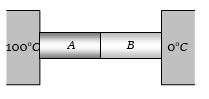
- 1Two metal cubes $A$ and $B$ of same size are arranged as shown in the figure. The extreme ends of the combination are maintained at the indicated temperatures. The arrangement is thermally insulated. The coefficients of thermal conductivity of $A$ and $B$ are $300\;W/m{\;^o}C$ and $200\;W/m{\;^o}C$, respectively. After steady state is reached, the temperature of the interface will be...... $^oC$View Solution
- 2View SolutionCan we boil water inside the earth satellite by convection
- 3A wall has two layers $A$ and $B$, each made of a different material. Both the layers have the same thickness. The thermal conductivity of the material of $A$ is twice that of $B$. Under thermal equilibrium, the temperature difference across the wall is $36\,^oC$. The temperature difference across the layer $A$ is ......... $^oC$View Solution
- 4An object is at a temperature of ${400^o}C$. At what temperature would it radiate energy twice as fast? The temperature of the surroundings may be assumed to be negligibleView Solution
- 5$A$ wall has two layers $A$ and $B$ made of different materials. The thickness of both the layers is the same. The thermal conductivity of $A$ and $B$ are $K_A$ and $K_B$ such that $K_A = 3K_B$. The temperature across the wall is $20°C$ . In thermal equilibriumView Solution
- 6Four rods of identical cross-sectional area and made from the same metal form the sides of square. The temperature of two diagonally opposite points and $T$ and $\sqrt 2 $ $T$ respective in the steady state. Assuming that only heat conduction takes place, what will be the temperature difference between other two pointsView Solution
- 7The sun radiates electromagnetic energy at the rate of $3.9 \times 10^{26}\,W$. It's radius is $6.96 \times 10^8\,m$. The intensity of sun light at the solar surface will be (in $W/m^2$)View Solution
- 8View SolutionIf the initial temperatures of metallic sphere and disc, of the same mass, radius and nature are equal, then the ratio of their rate of cooling in same environment will be
- 9A body cools in $7$ minutes from ${60^o}C$ to ${40^o}C$ What time (in minutes) does it take to cool from ${40^o}C$ to ${28^o}C$ if the surrounding temperature is ${10^o}C$? Assume Newton’s Law of cooling holdsView Solution
- 10Three conducting rods of same material and cross-section are shown in figure. Temperatures of$ A, D$ and $C$ are maintained at $20^o C, 90^o C$ and $0^o C$. The ratio of lengths of $BD$ and $BC$ if there is no heat flow in $AB$ is:View Solution