MCQ
Boyle’s law is applicable for an:
  • A
    Diabatic process.
  • Isothermal process.
  • C
    Isobaric process.
  • D
    Isochoric process.

Answer

Correct option: B.
Isothermal process.
Boyle’s law is applicable at constant temperature, and temperature remains constant in isothermal process,
PV = nRT (n, R and T are constant)
$\therefore$ PV = constant
$\text{P}\alpha\frac{1}{\text{V}}$ (where constant = nRT)

Need a full question paper?

Generate a complete, print-ready paper with questions like this in minutes — across 16+ boards, with answer keys.

Start Generating Free

Similar questions

It is hotter at the some distance over the top of a fire than it is on the side of it mainly because:
In the above question, if another body is at rest, then velocity of the compound body after collision is
If the radius of earth shrinks by $2 \%$ while its mass remains same. The acceleration due to gravity on the earth's surface will approximately.
A crystal has a coefficient of expansion $13\times10^{-7}$ in one direction and $231\times10^{-7}$ in every direction at right angles to it. Then the cubical coefficient of expansion is
If the temperature increases, the modulus of elasticity
Two projectiles are thrown simultaneously in the same plane from the same point. If their velocities are $v_1$ and $v_2$ at angles $\theta _1$ and $\theta_2$ respectively from the horizontal, then answer the following question

If $v_1\,\,sin\,\,\theta _1 = v_2\,\,sin\,\,\theta _2$, then choose the incorrect statement
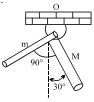
Two uniform rods of equal length but different masses are rigidly joined to form an $L$ -shaped body, which is then pivoted as shown. If in equilibrium the body is in the shown configuration, ratio $M/m$ will be:
The force acting on a body moving along $x-$axis varies with the position of the particle as shown in the fig.The body is in stable equilibrium at
A particle is moving in a circle with uniform speed $v$. In moving from a point to another diametrically opposite point
A vector in $x-y$ plane makes an angle of $30^{\circ}$ with $y$-axis The magnitude of $y$-component of vector is $2 \sqrt{3}$. The magnitude of $x$-component of the vector will be