MCQ
Bragg's law for $X$-rays is
  • A
    $d \sin \theta=2 n \lambda$
  • $2 d \sin \theta=n \lambda$
  • C
    $n \sin \theta=2 \lambda d$
  • D
    None of these

Answer

Correct option: B.
$2 d \sin \theta=n \lambda$

Need a full question paper?

Generate a complete, print-ready paper with questions like this in minutes — across 16+ boards, with answer keys.
Start Generating Free

Similar questions

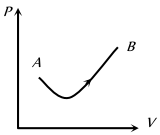
Consider a process shown in the figure. During this process the work done by the system

Image

If $x=a \sin \left(\omega t+\frac{\pi}{6}\right)$ and $x^{\prime}=a \cos \omega t$, then what is the phase difference between the two waves
A ladder rests against a frictionless vertical wall, with its upper end $6 m$ above the ground and the lower end $4 m$ away from the wall. The weight of the ladder is $500 N$ and its C. G. at $1 / 3$ rd distance from the lower end. Wall's reaction will be, (in Newton)
A slab consists of two parallel layers of copper and brass of the same thickness and having thermal conductivities in the ratio $1: 4$. If the free face of brass is at $100^{\circ} \mathrm{C}$ and that of copper at $0^{\circ} \mathrm{C}$, the temperature of interface is
The eye can detect $5 \times 10^{4}$ photons per square metre per sec of green light $(\lambda=5000 \mathring A)$ while the ear can detect $10^{-13}\left(\mathrm{~W} / \mathrm{m}^2\right)$. The factor by which the eye is more sensitive as a power detector than the ear is close to
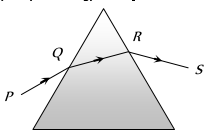
A ray of light is incident on an equilateral glass prism placed on a horizontal table. For minimum deviation which of the following is true
Image
The pair(s) of physical quantities that have the same dimensions, is (are)
The power of a sound from the speaker of a radio is $20 \mathrm{~mW}$. By turning the knob of the volume control, the power of the sound is increased to $400 \mathrm{~mW}$. The power increase in decibels as compared to the original power is
The magnetic susceptibility is negative for
A fixed volume of iron is drawn into a wire of length $L$. The extension $x$ produced in this wire by a constant force $F$ is proportional to