MCQ 11 Mark
In Millikan's oil drop experiment, an oil drop of mass $16 \times 10^{-6} \mathrm{~kg}$ is balanced by an electric field of $10^6 \mathrm{~V} / \mathrm{m}$. The charge in coulomb on the drop, assuming $g=10 \mathrm{~m} / \mathrm{s}^2$ is
- A
$6.2 \times 10^{-11}$
- B
$16 \times 10^{-9}$
- ✓
$16 \times 10^{-11}$
- D
$16 \times 10^{-13}$
AnswerCorrect option: C. $16 \times 10^{-11}$
$e E=m g \Rightarrow e=\frac{m g}{E}=\frac{16 \times 10^{-6} \times 10}{10^6}=16 \times 10^{-11} C$.
View full question & answer→MCQ 21 Mark
$\mathrm{X}$-rays are produced by accelerating electrons by voltage $V$ and let they strike a metal of atomic number $Z$. The highest frequency of Xrays produced is proportional to
- A
$V$
- B
$Z$
- C
$(Z-1)$
- ✓
$(Z-1)^2$
AnswerCorrect option: D. $(Z-1)^2$
According to Mosley's law $v \propto(Z-b)^2$For $k_\alpha$ line, $b=1$, and it has maximum frequency so $v_{\max } \propto(Z-1)^2$
View full question & answer→MCQ 31 Mark
If the energy of the photon is increased by a factor of $4$ , then its momentum
- A
- B
Decreases by a factor of $4$
- ✓
Increases by a factor of $4$
- D
Decreases by a factor of $2$
AnswerCorrect option: C. Increases by a factor of $4$
Increases by a factor of $4$
View full question & answer→MCQ 41 Mark
The kinetic energy of an electron with de-Broglie wavelength of $0.3$ nanometer is
- A
$0.168 \mathrm{eV}$
- ✓
$16.8 \mathrm{eV}$
- C
$1.68 \mathrm{eV}$
- D
$2.5 \mathrm{eV}$
AnswerCorrect option: B. $16.8 \mathrm{eV}$
$ \lambda=\frac{h}{\sqrt{2 m E}} \Rightarrow E=\frac{h^2}{2 m \lambda^2}$
$ =\frac{\left(6.6 \times 10^{-34}\right)^2}{2 \times 9.1 \times 10^{-31} \times \left(0.3 \times 10^{-9}\right)^2}=2.65 \times 10^{-18} \mathrm{~J} $
$ =16.8 \mathrm{eV}$
View full question & answer→MCQ 51 Mark
A photon and an electron have equal energy E. $\lambda_{\text {photon }} / \lambda_{\text {electron }}$ is proportional to
- A
$\sqrt{E}$
- ✓
$1 / \sqrt{E}$
- C
$1 / E$
- D
Does not depend upon $E$
AnswerCorrect option: B. $1 / \sqrt{E}$
$\lambda_{\text {photon }}=\frac{h c}{E} \text { and } \lambda_{\text {proton }}=\frac{h}{\sqrt{2 m E}} $
$\Rightarrow \frac{\lambda_{\text {photon }}}{\lambda_{\text {electron }}}=c \sqrt{\frac{2 m}{E}} \Rightarrow \frac{\lambda_{\text {photon }}}{\lambda_{\text {electron }}} \propto \frac{1}{\sqrt{E}}$
View full question & answer→MCQ 61 Mark
Bragg's law for $X$-rays is
- A
$d \sin \theta=2 n \lambda$
- ✓
$2 d \sin \theta=n \lambda$
- C
$n \sin \theta=2 \lambda d$
- D
AnswerCorrect option: B. $2 d \sin \theta=n \lambda$
View full question & answer→MCQ 71 Mark
The work function of a photoelectric material is $3.3 \mathrm{eV}$. The threshold frequency will be equal to
- A
$8 \times 10^4 \mathrm{~Hz}$
- B
$8 \times 10^{56} \mathrm{~Hz}$
- C
$8 \times 10^{10} \mathrm{~Hz}$
- ✓
$8 \times 10^{14} \mathrm{~Hz}$
AnswerCorrect option: D. $8 \times 10^{14} \mathrm{~Hz}$
$v_0=\frac{W_0}{h}=\frac{3.3 \times 1.6 \times 10^{-19}}{6.6 \times 10^{-34}}=8 \times 10^{14} \mathrm{~Hz}$
View full question & answer→MCQ 81 Mark
Intensity of $X$-rays depends upon the number of
AnswerIntensity of $X$-rays depends upon the number of electron striking the target.
View full question & answer→MCQ 91 Mark
On increasing the number of electrons striking the anode of an $X$ ray tube, which one of the following parameters of the resulting $X$ rays would increase
AnswerGreater the number of electrons striking the anode, larger is the number of $X$-ray photons emitted.
View full question & answer→MCQ 101 Mark
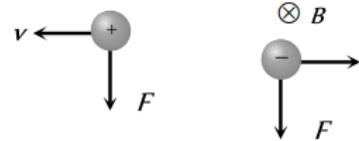
Cathode rays and canal rays produced in a certain discharge tube are deflected in the same direction if
- ✓
A magnetic field is applied normally
- B
An electric field is applied normally
- C
An electric field is applied tangentially
- D
A magnetic field is applied tangentially
AnswerCorrect option: A. A magnetic field is applied normally
In discharge tube cathode rays (a beam of negative particles) and canal rays (positive rays)moves opposite to each other.
They will experience a magnetic force in the same direction, if a normal magnetic field is switched on
View full question & answer→MCQ 111 Mark
An oxide coated filament is useful in vacuum tubes because essentially
- A
It has high melting point
- B
It can withstand high temperatures
- C
It has good machanical strength
- ✓
It can emit electrons at relatively lower temperatures
AnswerCorrect option: D. It can emit electrons at relatively lower temperatures
View full question & answer→MCQ 121 Mark
Which one of the following devices makes use of the electrons to strike certain substances to produce fluorescence
MCQ 131 Mark
Cathode rays are similar to visible light rays in that
- A
They both can be deflected by electric and magnetic fields
- B
They both have a definite magnitude of wavelength
- C
They both can ionise a gas through which they pass
- ✓
They both can expose a photographic plate
AnswerCorrect option: D. They both can expose a photographic plate
Light consists of photons and cathode rays consists of electrons. However both effect the photographic plate.
View full question & answer→MCQ 141 Mark
The work function of a metal is
- A
The energy for the electron to enter into the metal
- B
The energy for producing X-ray
- ✓
The energy for the electron to come out from metal surface
- D
AnswerCorrect option: C. The energy for the electron to come out from metal surface
View full question & answer→MCQ 151 Mark
The de-Broglie wavelength $\lambda$
- A
- B
is proportional to impulse
- ✓
Inversely proportional to impulse
- D
does not depend on impulse
AnswerCorrect option: C. Inversely proportional to impulse
The De-Broglie wavelength is $\lambda=\frac{h}{|p|}=\frac{h}{|I|} \Rightarrow \lambda \propto \frac{1}{|I|}$
View full question & answer→MCQ 161 Mark
If the minimum wavelength obtained in an $\mathrm{X}$-ray tube is $2.5 \times 10^{-10} \mathrm{~m}$, the operating potential of the tube will be
- A
$2 \mathrm{kV}$
- B
$3 \mathrm{kV}$
- C
$4 \mathrm{kV}$
- ✓
$5 \mathrm{kV}$
AnswerCorrect option: D. $5 \mathrm{kV}$
(d) $\lambda_{\min }=\frac{12375}{V} \mathring A $
$\Rightarrow V=\frac{12375}{2.5}=4950 \mathrm{~V} \simeq 5 \mathrm{kV}$.
View full question & answer→MCQ 171 Mark
If the voltage of X-ray tube is doubled, the intensity of X-rays will become
MCQ 181 Mark
If the operating potential of an X-ray tube is $50 \mathrm{kV}$, the velocity of $\mathrm{X}$-rays coming out of it is
- A
$4 \times 10^4 \mathrm{~m} / \mathrm{s}$
- ✓
$3 \times 10^8 \mathrm{~m} / \mathrm{s}$
- C
$10^8 \mathrm{~m} / \mathrm{s}$
- D
$3 \mathrm{~m} / \mathrm{s}$
AnswerCorrect option: B. $3 \times 10^8 \mathrm{~m} / \mathrm{s}$
The velocity of X-rays is always equal to that of light.
View full question & answer→MCQ 191 Mark
If the threshold wavelength for sodium is $5420 A$, then the work function of sodium is
- A
$4.58 \mathrm{eV}$
- ✓
$2.28 \mathrm{eV}$
- C
$1.14 \mathrm{eV}$
- D
$0.23 \mathrm{eV}$
AnswerCorrect option: B. $2.28 \mathrm{eV}$
$W_0=\frac{12375}{\lambda_0}=\frac{12375}{5420}=2.28 \mathrm{eV}$
View full question & answer→MCQ 201 Mark
The wavelength associated with an electron accelerated through a potential difference of $100\ V$ is nearly
- A
$100 \mathring A$
- B
$123 \mathring A$
- ✓
$1.23 \mathring A$
- D
$0.123 \mathring A$
AnswerCorrect option: C. $1.23 \mathring A$
$ \lambda=\frac{h}{\sqrt{2 m Q V}}=\frac{6.6 \times 10^{-34}}{\sqrt{2 \times 9.1 \times 10^{-31} \times 1.6 \times 10^{-19} \times 100}}$
$=1.23 \mathring A$
View full question & answer→MCQ 211 Mark
According to de-Broglie, the de-Broglie wavelength for electron in an orbit of hydrogen atom is $10 \mathrm{~m}$. The principle quantum number for this electron is
Answer$2 \pi r n=\lambda \Rightarrow n=\frac{\lambda}{2 \pi r}=\frac{10^{-9}}{2 \times 3.14 \times 5.13 \times 10^{-11}}=3$
View full question & answer→MCQ 221 Mark
$\mathrm{O}^{++}, \mathrm{C}^{+}, \mathrm{He}^{++}$and $\mathrm{H}^{+}$ions are projected on the photographic plate with same velocity in a mass spectrograph. Which one will strike farthest
- A
$\mathrm{O}^{++}$
- ✓
$C^{+}$
- C
$\mathrm{He}^{++}$
- D
$\mathrm{H}_2^{+}$
AnswerCorrect option: B. $C^{+}$
$2 r=\frac{2 m v}{q B} \Rightarrow 2 r \propto \frac{m}{q} \Rightarrow \frac{m}{q}$ is maximum for $C^{+}$
View full question & answer→MCQ 231 Mark
The wavelength of X-rays decreases, when
- A
Temperature of target is increased
- B
Intensity of electron beam is increased
- ✓
K.E. of electrons striking the target is increased
- D
K.E. of electrons striking the target is decreased
AnswerCorrect option: C. K.E. of electrons striking the target is increased
$ \lambda_{\min }=\frac{h c}{e V \text { (energy) }}$; when $K E$ (or $e V$ ) increases, $\lambda$ decreases.
View full question & answer→MCQ 241 Mark
In vacuum an electron of energy $10 \mathrm{keV}$ hits tungsten target, then emitted radiation will be
AnswerWhen a high energy electron incident on heavy metal, it produces X-rays.
View full question & answer→MCQ 251 Mark
Photon and electron are given same energy $\left(10^{-20} \mathrm{~J}\right)$. Wavelength associated with photon and electron are $\lambda_{P h}$ and $\lambda_{e l}$ then correct statement will be
- ✓
$\lambda_{P h}>\lambda_{e l}$
- B
$\lambda_{P h}<\lambda_{e l}$
- C
$\lambda_{P h}=\lambda_{e l}$
- D
$\frac{\lambda_{e l}}{\lambda_{P h}}=C$
AnswerCorrect option: A. $\lambda_{P h}>\lambda_{e l}$
Wavelength of photon will be greater than that of electr because mass of photon is less than that of electr
$\Rightarrow \lambda_{\mathrm{ph}}>\lambda_e$
View full question & answer→MCQ 261 Mark
For moving ball of cricket, the correct statement about de-Broglie wavelength is
- A
It is not applicable for such big particle
- ✓
$\frac{h}{\sqrt{2 m E}}$
- C
$\sqrt{\frac{h}{2 m E}}$
- D
$\frac{h}{2 m E}$
AnswerCorrect option: B. $\frac{h}{\sqrt{2 m E}}$
View full question & answer→MCQ 271 Mark
If work function of metal is $3\ \mathrm{eV}$ then threshold wavelength will be
- ✓
$4125 \mathring A$
- B
$4000 \mathring A$
- C
$4500 \mathring A$
- D
$5000 \mathring A$
AnswerCorrect option: A. $4125 \mathring A$
$\lambda_0=\frac{12375}{W_0(\mathrm{eV})}=\frac{12375}{3}=4125 \mathring A$
View full question & answer→MCQ 281 Mark
In photoelectric effect if the intensity of light is doubled then maximum kinetic energy of photoelectrons will become
Answer$K_{\max }$ of photoelectrons doesn't depends upon intensity of incident light.
View full question & answer→MCQ 291 Mark
X-rays are produced in laboratory by
- A
- B
Decomposition of the atom
- ✓
Bombardment of high energy electron on heavy metal
- D
AnswerCorrect option: C. Bombardment of high energy electron on heavy metal
View full question & answer→MCQ 301 Mark
Positive rays was discovered by
AnswerPositive rays was discovered by J.J. Thomson.
View full question & answer→MCQ 311 Mark
Electric field and magnetic field in Thomson mass spectrograph are applied
- A
Simultaneously, perpendicular
- B
Perpendicular but not simultaneously
- C
Parallel but not simultaneously
- ✓
AnswerIn Thomson's mass spectrograph $\vec{E} \| \vec{B}$
View full question & answer→MCQ 321 Mark
In Bainbridge mass spectrograph a potential difference of $1000 \mathrm{~V}$ is applied between two plates distant $1 \mathrm{~cm}$ apart and magnetic field in $B=1 T$. The velocity of undeflected positive ions in $\mathrm{m} / \mathrm{s}$ from the velocity selector is
- A
$10^7 \mathrm{~m} / \mathrm{s}$
- B
$10^4 \mathrm{~m} / \mathrm{s}$
- ✓
$10^5 \mathrm{~m} / \mathrm{s}$
- D
$10^2 \mathrm{~m} / \mathrm{s}$
AnswerCorrect option: C. $10^5 \mathrm{~m} / \mathrm{s}$
$ v=\frac{E}{B} ; \text { where } E=\frac{V}{d}=\frac{1000}{1 \times 10^{-2}}=10^5 \mathrm{~V} / \mathrm{m} $
$ \Rightarrow v=\frac{10^5}{1}=10^5 \mathrm{~m} / \mathrm{s} .$
View full question & answer→MCQ 331 Mark
Energy of a quanta of frequency $10^{15} \mathrm{~Hz}$ and $h=6.6 \times 10^{-34} \mathrm{~J}-\mathrm{sec}$ will be
- ✓
$6.6 \times 10^{-19} \mathrm{~J}$
- B
$6.6 \times 10^{-12} \mathrm{~J}$
- C
$6.6 \times 10^{-49} \mathrm{~J}$
- D
$6.6 \times 10^{-41} \mathrm{~J}$
AnswerCorrect option: A. $6.6 \times 10^{-19} \mathrm{~J}$
$E=h v=6.6 \times 10^{-34} \times 10^{15}=6.6 \times 10^{-19} \mathrm{~J}$
View full question & answer→MCQ 341 Mark
Positive rays consists of
AnswerPositive rays consist of positive ions.
View full question & answer→MCQ 351 Mark
What determines the hardness of the $X$-rays obtained from the Coolige tube
- A
(a) Current in the filament
- B
(b) Pressure of air in the tube
- C
- ✓
(d) Potential difference between cathode and target
AnswerCorrect option: D. (d) Potential difference between cathode and target
(d) Hard $X$-rays are of higher energy and the energy of $X$-rays depends on the potential difference between the cathode and the target.
View full question & answer→MCQ 361 Mark
What is the de-Broglie wavelength of the $\alpha$-particle accelerated through a potential difference $V$
- A
$\frac{0.287}{\sqrt{V}} \mathring A$
- B
$\frac{12.27}{\sqrt{V}} \mathring A$
- ✓
$\frac{0.101}{\sqrt{V}} \mathring A$
- D
$\frac{0.202}{\sqrt{V}} \mathring A$
AnswerCorrect option: C. $\frac{0.101}{\sqrt{V}} \mathring A$
$\lambda=\frac{h}{\sqrt{2 m E}}=\frac{h}{\sqrt{2 m_\alpha Q_\alpha V}}$
On putting $Q_\alpha=2 \times 1.6 \times 10^{-19} \mathrm{C}$
$m_\alpha=4 m_p=4 \times 1.67 \times 10^{-27} \mathrm{~kg}$
$ \Rightarrow \lambda=\frac{0.101}{\sqrt{V}} \mathring A$
View full question & answer→MCQ 371 Mark
The radius of the orbital of electron in the hydrogen atom $0.5 \mathring A$. The speed of the electron is $2 \times 10^6 \mathrm{~m} / \mathrm{s}$. Then the current in the loop due to the motion of the electron is
AnswerCorrect option: A. $1 \mathrm{~mA}$
Time period of revolution of electron $T=\frac{2 \pi}{\omega}=\frac{2 \pi r}{v}$
Hence corresponding electric current $i=\frac{e}{T}=\frac{e v}{2 \pi r}$
$\Rightarrow i=\frac{1.6 \times 10^{-19} \times 2 \times 10^6}{2 \times 3.14 \times 0.5 \times 10^{-10}}=1 \mathrm{~mA}.$
View full question & answer→MCQ 381 Mark
In X-ray spectrum wavelength $\lambda$ of line $K_\alpha$ depends on atomic number $Z$ as
AnswerCorrect option: D. $\lambda \propto \frac{1}{(Z-1)^2}$
View full question & answer→MCQ 391 Mark
If the potential difference applied across $X$-ray tube is $V$ volts, then approximately minimum wavelength of the emitted $X$-rays will be
AnswerCorrect option: D. $\frac{12400}{V} A$
$\lambda_{\min }=\frac{h c}{e V}=\frac{6.6 \times^{-34} \times 3 \times 10^8}{1.6 \times 10^{-19} V}=\frac{12375}{V} \approx \frac{12400}{V} A$
View full question & answer→MCQ 401 Mark
Absorption of X-ray is maximum in which of the following different sheets
MCQ 411 Mark
In Thomson's experiment if the value of $q / m$ is the same for all positive ions striking the photographic plate, then the trace would be
View full question & answer→MCQ 421 Mark
The frequency and work function of an incident photon are $v$ and $\phi_0$. If $v$ is the threshold frequency then necessary condition for the emission of photo electron is
- A
$v_1$
- B
$v=\frac{v_0}{2}$
- ✓
$v \geq v_0$
- D
AnswerCorrect option: C. $v \geq v_0$
$v \geq v_0$
View full question & answer→MCQ 431 Mark
The de-Broglie wavelength is proportional to
- A
$\lambda \propto \frac{1}{v}$
- B
$\lambda \propto \frac{1}{m}$
- ✓
$\lambda \propto \frac{1}{p}$
- D
$\lambda \propto p$
AnswerCorrect option: C. $\lambda \propto \frac{1}{p}$
$\lambda=\frac{h}{p} \Rightarrow \lambda \propto \frac{1}{p}$
View full question & answer→MCQ 441 Mark
Davission and Germer experiment proved
AnswerDavission and Germer proved the wave nature of electron by performing an experiment.
View full question & answer→MCQ 451 Mark
If energy of $K$-shell electron is $-40000 \mathrm{eV}$ and if $60000 \mathrm{~V}$ potential is applied at coolidge tube then which of the following $X$ ray will get form
- A
- B
(b) White $X$-rays
- ✓
(c) Continuous and all series of characteristic
- D
AnswerCorrect option: C. (c) Continuous and all series of characteristic
(c) When applied voltage is greater then energy of $K$-electron, continuous and all characterstic $X$-rays are emitted.
View full question & answer→MCQ 461 Mark
If intensity of incident light is increased in PEE then which of the following is true
- A
Maximum K.E. of ejected electron will increase
- ✓
Work function will remain unchanged
- C
Stopping potential will decrease
- D
Maximum K.E. of ejected electron will decrease
AnswerCorrect option: B. Work function will remain unchanged
With the increase in intensity of light photoelectric current increases, but Kinetic energy of ejected electron, stopping potential and work function remains unchanged.
View full question & answer→MCQ 471 Mark
If threshold wavelength for sodium is $6800 \mathring A$ then the work function will be
- ✓
$1.8 \mathrm{eV}$
- B
$2.5 \mathrm{eV}$
- C
$2.1 \mathrm{eV}$
- D
$1.4 \mathrm{eV}$
AnswerCorrect option: A. $1.8 \mathrm{eV}$
$W_0=\frac{12375}{6800}=1.8 \mathrm{eV}$
View full question & answer→MCQ 481 Mark
Which of the following is true for photon
- ✓
$E=\frac{h c}{\lambda}$
- B
$E=\frac{1}{2} m u^2$
- C
$p=\frac{E}{2 v}$
- D
$E=\frac{1}{2} m c^2$
AnswerCorrect option: A. $E=\frac{h c}{\lambda}$
View full question & answer→MCQ 491 Mark
Quantam nature of light is explained by which of the following phenomenon
- A
- ✓
- C
Maxwell electromagnetic theory
- D
View full question & answer→MCQ 501 Mark
When wavelength of incident photon is decreased then
- A
Velocity of emitted photo-electron decreases
- ✓
Velocity of emitted photoelectron increases
- C
Velocity of photoelectron do not charge
- D
Photo electric current increases
AnswerCorrect option: B. Velocity of emitted photoelectron increases
With decrease in wavelength of incident photons, energy of photoelectrons increases.
View full question & answer→