Question
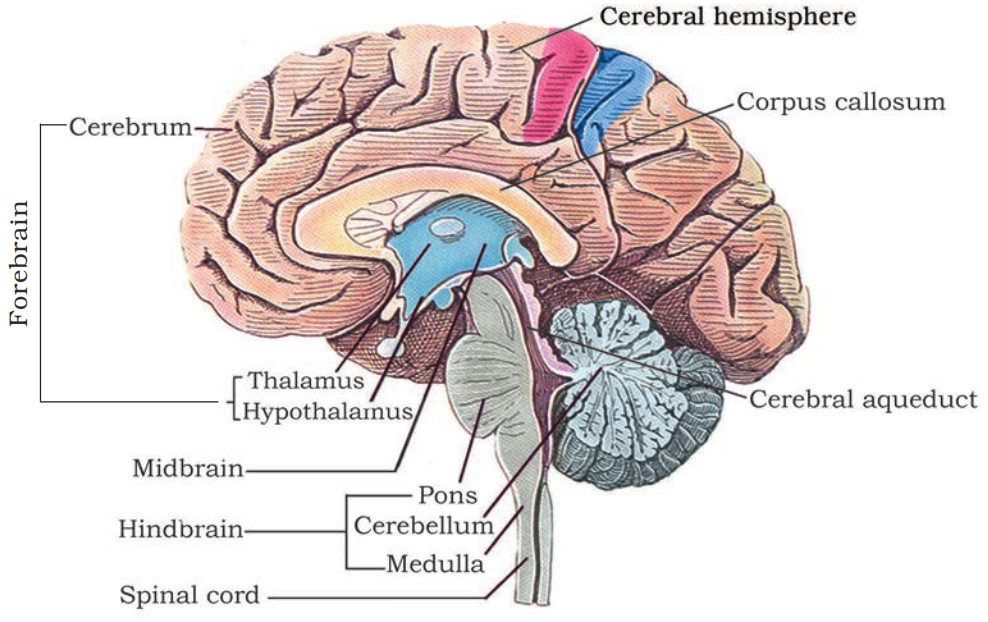
Briefly describe the structure of brain.
Forebrain: It is the main thinking part of the brain. It consists of cerebrum, thalamus, and hypothalamus.
Cerebrum is the largest part of the brain and constitutes about four-fifth of its weight. Cerebrum is divided into two cerebral hemispheres by a deep longitudinal cerebral fissure. These hemispheres are joined by a tract of nerve fibre known as corpus callosum. The cerebral hemispheres are covered by a layer of cells known as cerebral cortex or grey matter. Cerebrum has sensory regions known as association areas that receive sensory impulses from various receptors as well as from motor regions that control the movement of various muscles. The innermost part of cerebrum gives an opaque white appearance to the layer and is known as the white matter.
Thalamus is the main centre of coordination for sensory and motor signalling. It is wrapped by cerebrum.
It lies at the base of thalamus and contains a number of centres that regulate body temperature and the urge for eating and drinking. Some regions of cerebrum, along with hypothalamus, are involved in the regulation of sexual behaviour and expression of emotional reactions such as excitement, pleasure, fear, etc.
Midbrain:
It is located between the thalamus region of the forebrain and pons region of hindbrain. The dorsal surface of midbrain consists of superior and inferior corpora bigemina and four round lobes called corpora quadrigemina. A canal known as cerebral aqueduct passes through the midbrain. Midbrain is concerned with the sense of sight and hearing.
Hindbrain:
It consists of three regions − pons, cerebellum, and medulla oblongata.
Generate a complete, print-ready paper with questions like this in minutes — across 16+ boards, with answer keys.
| | Column I | | Column II |
| a. | Eosinophils | i. | Coagulation |
| b. | RBC | ii. | Universal Recipient |
| c. | AB Group | iii. | Resist Infections |
| d. | Platelets | iv. | Contraction of Heart |
| e. | Systole | v. | Gas transport |