Question
Briefly explain about light.

Answer

→The human eye is only sensitive to small range of electromagnetic spectrum.
→This region is known as visible light.
→The wavelength of this region is 400 nm to 750 nm.
Two important points about light:
(i) Light travels with enormous speed. Speed of light is limited and measurable.
→Its presently accepted value in Vacuum is c = 2.99792458 × 10⁸ m/s
→For ease of calculations the velocity of light in free space is taken as c = 3 x 10⁸ m/s
(ii) Light travels in a straight line.

Need a full question paper?

Generate a complete, print-ready paper with questions like this in minutes — across 16+ boards, with answer keys.
Start Generating Free

Similar questions

The equation $\omega=\frac{\mu_\text{v}-\mu_\text{r}}{\mu-1}$ asderived for a prism having small refracting angle. Is it also valid for a prism of large refracting angle? Is it also valid for a glass slab or a glass sphere?
The force on a north pole,$\overrightarrow{\text{F}}=\text{m}\overrightarrow{\text{B}},$ is parallel to the field $\overrightarrow{\text{B}}.$ Does it contradict our earlier knowledge that a magnetic field can exert forces only perpendicular to itself?
What is resistivity ? On What factors does it depend and write its unit and dimensional formula.
Write short note on Nuclear Force.
Explain the concept of hole in intrinsic semiconductors.
Can you add two vectors representing physical quantities having different dimensions? Can you multiply two vectors representing physical quantities having different dimensions?
Define the ionisation energy. What is the value of it for hydrogen atom?
A bulb is made using two filaments. A switch selects whether the filaments are used individually or in parallel. When used with a 15V battery, the bulb can be operated at 5W, 10W or 15W. What should be the resistances of the filaments?
The magnetic field inside a tightly wound, long solenoid is $\text{B}=\mu_0\text{ni}.$ It suggests that the field does not depend on the total length of the solenoid, and hence if we add more loops at the ends of a solenoid the field should not increase. Explain qualitatively why the extra-added loops do not have a considerable effect on the field inside the solenoid.
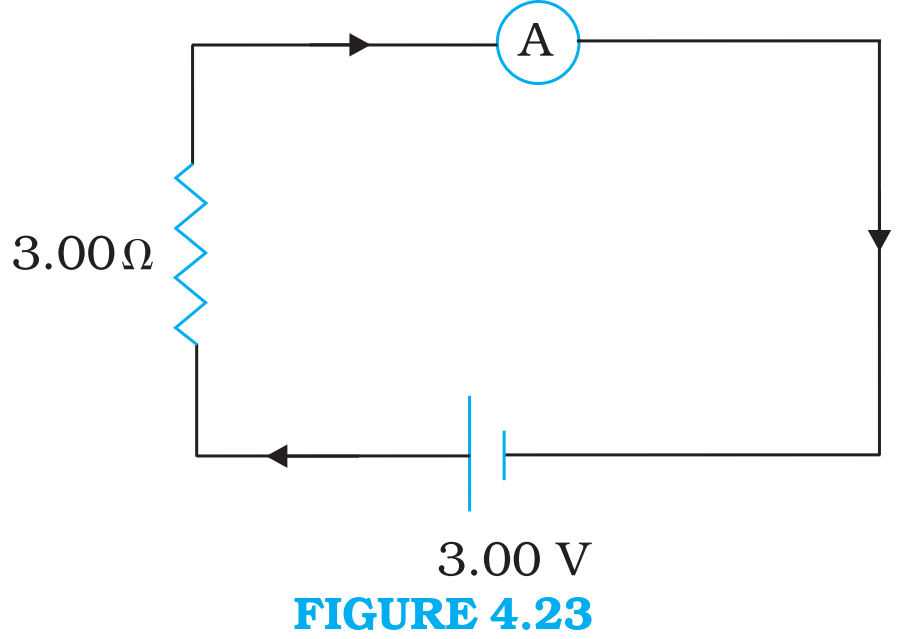
In the circuit (Fig. 4.23) the current is to be measured. What is the value of the current if the ammeter shown (a) is a galvanometer with a resistance $R_G=60.00 \Omega$; (b) is a galvanometer described in (a) but converted to an ammeter by a shunt resistance $r_s=0.02 \Omega$; (c) is an ideal ammeter with zero resistance?
Image