Question
Write short note on Nuclear Force.
Answer

→Nucleus contains protons and neutrons, in which there is a coulomb repulsion between protons and protons. However, the proton can not escape from the nucleus. Because to bind a nucleus together there must be a strong attractive force of a totally different kind. It must be strong enough to overcome the repulsion between (the positively charged) protons and to bind both protons and neutrons into the tiny nuclear volume.
→Many features of the nuclear binding force are summarised below :
(i) The nuclear force is much stronger than the Coulomb force acting between charges or the gravitational forces between masses. That's why it holds protons and neutrons in the nucleus.
(ii) The range of the nuclear force is of the order of femtometres. For distances greater than one femtometres this force rapidly decreases to zero.
→This leads to saturation of forces in a medium or a large sized nucleus.
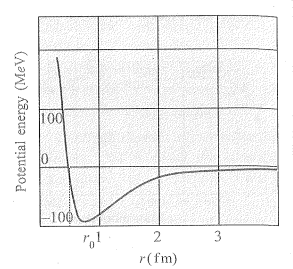
→A plot of the potential energy between two nucleons as a function of distance as shown in figure.
Image
→The potential energy is minimum at a distance $r_0$ of about 0.8 fm .The force is attractive for distance larger than 0.8 fm .
→The force is repulsive for distance less than 0.8 fm .
(iii) The nuclear force between neutronneutron, proton-neutron and proton-proton is approximately the same. The nuclear force does not depend on the electric charge.
→Unlike Coulomb's law or the Newton's law of gravitation there is no simple mathematical form of the nuclear force.

Need a full question paper?

Generate a complete, print-ready paper with questions like this in minutes — across 16+ boards, with answer keys.

Start Generating Free

Similar questions

Distinguish between polarised and unpolarized light. Does the intensity of polarised light emitted by a Polaroid depend on its orientation? Explain briefly.
The vibrations in a beam of polarised light make an angle of 60° with the axis of the polaroid sheet. What percentage of light is transmitted through the sheet?
Given a uniform electric field$\overrightarrow{\text{E}}$: 5 x 10³ $\hat{i}$ N/C, find the flux of this field through a square of l0 cm on a side whose plane is parallel to the y-z plane. What would be the flux through the same square if the plane makes a 300 angle with the x-axis?
A parallel plate capacitor of capacitance C is charged to a potential V. It is then connected to another uncharged capacitor having the same capacitance. Find out the ratio of the energy stored in the combined system to that stored initially in the single capacitor.
What conclusion can you draw from the following observations on a resistor made of alloy manganin?
Current A
Voltage V
Current A
Voltage V
0.2 
0.4
0.6
0.8
1.0
2.0
3.94
7.87
11.8
15.7
19.7
39.4
3.0
4.0
5.0
6.0
7.0
8.0
59.2
78.8
98.6
118.5
138.2
158.0
Briefly explain about light.
In a double-slit experiment the angular width of a fringe is found to be 0.2° on a screen placed 1 m away. The wavelength of light used is 600 nm. What will be the angular width of the fringe if the entire experimental apparatus is immersed in water? Take refractive index of water to be 4/3.
Draw a graph between photoelectric current and anode potential for two light beams of different intensity and same wavelength.
An electric field $\vec{\text{E}}=(\vec{\text{i}}20+\vec{\text{j}}30)\text{N}\text{C}^{-1}$ exists in the space. If the potential at the origin is taken to be zero, find the potential at (2m, 2m).
Figure shows a conducting circular loop of radius a placed in a uniform, perpendicular magnetic field B. A thick metal rod OA is pivoted at the centre O. The other end of the rod touches the loop at A. The centre O and a fixed point C on the loop are connected by a wire OC of resistance R. A force is applied at the middle point of the rod OA perpendicularly, so that the rod rotates clockwise at a uniform angular velocity $\omega.$ Find the force.

Each side of a square is 90 cm long. At its corners $-2,+3,-4$ and +5 micro coulomb charges are placed respectively. Find the electric potential at the centre of the square.