Question
Briefly explain how does Bernoulli's principle help in explaining blood flow in human beings. What is the cause of a heart attack?

Answer

The blood flow in artery of a human being can be easily explained on the basis of Bernoulli's principle. The heart applies a pressure to maintain blood flow through the arteries.
In persons suffering with advanced heart condition, the artery gets constricted due to the accumulation of plaque on its inner walls. In order to drive the blood through this constriction a greater activity of the heart is required. The speed of the flow of the blood in this region is raised which lowers the pressure inside, and the artery may collapse due to this external pressure.
The heart exerts further pressure to open this artery and forces the blood through. As the blood rushes through the opening, the internal pressure once again drops leading to a repeat collapse. This may result in heart attack.
Need a full question paper?

Generate a complete, print-ready paper with questions like this in minutes — across 16+ boards, with answer keys.

Start Generating Free

Similar questions

A block placed on a rough horizontal surface is pulled by a horizontal force F. Let f be the force applied by the rough surface on the block. Plot a graph of f versus F.
The sap in trees, which consists mainly of water in summer, rises in a system of capillaries of radius r = 2.5 × 10⁻⁵m. The surface tension of sap is T = 7.28 × 10⁻²N m-1 and the angle of contact is 0°. Does surface tension alone account for the supply of water to the top of all trees?
An ice cube of mass 0.1 kg at $0^{\circ} C$ is placed in an isolated container which is at $227^{\circ} C$. The specific heat S of the container varies with temperature T according to the empirical relation $S = A + BT$, where $A =100 cal / kg - K$ and $B=2 \times 10^{-2} cal / kg - K ^2$. If the final temperature of the container is $27^{\circ} C$, determine the mass of the container. (Latent heat of fusion of water $=8 \times 10^4$ call kg. Specific heat of water $=10^3 cal / kg - K$ ).
A function $\text{f}(\theta)$ is defined as:
$\text{f}(\theta)=1-\theta+\frac{\theta^2}{2!}-\frac{\theta^3}{3!}+\frac{\theta^4}{4!}$
Why is it necessary for q to be a dimensionless quantity?
A particle located at x = 0 at t = 0 starts moving along the positive x-direction with a velocity v that varies as $\text{v}=\alpha\sqrt{\text{x}}.$ How does the displacement of the particle vary with time?
A spring stores 5J of energy when stretched by 25cm. It is kept vertical with the lower end fixed. A block fastened to its other end is made to undergo small oscillations. If the block makes 5 oscillations each second, what is the mass of the block?
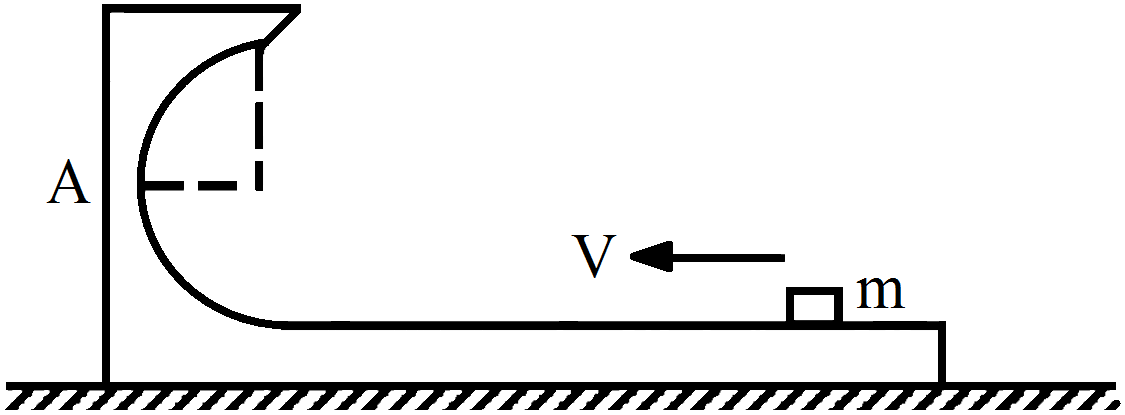
Figure shows a small block of mass m which is started with a speed v on the horizontal part of the bigger block of mass M placed on a horizontal floor. The curved part of the surface shown is semicircular. All the surfaces are frictionless. Find the speed of the bigger block when the smaller block reaches the point A of the surface.

An electric heater supplies heat to a system at a rate of 100W. If system performs work at a rate of 75 joules per second. At what rate is the internal energy increasing?
A capacitor of capacitance $10\mu\text{F}$ is connected across a battery of emf 6.0V through a resistance of $20\text{k}\Omega$ for 4.0s. The battery is then replaced by a thick wire. What will be the charge on the capacitor 4.0s after the battery is disconnected?
What are the basic requirements of a cooking utensil in respect of specific heat, thermal conductivity and coefficient of expansion?