Questions

3 Marks Question

Take a timed test

8 questions · self-marked practice — reveal the answer and mark yourself.

Question 13 Marks
Glycerine flows steadily through a horizontal tube of length 1.5 m and radius 1.0 cm . If the amount of glycerine collected per second at one end is $4.0 \times 10^{-3} kgs ^{-1}$, what is the pressure difference between the two ends of the tube? (Density of glycerine $=1.3 \times 10^3 kgm ^{-3}$ and viscosity of glycerine $=0.83 Pa$ s). [You may also like to check if the assumption of laminar flow in the tube is correct].
Answer
Length of the horizontal tube is given by, $l =1.5 m$
Radius of the tube is, $r =1 cm=0.01 m$
Diameter of the tube is given by, $d=2 r=0.02 m$
Glycerine is flowing at a rate of $4.0 \times 10^{-3} kgs ^{-1}$.
$
M=4.0 \times 10^{-3} kg^{-1}
$
Density of Glycerine is given by, $\rho=1.3 \times 10^3 kgm ^{-3}$
Viscosity of Glycerine is given by, $\eta=0.83$ Pa s
Volume of Glycerine flowing per sec is given by :
$
\begin{aligned}
& V=\frac{M}{\rho} \\
& =\frac{4.0 \times 10^{-3}}{1.3 \times 10^3} \\
& =3.08 \times 10^{-6} m^3 s^{-1}
\end{aligned}
$
According to Poiseville's formula, we have the relation for the rate of flow:
$
V=\frac{\pi p r^4}{8 \eta l}
$
Where, $p$ is the pressure difference between the two ends of the tube
$
\begin{aligned}
& \therefore p=\frac{V 8 \eta l}{\pi r^4} \\
& =\frac{3.09 \times 10^{-8} \times 8 \times 0.83 \times 1.5}{\pi \times(0.01)^4} \\
& =9.8 \times 10^2 Pa
\end{aligned}
$
Reynolds' number is given by the relation:
$
\begin{aligned}
& R=\frac{4 \rho V}{\pi d \eta} \\
& =\frac{4 \times 1.3 \times 10^3 \times 3.08 \times 10^{-5}}{\pi \times(0.02) \times 0.83}=0.3
\end{aligned}
$
Reynolds' number is about 0.3 . Hence, the flow is laminar.
View full question & answer
Question 23 Marks
Two mercury droplets of radii 0.1 cm . and 0.2 cm . collapse into one single drop. What amount of energy is released? The surface tension of mercury $T =435.5 \times 10^{-3} N m ^{-1}$.
Answer
Energy due to surface Tension $E=\sigma \Delta A$
By law of conservation of mass, volume of drop $V_1+V_2=V$
$
\begin{aligned}
& r_1=0.1 cm=0.1 \times 10^{-2} m=10^{-3} m \\
& r_2=0.2 cm=2 \times 10^{-3} m \\
& \Delta A=4 \pi r_1^2+4 \pi r_2^2-4 \pi R^2=4 \pi\left[r_1^2+r_2^2-R^2\right]
\end{aligned}
$
R is the radius of new drop formed by the combination of two smaller drops.
$
\begin{aligned}
& \frac{4}{3} \pi R^3=\frac{4}{3} \pi r_1^3+\frac{4}{3} \pi r_2^3 \\
& \frac{4}{3} \pi R^3=\frac{4}{3} \pi\left[r_1^3+r_2^3\right] \Rightarrow R^3=r_1^3+r_2^3 \\
& R^3=\left[\left(1 \times 10^{-3}\right)^3+\left(2 \times 10^{-3}\right)^3\right]=\left[10^{-9}+8 \times 10^{-9}\right]=9 \times 10^{-9} \\
& R=2.1 \times 10^{-3} m \\
& E=\Delta A \sigma=4 \times 3.14\left[\left(10^{-3}\right)^2+\left(2.0 \times 10^{-3}\right)^2\right. \\
& \left.-\left(2.1 \times 10^{-3}\right)^2\right] \times 435.5 \times 10^{-3}
\end{aligned}
$
$
\begin{aligned}
& E=4 \times 3.14 \times 435.5 \times 10^{-3} \times\left(10^{-3}\right)^2\left[1+4-(2.1)^2\right] \\
& =4 \times 3.14 \times 435.5 \times 10^{-9}[5-41] ; \\
& E=1742.0 \times 3.14 \times 10^{-9}[0.59]=5469.88 \times 0.59 \times 10^{-9} \\
& E=3227.23 \times 10^{-9}=32.2723 \times 10^{-7} J \\
& E=32.27 \times 10^{-7} J
\end{aligned}
$
Energy is released due to formation of bigger drop from smaller drops because final area will be smaller than former case.
View full question & answer
Question 33 Marks
Show that the coefficient of volume expansion for a solid substance is three times its coefficient of linear expansion.
View full question & answer
Question 43 Marks
Answer
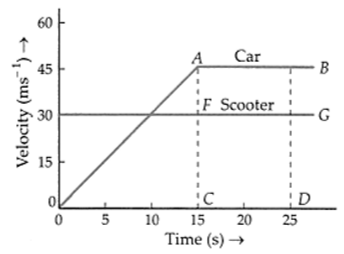
i. Distance travelled by car in $15 s=$ Area of $\triangle OAC$
$
=\frac{1}{2} \times OC \times AC=\frac{1}{2} \times 15 \times 45=337.5 m
$
Distance travelled by the scooter in $15 s=$ Area of rect. OEFC
$
=15 \times 30=450 m
$
Difference in the distances travelled $=450-337.5=112.5 m$.
ii. After $t=15 s$, relative velocity of the car w.r.t. the scooter $=45-30=15 ms^{-1}$
$\therefore$ Time taken in covering a difference of 112.5 m
$
=\frac{112.5 m}{15 ms^{-1}}=7.5 s
$
$\therefore$ Time after which car will catch up the scooter $=15+7.5=22.5 s$.
iii. Distance travelled by the scooter in 22.5 s
$
=30 ms^{-1} \times 22.5 s=675 m
$
So the car catches the scooter when both are at 675 m from the starting point.
View full question & answer
Question 53 Marks
State first law of thermodynamics. Why is $C_p>C_v$ ? Derive the relation $C_p-C_v=R$ for an ideal gas.
Answer
The first law of thermodynamics states that energy can be converted from one form to another, but cannot be created or destroyed.
The most important and critical aspect of life revolves around the idea of energy.
The heat capacity at constant pressure $C _{ P }$ is greater than the heat capacity at constant volume $C _{ v }$, because when heat is added at constant pressure, the substance expands and work.
The relation $C _{ p }- C _{ v }= R$ for an ideal gas.
According to the first law of thermodynamics, $q = nC \Delta T \ldots(1)$
Where q is the heat, n is the number of moles, C molar heat capacity and $\Delta T$ is the change in temperature.
At constant pressure, in the equation (1), then
$
q_{p}=nC_{p} \Delta T
$
The above equation is equal to the change in enthalpy, then
$
q_{p}=nC_{p} \Delta T=\Delta H\ldots(2)
$
Similarly, at constant, volume, in equation (1), then
$
q_{v}=nC_{v} \Delta T
$
The above equation is equal to the change in internal energy, then
$
q_{p}=nC_{p} \Delta T=\Delta U\ldots(3)
$
The formula for one mole of an ideal gas is,
 $\Delta H =\Delta U +\Delta( pv )( pv = nRT )($ For one mole $n =1)$
Then the above equation is written as,
$
\Delta H=\Delta U+\Delta(RT)
$
By rearranging the above equation, then
$
\Delta H=\Delta U+R \Delta T \ldots(4)
$
By substituting the equation (2) and equation (3) in the equation (4), then
$
nC_{p} \Delta T=nC_{v} \Delta T+R \Delta T
$
Here, $n =1$, then the above equation is written as,
$
C_{p} \Delta T=C_{v} \Delta T+R \Delta T
$
By taking $\Delta T$ as a common term, then $C _{ p } \times \Delta T =\left( C _{ v }+ R \right) \Delta T$
By cancelling the terms $\Delta T$ on both sides, then
$
C_p=C_v+R
$
By rearranging the above equation, then
$
C_p-C_v=R
$
View full question & answer
Question 63 Marks
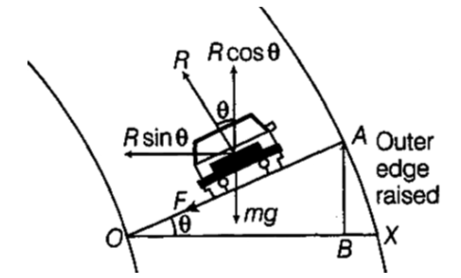
If a car having speed $50 km / h$ can round the curve banked at an angle $\theta$. Find out the value of $\theta$, if radius of the curve is 40 m and consider the friction is negligible, $\left[\tan ^{-1}(0.5)=26.5\right]$
View full question & answer
Question 73 Marks
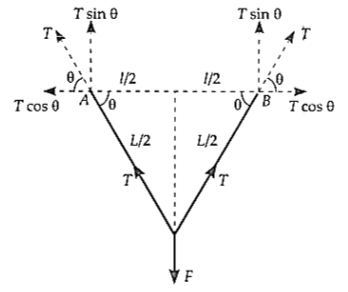
Two identical point masses, each of mass $M$ are connected to one another by a massless string of length $L$. $A$ constant force $F$ is applied at the mid-point of the string. If l be the instantaneous distance between the two masses, what will be the acceleration of each mass?
Answer
Figure shows the position of string at any instant after the application of a force $F$ at the mid point. It also shows the various forces acting on the two masses at any instant. If tension T in the string is resolved into horizontal and vertical components, then $F =2 T \sin \theta \ldots( i )$
and $Ma = T \cos \theta \ldots$...(ii)
where $a$ is the acceleration of each mass.
Image
Dividing (ii) by (i), we get
$
\begin{aligned}
& \frac{\cos \theta}{2 \sin \theta}=\frac{M a}{F} \\
& \text { or } \cot \theta=\frac{2 M a}{F} \\
& \text { or } \frac{l / 2}{\sqrt{(L / 2)^2-(l / 2)^2}}=\frac{2 M a}{F} \\
& \text { or } \frac{2 M a}{F}=\frac{l}{\sqrt{L^2-l^2}} \\
& \text { or } a=\frac{F}{2 M}\left(\frac{l}{\sqrt{L^2-l^2}}\right)
\end{aligned}
$
View full question & answer
Question 83 Marks
Briefly explain how does Bernoulli's principle help in explaining blood flow in human beings. What is the cause of a heart attack?
Answer
The blood flow in artery of a human being can be easily explained on the basis of Bernoulli's principle. The heart applies a pressure to maintain blood flow through the arteries.
In persons suffering with advanced heart condition, the artery gets constricted due to the accumulation of plaque on its inner walls. In order to drive the blood through this constriction a greater activity of the heart is required. The speed of the flow of the blood in this region is raised which lowers the pressure inside, and the artery may collapse due to this external pressure.
The heart exerts further pressure to open this artery and forces the blood through. As the blood rushes through the opening, the internal pressure once again drops leading to a repeat collapse. This may result in heart attack.
View full question & answer
3 Marks Question - Physics STD 11 Science Questions - Vidyadip