Question
Briefly explain Rutherford's nuclear model.

Answer

In 1906, Rutherford suggested a brilliant experiment involving the scattering of $\alpha$-particles by atoms to understand the structure of atoms.
This experiment was later performed around 1911 by Geiger and Marsden.
The results of these experiments revealed that the model of the atom resembles the model of the sun and the planets.
According to this model, the entire positive charge and almost all the mass of the atom is concentrated in a small volume called the nucleus with the electrons revolving around the nucleus just like planets revolve around the sun.
Rutherford's atomic model cannot explain the following points.
(i) Why atoms emit light of only certain (discrete) wavelengths ?
(ii) A very simple atom like hydrogen consisting of a single electron and proton, how does it give a complex spectrum of specific wavelengths ?

Need a full question paper?

Generate a complete, print-ready paper with questions like this in minutes — across 16+ boards, with answer keys.
Start Generating Free

Similar questions

Rain is falling vertically. A man running on the road keeps his umbrella tilted but a man standing on the street keeps his umbrella vertical to protect himself from the rain. But both of them keep their umbrella vertical to avoid the vertical sun-rays. Explain.
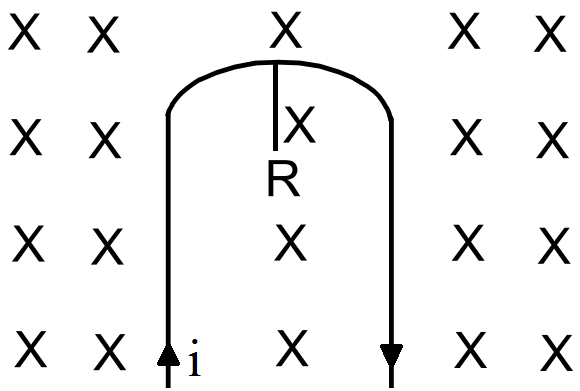
A rigid wire consists of a semi-circular portion of radius R and two straight sections The wire is partially immersed in a perpendicular magnetic field B, as shown in the figure. Find the magnetic force on the wire if it carries a current i.

How the photoelectric effect depends on time? Explain.
Write the formula for the potential energy of a dipole in an electric field and find its minimum and maximum values.
Explain the use of transformer for distribution of power over long distances.
On which two factors the extent of polarization in a polar dielectric depends ? what is polarization of dielectric ? Write its formula.
A parallel plate capacitor is charged with a potential difference 50 V . Thereafter it is discharged by a resistor for 2 sec , due to which its potential decreases by 10 V . Calculate the portion of energy stored in the capacitor.
A photographic film is coated with a silver bromide layer. When light fells on this film, silver bromide molecules dissociate end the film records the light there. A minimum of 0.6eV is needed to dissociate a silver bromide molecule. Find the maximum wavelength of light that can be recorded by the film.
The electric field and electric potential at any point due to a point charge kept in air is $20 NC^{-1}$ and $10 NC^{-1}$ respectively. Compute the magnitude of this charge.
A parallel plate capacitor is being charged by a time varying current. Explain briefly how Ampere's circuital law is generalized to incorporate the effect due to the displacement current.