Questions

2 Marks Questions

🎯

Test yourself on this topic

17 questions · timed · auto-graded

Question 12 Marks
Using the formula for the radius of $n ^{\text {th }}$ orbit $r_n=\frac{n^2 h^2 \varepsilon_0}{\pi m e^2}$ derive an expression for the total energy of electron in $n^{\text {th }}$ Bohr's orbit.
Answer
From Bohr's second postulate, the formula for the radius of $n^{\text {th }}$ orbit for hydrogen atom is.
$r_n=\frac{n^2 h^2 \varepsilon_0}{\pi m e^2}$
The total energy of the electron in the stationary states of the hydrogen atom is
$E _n=-\frac{1}{8 \pi \varepsilon_0} \frac{e^2}{r_n}$
Using equation (1) and equation (2)
$E _n=-\frac{1}{8 \pi \varepsilon_0} \frac{e^2}{\left(\frac{ n ^2 h^2 \kappa_0}{\pi m e^2}\right)}$
$\therefore E _n=-\frac{m e^4}{8 \varepsilon_0{ }^2 n^2 h^2}$
Substituting $m=9.1 \times 10^{-31} kg$
$\begin{array}{l}
e=1.6 \times 10^{-19} C \\
\varepsilon_0=8.85 \times 10^{-12} \frac{ C ^2}{ Nm ^2} \\
h=6.625 \times 10^{-34} Js
\end{array}$
Simplifying equation,
$E _n=-\frac{2.18 \times 10^{-18}}{n^2} J$
Atomic energies are often expressed in electron volts $(e V)$.
$\begin{array}{l} 
\therefore E _n=-\frac{2.18 \times 10^{-18}}{n^2 \times 1.6 \times 10^{-19}} eV \\
\therefore E _n=-\frac{13.6}{n^2} eV
\end{array}$
The negative sign of the total energy of an electron moving in an orbit means that the electron is bound with the nucleus.
Thus, energy will be required to remove the electron from the hydrogen atom to a distance infinitely far away from its nucleus.
View full question & answer
Question 22 Marks
What is the impact parameter? Explain the trajectory of $\alpha$-particle from it.
Answer
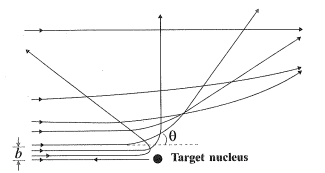
→Impact parameter (b) : "The perpendicular distance of the initial velocity vector of the $\alpha$-particle from the centre of the nucleus is called the impact parameter."
The path (trajectory) of an $\alpha$-particle depends on impact parameter of the collision with the nucleus.
Image
As shown in the figure, the impact parameters (b) of $\alpha$-particles are different so that they scattered in various directions with different probabilities.
An $\alpha$-particle which is close to the nucleus suffers large scattering.
In case of head-on collision, the impact parameter is minimum and the $\alpha$-particle rebounds back. (For head-on collision $b \approx 0, \theta \approx 180^{\circ}$ )
For a large impact parameter, the $\alpha$-particle goes nearly undeviated and has a small deflection.
The fact that only a small fraction of the number of incident particles of the number of incident particles rebound back indicates that the number of $\alpha$-particles undergoing head on collision is small. This implies that the mass and positive charge of the atom is concentrated in a small volume.
Therefore, Rutherford scattering experiment is a powerful way to determine the size of the nucleus.
View full question & answer
Question 32 Marks
Explain Rutherford's argument for scattered $\alpha$-particles.
Answer
In $\alpha$-particle scattering experiment most $\alpha$-particles pass through without being detected.
Only about $0.14 \% \alpha$-particles scatter by more than $1^{\circ}$ and about 1 in 8000 deflect by more than $90^{\circ}$.
For this Rutherford argued that for the $\alpha$-particle to be deflected backwards it must experience a large repulsive force.
This is possible only when almost entire mass of the atom is concentrated in its center and this center is positively charged.
Then incoming $\alpha$-particle could get very close to the positive charge without penetrating it and such a close encounter would result in a large deflection.
This agreement supported the hypothesis of the nuclear atom. This is why Rutherford is credited with the discovery of the nucleus.
View full question & answer
Question 42 Marks
Explain the arrangment of Geiger-Marsden's experiment of $\alpha$-particle scattering.
Answer
Image

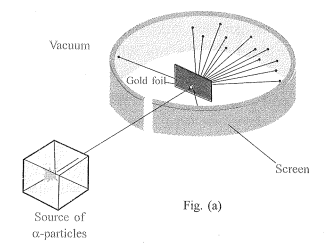
At the suggestion of Rutherford, Geiger and Marsden did some experiments.
In one of their experiments, as shown in the figure (a), a beam of $5.5 MeV \alpha$-particles emitted from a ${ }_{83} Bi ^{214}$ radioactive source at a thin metal foil made of gold and the entire device is placed in a vacum chamber.
Image
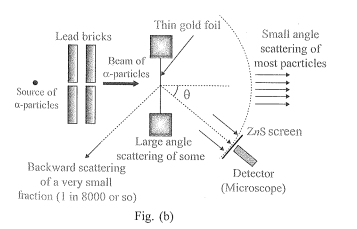
Figure (b) shows a schematic diagram of this experiment. $\alpha$-particles emitted by a radioactive source ${ }_{83} Bi ^{214}$ are passed through a block of lead to produce a narrow beam.
This beam is projected on to a thin gold foil of thickness $2.1 \times 10^{-7} m$.
The scattered alpha $(\alpha)$-particles were observed through a rotatable detector consisting of zinc sulphide screen and a microscope. The scattered $\alpha$-particles on striking the screen produced brief light flashes or scintillations. This flashes can be observed with microscope and the distribution of the number of scattered particles can be studied as a function of angle of scattering.
View full question & answer
Question 52 Marks
Explain the close relationship between the internal structure of an atom and the emission spectrum.
Answer
Every substance (solid, liquid and gas) emits electromagnetic radiation at every temperature. This radiation contains many different wavelengths. Among these, some wave lengths are continuously distributed but their intensity varies.
This radiation arises due to the oscillations of atoms and molecules.
By heating or exciting a gas of sufficiently low density, the light emitted from it contains only a few discrete or specific wave lengths. This spectrum appear as a series of light.
Gases with sufficiently low density have more space between atoms. Hence the emitted radiation can be assumed to be due to individual atoms rather than interactions between molecules or atoms.
Each element is associated with a characteristic spectrum of radiation. For example, hydrogen always gives a set of lines with fixed relative position between the lines. Means they are at certain fixed locations.
This fact shows that there is a close relationship between the internal structure of an atom and the spectrum of radiation emitted by it.
View full question & answer
Question 62 Marks
Write the limitations of Bohr model.
Answer
The limitations of the Bohr model are as follows.
(i) The Bohr model is applicable to hydrogenic atoms. It cannot be extended even to more two electron atoms such as helium.
The analysis of atoms with more than one electron was attempted on the lines of Bohr's model for hydrogenic atoms but did not meet with any success. Because the electron interacts not only with the positively charged nucleus but also with all other electrons.
(ii) The Bohr's model correctly predicts the frequencies of the light emitted by hydrogenic atoms. However, the model cannot explain the relative intensities of the frequencies in the spectrum.
In emission spectrum of hydrogen, some of the visible frequencies have weak intensity, others strong which cannot be explained by Bohr's model.
Experimental observation show that some transitions are more favoured than others. Bohr's model is unable to account for the intensity variation.
View full question & answer
Question 72 Marks
Explain Rutherford's nuclear model of the atom.
Answer
In Rutherford's nuclear model of the atom, the entire positive charge and most of the mass of the atom are concentrated in the nucleus with the electrons some distance away.
The electrons would be moving in orbits about the nucleus just as the planets do around the sun.
Rutherford's experiments suggested the size of the nucleus to be about $10^{-15} m$ to $10^{-14} m$.
From kinetic theory, the size of an atom was known to be $10^{-10} m$, about 10,000 to 100,000 times larger than the size of the nucleus.
Thus, most of an atom is empty space. It is easy to understand why most of $\alpha$-particles go right through a thin metal foil as the atom is relatively empty.
However, when an $\alpha$-particles approaches the nucleus, the intense electric field there scatters it through a large angle.
Since the electrons of the atom are very light, they do not have much effect on the $\alpha$-particles.
View full question & answer
Question 82 Marks
Discuss the results of the Geiger-Marsden $\alpha$-particle scattering experiment with necessary graphs.
Answer

Image
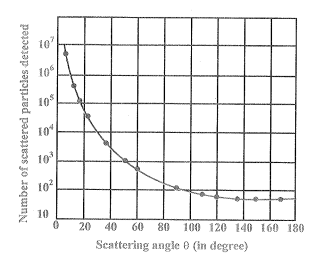
A typical graph of the total number of $\alpha$-particles scattered at different angles, in a given interval of time is shown in Figure.
The dots in this figure represent the data points and the solid curve is the theoretical prediction based on the assumption that the target atom has a small, dense, positively charged nucleus.
Many of the $\alpha$-particles pass through the foil. It means that they do not suffer any collisions.
Only about $0.14 \%$ of the incident $\alpha$-particles scatter by more than $1^{\circ}$ and about 1 in 8000 deflect by more than $90^{\circ}$.
View full question & answer
Question 92 Marks
Explain emission lines and absorption lines.
Answer
According to the third postulate of Bohr's model, when an atom makes a transition from the higher energy state with quantum number $n_{ i }$ to the lower energy state with quantum number $n_f\left(n_f<n_i\right)$, the difference of energy is carried away by a photon of frequency $V_{i f}$ such that $h V_{i_f}= E _{n_i}- E _{n_f}$
Since both $n_f$ and $n _i$ are integers, this shows that in transitions between different atomic levels, light is radiated in various discrete frequencies.
The various lines in the atomic spectra are produced when electrons jump from higher energy state to a lower energy state and photons are emitted. These spectral lines are called emission lines.
On the other hand, when an atom absorbs a photon that has the same energy needed by the electron in a lower energy state to make transitions to a higher energy state, the process is called absorption.
Thus, if photons with a continuous range of frequencies pass through a rarefied gas and then are analysed with a spectrometer, a series of dark spectral absorption lines appear in the continuous spectrum. The dark lines indicate the frequencies that have been absorbed by the atoms of the gas.
View full question & answer
Question 102 Marks
Explain the Rutherford atomic model and its limitations.
Answer
→Rutherford suggested that negatively charged electron revolves around the central nucleus just like the planets revolve around the sun.
→In a planetary system, the planets are held together by the gravitational force, while in an atom the electrons around the nucleus are held together by the Coulomb force.
Limitations :
→An object which moves in a circular path is being constantly accelerated. This acceleration is called centripetal acceleration.
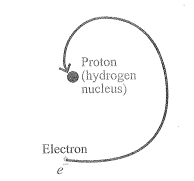
→According to classical electromagnetic theory, an accelerating charged particle emits radiation in the form of electromagnetic waves. Therefore the energy of an accelerating electron should continuously decrease.
→The electron would spiral inward and eventually fall into the nucleus. Thus, such an atom can not be stable.
→According to the classical electromagnetic theory, the frequency of the electromagnetic waves emitted by the revolving electrons is equal to the frequency of revolution.

Image
→As the electrons spiral inwards, their angular velocities and their frequencies would change continuously, so the frequency of the light emitted also changes. Thus, they would emit a continuous spectrum, opposite to the line spectrum actually observed.
View full question & answer
Question 112 Marks
Derive the formulas for the kinetic energy, potential energy and total energy of an electron revolving around the nucleus in hydrogen atom.
Answer
The centripetal force on the electron in the hydrogen atom is provided by Coulomb force exerted by the proton.
Centripetal force $=$ Coulomb force
$\begin{aligned}
\frac{m v^2}{r} & =\frac{1}{4 \pi \varepsilon_0} \frac{e^2}{r^2} \\
\therefore \quad m v^2 & =\frac{1}{4 \pi \varepsilon_0} \frac{e^2}{r} \\
\therefore \quad \frac{1}{2} m v^2 & =\frac{1}{8 \pi \varepsilon_0} \frac{e^2}{r} \\
K & =\frac{1}{8 \pi \varepsilon_0} \frac{e^2}{r}
\end{aligned}$
The electrostatic potential energy of the electron in hydrogen atom is
$\begin{aligned}
U & =\frac{k(e)(-e)}{r} \\
\therefore \quad U & =-\frac{1}{4 \pi \varepsilon_0} \frac{e^2}{r}
\end{aligned}$
Thus, the total energy of the electron in a hydrogen atom is,
$\begin{aligned}
E & = K + U \\
E & =\frac{e^2}{8 \pi \varepsilon_0 r}-\frac{1}{4 \pi \varepsilon_0} \frac{e^2}{r} \\
\therefore \quad E & =-\frac{1}{8 \pi \varepsilon_0} \frac{e^2}{r}
\end{aligned}$
The total energy of the electron is negative which implies that the electron is bound to the nucleus.
View full question & answer
Question 122 Marks
Explain J J. Thomson's plum pudding model of atom.
Answer
Experiments by physicist J.J. Thomson showed that atoms of various elements contain negatively charged constituents (electrons). which are the same for all atoms. Although the atom is electrically neutral.
Hence the atom must also have some positive charge to neutralise the negative charge of the electron.
To explain the arrangement of positive and negative charge in atom, Thomson gave an atomic model called the plum pudding model.
The first model of the atom was given by J.J. Thomson. According to this model, the positive charge of the atom is uniformly distributed throughout the volume of the atom and the negatively charged electrons are embedded in like seeds in a watermelon. This model is called plum pudding model of the atom.
View full question & answer
Question 132 Marks
Explain ground state and ionisation energy of hydrogen atom.
Answer
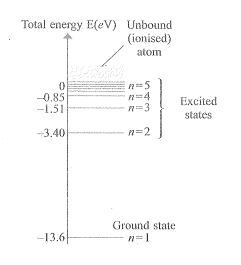
The energy of an atom is the least when its electron is revolving in an orbit closest to the nucleus i.e., for $n=1$.
As the value of $n$ increases, the energy of the electron also increases.
The lowest state of the atom is called the ground state, is that of lowest energy, with the electron revolving in the orbit of smallest radius, the Bohr radius $\left(a_0\right)$.

Image
The energy of this state
$\begin{array}{l} 
E _n=-\frac{13.6}{n^2} e V \\
n=1 \\
E _1=-13.6 eV
\end{array}$
Therefore, the minimum energy required to free the electron from the ground state of the hydrogen atom is 13.6 eV . It is called the ionisation energy of a the hydrogen atom.
View full question & answer
Question 142 Marks
Explain in brief about emission spectrum and absorption spectrum.
Answer
• Emission Spectrum
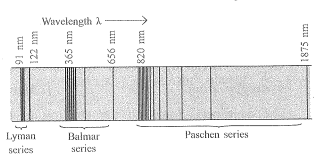
Each element has a characteristic spectrum of radiation emitted by it.
When an atomic gas or vapour is excited at low pressure by passing an electric current through it, the emitted radiation has a spectrum which contains certain specific wavelengths.
Image
A spectrum of this type is called emission line spectrum and it consists of bright lines on a dark background.
The spectrum emitted by atomic hydrogen is shown in the figure.
• Absorption spectrum :
When white light is passed through an atomic gas, certain types of wavelengths are absorbed.
An atom absorbs only those wavelengths that takes it from one excited state to another excited state.
As a result if the emitted light is analyzed with a spectrometer, a dark line is seen instead of the wavelength that has been absorbed.
Thus, this is called the absorption spectrum of the material of the gas.
View full question & answer
Question 152 Marks
Briefly explain Rutherford's nuclear model.
Answer
In 1906, Rutherford suggested a brilliant experiment involving the scattering of $\alpha$-particles by atoms to understand the structure of atoms.
This experiment was later performed around 1911 by Geiger and Marsden.
The results of these experiments revealed that the model of the atom resembles the model of the sun and the planets.
According to this model, the entire positive charge and almost all the mass of the atom is concentrated in a small volume called the nucleus with the electrons revolving around the nucleus just like planets revolve around the sun.
Rutherford's atomic model cannot explain the following points.
(i) Why atoms emit light of only certain (discrete) wavelengths ?
(ii) A very simple atom like hydrogen consisting of a single electron and proton, how does it give a complex spectrum of specific wavelengths ?
View full question & answer
Question 162 Marks
Explain the excited states for the hydrogen atom.
Answer

Image
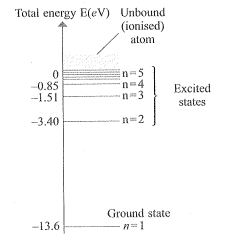
At room temperature, most of the hydrogen atoms are in ground state.
When a hydrogen atom receives energy by processes such as electron collisions, the atom may acquire sufficient energy to raise the
electron to higher energy states. The atom is then said to be in an excited state.
Putting $n=2$ in
$\begin{array}{l} 
E _{ n }=-\frac{13.6}{n^2} e V \\
E _2=-3.4 e V .
\end{array}$
It means that the energy required to excite an electron in hydrogen atom to its first excited state, is an energy equal to
$\begin{aligned}
E _2- E _1 & =-3.40 eV -(-13.6) eV \\
& =-3.4 eV +13.6 eV \\
& =10.2 eV
\end{aligned}$
Similarly, $E _3=-1.51 eV$
To excite the hydrogen atom from its ground state to second excited state, energy required is
$\begin{aligned}
E _3- E _1 & =-1.51 eV -(-13.6) eV \\
& =-1.51 eV +13.6 eV \\
& =12.09 eV
\end{aligned}$
In contrast, when an electron moves from an excited state to a lower energy state a photon is emitted.
Thus, as the excitation of hydrogen atom increases (as $n$ increases) the value of minimum energy required to free the electron from the excited atom decreases.
The energies of the excited states come closer and closer together as $n$ increases.
View full question & answer
Question 172 Marks
Write the centripetal force formula for an electron moving in a stationary orbit in a hydrogen atom and derive the formula for the radius of the orbit.
Answer
Form Rutherford's nuclear model of the atom, it can be said that atom is an electrically neutral sphere consisting of a very small, massive and positively charged nucleus at the centre surrounded by the revolving electrons in their respective dynamically stable orbits.
The electrostatic force of attraction $F _{ e }$ between the revolving electrons and the nucleus provides the required a centripetal force $F _{ c }$ to keep them in their orbits.
Thus, for a dynamically stable orbit in a hydrogen atom,
$F _{ e }= F _{ c }$
$\begin{aligned}
\therefore \quad \frac{1}{4 \pi \varepsilon_0} \cdot \frac{e^2}{r^2} & =\frac{m v^2}{r} \\
\therefore \quad \frac{1}{4 \pi \varepsilon_0} \cdot \frac{e^2}{r} & =m v^2 \\
\therefore \quad r & =\frac{e^2}{4 \pi \varepsilon_0 m v^2} \\
& \text { OR } \\
\therefore \quad v^2 & =\frac{e^2}{4 \pi \varepsilon_0 m r} \\
\therefore & =\sqrt{\frac{e^2}{4 \pi \varepsilon_0 m r}}
\end{aligned}$
View full question & answer
2 Marks Questions - Physics STD 12 Science Questions - Vidyadip