Question
Briefly explain the concept of GST.

Answer

Goods and Services Tax (GST): It is a tax levied and collected on supply (sale) of goods and/ or services or both. It is charged by the seller on the net sale value, i.e., sale value less trade discount. The seller is bound to charge GST on sale made and deposit it in the Government Account. For the seller of goods, it is not sale because it is collected on behalf of the Government and is to be paid into Government Account.
In the case of intra-state (i.e., within the state) sale of goods, both CGST and SGST is charged at half the prescribed rate of GST. And in the case of inter-state (i.e., outside the state) sale of goods, IGST is charged at the prescribed rate of GST.
CGST and SGST charged on intra-state sale of goods is credited to 'Output CGST Account and Output SGST Account' respectively. IGST charged on inter-state sale of goods is credited to Output IGST Account.

Need a full question paper?

Generate a complete, print-ready paper with questions like this in minutes — across 16+ boards, with answer keys.

Start Generating Free

Similar questions

Prepare Accounting Equation from the following:
  1. Started business with cash ₹ 75,000 and goods ₹ 25,000.
  2. Paid for Rent ₹ 2,000.
  3. Bought goods for cash ₹ 30,000 and on credit for ₹ 44,000.
  4. Goods costing ₹ 50,000 sold at a profit of 25%, out of which ₹ 27,500 received in Cash.
  5. Purchased a Motor-cycle for personal use ₹ 20,000.
Rectify the following errors assuming that a suspense account was opened. Ascertain the difference in trial balance.
  1. Credit sales to Mohan ₹ 7,000 were posted to Karan as ₹ 5,000.
  2. Credit purchases from Rohan ₹ 9,000 were posted to the debit of Gobind as ₹ 10,000.
  3. Goods returned to Rakesh ₹ 4,000 were posted to the credit of Naresh as ₹ 3,000.
  4. Goods returned from Mahesh ₹ 1,000 were posted to the debit of Manish as ₹ 2,000.
  5. Cash sales ₹ 2,000 were posted to commission account as ₹ 200.
Transactions of M/s Vipin Traders are given below.
Show the effects on Assets, Liabilities and Capital with the help of accounting Equation.
a.
Business started with cash
₹ 1,25,000
b.
Purchased goods for cash
₹ 50,000
c.
Purchase furniture from R.K. Furniture
₹ 10,000
d.
Sold goods to Parul Traders (Costing ₹ 7,000 vide bill no. 5674)
₹ 9,000
e.
Paid cartage
₹ 100
f.
Cash Paid to R.K. furniture in full settlement
₹ 9,700
g.
Cash sales (costing ₹ 10,000)
₹ 12,000
h.
Rent received
₹ 4,000
i. Cash withdrew for personal use ₹ 3,000
(Ans: Asset = cash ₹ 78,200 + Goods ₹ 33,000 + Furniture ₹ 10,000 Debtors ₹ 9,000 = ₹ 1,30,200; Liabilities = Capital ₹ 1,30,200)
What are the different types of errors that are usually committed in recording business transaction.
Enter the following transactions in the 'Journal Proper' of Karuna Stores:
March 1 Purchased furniture on credit from Kuber Furniture Store for ₹ 15,000.
March 5 Goods for ₹ 6,000 given away as charity.
March 12 Goods worth ₹ 8,000 and Cash ₹ 4,000 were stolen by an employee.
March 15 Arun who owed us ₹ 20,000 was declared insolvent and nothing was received from him.
March 18 Proprietor withdrew for his personal use cash ₹ 5,000 and goods worth ₹ 10,000.
March 31 Provide interest on capital of ₹ 5,00,000 at 6% p.a. for full year.
March 31 Out of the rent paid this year, ₹ 5,000 is related to the next year.
March 31 Salaries due to clerks ₹ 12,000.
Explain the business entity concept with example.
On 30th June 2014, the bank balance as per Sanjay Yadav's Cash Book was ₹ 1,500. On comparing with the Pass Book the following information was received:-
  1. Cheques amounting to ₹ 7,290 were issued on 28th June, of which one cheque of ₹ 1,300 was presented in the bank for payment on 4th July.
  2. Cheques deposited into bank for ₹ 10,000, but of these cheques for ₹ 4,000 were cleared and credited in July.
  3. Interest and Dividend on investments ₹ 580 collected by bank and credited to his account but he did not have any information for this.
  4. Life Insurance Premium ₹ 750 paid by bank according to his standing orders.
  5. Bank Charges ₹ 25 not recorded in the Cash Book.
Prepare a Bank Reconciliation Statement.
Ashoka Ltd. bought a machine on 1st April, 2010 for ₹ 2,40,000 and spent ₹ 4,000 on its carriage and ₹ 6,000 towards installation cost. On 1st July, 2011 it purchased a second hand machinery for ₹ 75,000 and spent ₹ 25,000 on its overhauling.On 1st January, 2013 it decided to sell the machinery bought on 1st April, 2010 at a loss of ₹ 20,000. It bought another machine on the same date for ₹ 40,000. Company decided to charge depreciation @ 15% p.a. on written down value method. Prepare machinery account for 3 years. Books are closed each year on 31st March.
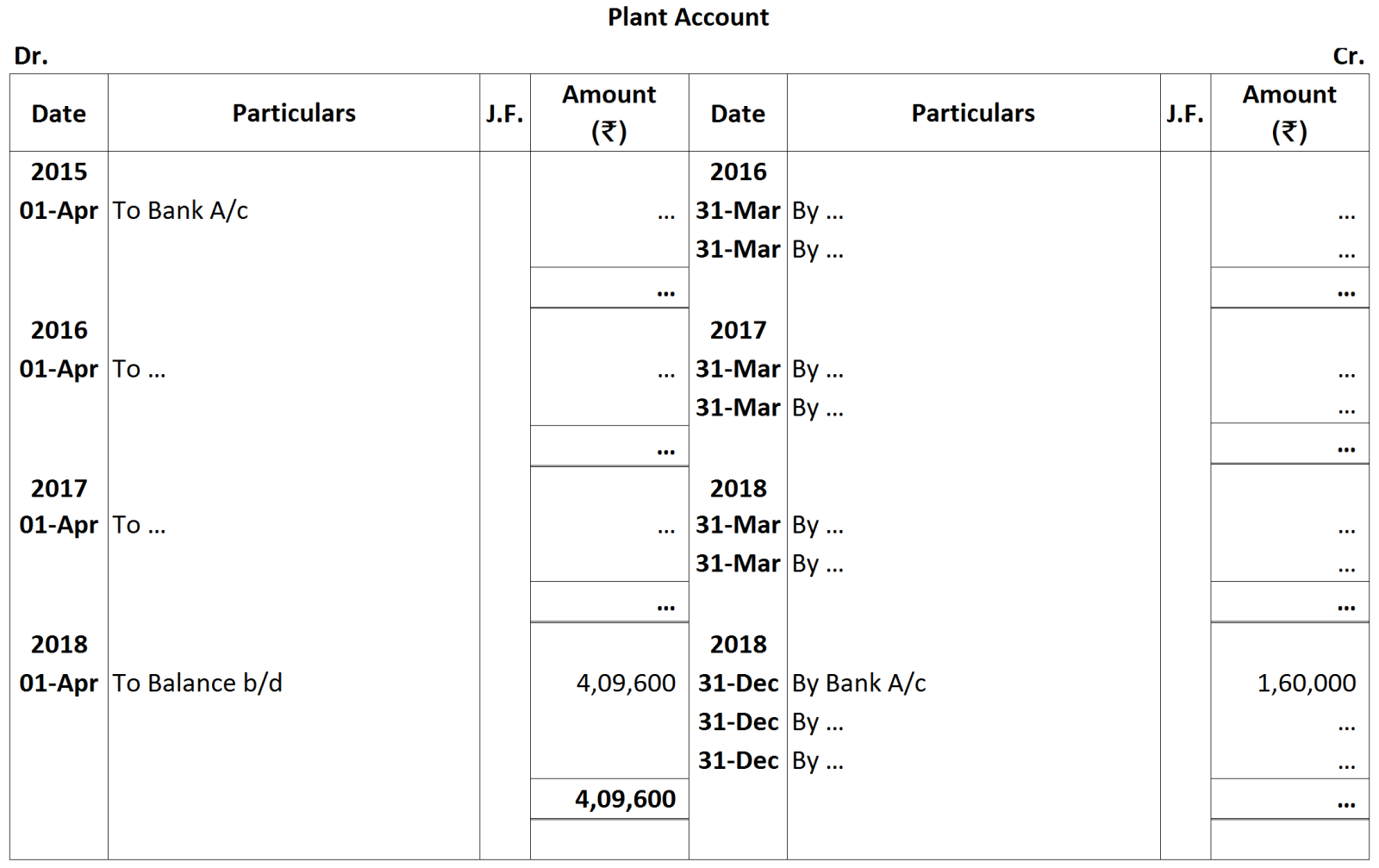
Fill up the missing information in the plant Account given below, Depreciation was profided at 20% p.a. on the written down value method on this palnt.
Record the following transactions in the Journal of Ashoka Furniture Traders, Ludhiana (Punjab):
2019
 
Jan.1
Started business with cash
50,000
Jan.2
Opened a Current Account by personal cheque
3,50,000
Jan.10
Purchased machinery against cheque
1,00,000
Jan.15
Paid wages for installation of machinery
2,000
Jan.20
Purchased timber from Singh & Co., Ludhiana (Punjab) of the list price of ₹ 20,000 at 10% trade discount
 
Jan.25
Out of the above, timber used for furnishing the office
5,000
Jan.31
Sold timber to Rakesh of the list price of ₹ 10,000 and allowed him 10% trade discount
 
Feb.10
Issued to Singh & Co. a cheque in full settlement
20,000
Feb.15
Received from Rakesh in full and final settlement
10,000
Feb.20
Paid Wages
15,000
Feb.28 Issued a cheque for ₹ 5,000 in favour of the landlord for rent of February  
CGST and SGST is levied @ 6% each on intra-state sale and purchase. IGST is levied @ 12% on inter-state sale and purchase.