Question
Briefly explain the formation of trade wind.

Answer

Trade winds are steady surface winds on the earth due to the natural convection phenomenon. The equatorial and polar regions of the earth receive unequal solar heat. The equatorial region receives more heat than the polar region. So air at the earth's surface near the equator is hotter than the air in the upper atmosphere of the poles, due to which a convection current would be set up, with the hot air at the equatorial surface rising and moving out towards the poles and in turn, colder air at poles descending and streaming in towards the equator. Because of earth's rotation about its own axis, the air close to the equator region has an eastward speed of $1600 km h ^{-1}$, while it is zero close to the polar region. As a result, the hot air from the equator descends not at the poles but at $30^{\circ} N$ latitude and returns to the equator. So in this way trade winds are formed.

Need a full question paper?

Generate a complete, print-ready paper with questions like this in minutes — across 16+ boards, with answer keys.
Start Generating Free

Similar questions

Define Coefficient of Thermal Conductivity and derive its SI unit. Calculate the rate of loss of heat through a glass window of area $1000 cm^2$ and thickness $0.4 cm$ when temperature inside is $37^\circ C$ and outside is $-5^\circ C$. Coefficient of thermal conductivity of glass is $2.2 \times 10^{-3}cal \  s^{-1}\ cm^{-1}\ K^{-1}$.
What is the nature of sound waves in air? How is the speed of sound waves in atmosphere affected by the $(i)$ humidity $(ii)$ temperature?
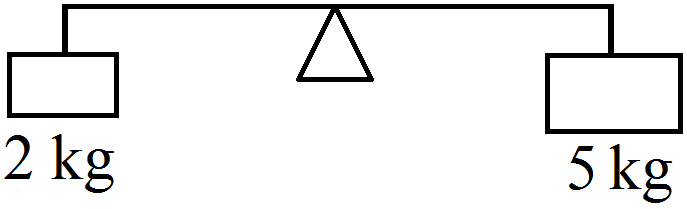
A light rod of length 1m is pivoted at its centre and two masses of 5kg and 2kg are hung from the ends as shown in figure. Find the initial angular acceleration of the rod assuming that it was horizontal in the beginning.
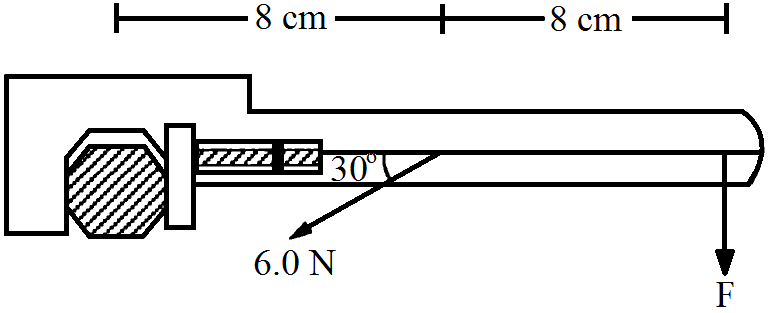
When a force of 6.0N is exerted at 30° to a wrench at a distance of 8cm from the nut, it is just able to loosen the nut. What force F would be sufficient to loosen it if it acts perpendicularly to the wrench at 16cm from the nut?
A child sits stationary at one end of a long trolley moving uniformly with a speed V on a smooth horizontal floor. If the child gets up and runs about on the trolley in any manner, what is the speed of the CM of the (trolley + child) system?
What is the meaning of the components of vectors along $X, Y, Z$ axes and prove that $\cos ^2 \alpha+\cos ^2$ $\beta+\cos ^2 r=1$.
Draw the following graphs for an object projected upward with a velocity $v _0$, which comes back to the same point after some time:
i. Acceleration versus time graph,
ii. Speed versus time graph,
iii. Velocity versus time graph.
Give examples of a one-dimensional motion where:
The particle moving along positive x-direction comes to rest periodically and moves forward.
A vessel contains 1.60 g of oxygen and 2.80 g of nitrogen. The temperature is maintained at 300 K and the volume of the vessel is $0.166 \mathrm{~m}^3$. Find the pressure of the mixture.